Care is not only pastoral – it’s also about task design.

As educators, we are acutely aware of the need to develop positive attitudes towards maths. The way that children view maths, and view themselves as mathematicians, are crucially important. In the blog Emotional Regulation in Learning Mathematics, I explore how we can help children to navigate the emotional experience of being a mathematician.

However, caring for children as mathematicians is far more than providing emotional support: it is about the nature of the tasks that we put in front of children. This is how we show what we value and what we believe mathematics is. On this subject, I have been inspired by the work of the wonderful Anne Watson. She has written and spoken extensively on this topic, both in the UK and internationally.

I had the fortune to spend a day with Anne. When we met, talked about my daughters school play. After the performance, a parent said how wonderful it was for the children to have this experience, where they can flourish personally (I totally agree). This is different to learning maths, I was told, which is academic. This felt so jarring! Anne said that we would never think that way about a child writing a poem. Writing poetry requires academic skills, but we also think of it as a personally expansive act. And so is mathematics. Maths can be such a powerful lever for personal development, when children engage in rich mathematical tasks.

In the last decade, I we have developed more awareness of educational research and of best practices in mathematics teaching internationally. This has added real rigour to mathematics teaching in the UK, it has been very positive. I also believe that the true nature of mathematics is for children to be playful, curious and engage with their classmates in a shared pursuit. I believe that these two things – rigour and playfulness – can sit together. They are not opposing forces.

It has made me think about how we can design a curriculum that is mathematically rigorous and mathematically playful. It has made me think about how mathematics can also be a tool for connection, how it can be socially enriching.

The actual task design, I believe, is not something to dump at the feet of teachers. It is for those of us involved in leading mathematics and who design mathematics. We must care about children’s emotional and intellectual engagement in mathematics. This must be the unmissable hallmark of the tasks that we provide for children.

My default has always been to focus on the ‘how’ and I will share some examples below. But more than anything, I would love to engage in a global conversation on how mathematics can be playful and rigorous. I would love to hear your thoughts, ideas and examples. I want to broaden my view and build upon my own repertoire as a task designer. I would love to work alongside different people locally and internationally as part of this shared pursuit.

A few examples…

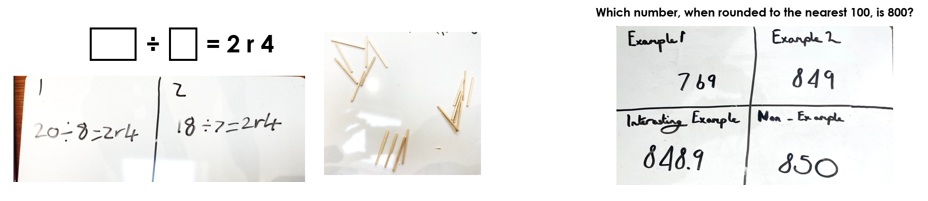
One technique that can be used are the ‘odd one out’ tasks below (akin to the Which One Doesn’t Belong examples). Children can access the task if they can give an answer; the challenge is to come up with a reason for each example.

I also love questions with different possible answers. Prior to the left-hand example question being given, the children explored dividing by 3 by making triangles with matchsticks (e.g. with 20 matchsticks, 6 triangles can be made and the remainder is 2). We understood that the there remainder is always smaller than the divisor. Then, children found answers to the question ___ / __ = 2 r 4. Answers included 68 / 32 = 2 r 4. For the example on the right, we modelled the process of rounding using number lines. Misconceptions were highlighted and discussed. Then, children found a range of different answers to the question and could identify common wrong answers.
I’d love to hear your thoughts and your own examples – Gareth.
Reasoning for all in the ‘We’ of a maths lesson

In my blog Adapting ‘I-We-You’ to Deepen Mathematical Thinking I describe how we can provide high-quality modelling whilst enabling children to form their own thinking in the ‘We’ phase of a lesson. I described how slowly revealing information can engage all children in deep mathematical discussions, taking the focus away from finding an answer to understanding a concept.

There is another technique that I often use for opening up mathematical conversations: using pairs of examples/questions. This is one of the simplest, most effective ways of highlighting specific ideas, in a way that is accessible for all children. Again, it emphasises understanding over answers. Here are some examples.

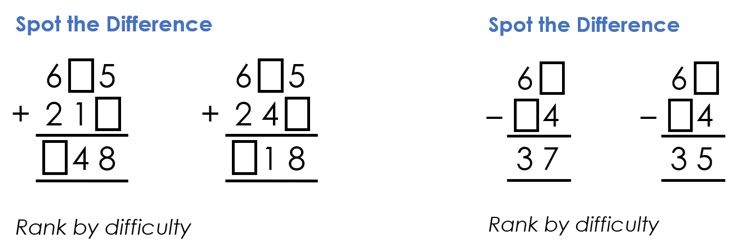
Spot the difference, rank by difficulty’ for missing digit questions:

Consider these pair of examples (only use one pair at a time!). The key to unlocking these questions is for children to understand what happens when a calculation borders over 10. For the addition examples, this is in the tens columns for the right-hand question, but not the left-hand question. This is due to the positions of the digits 1 and 4. For the subtraction examples, a regroup is only needed in the left-hand example (___ – 4 = 7, must be 11). When a pair of examples is shown, all children can access the discussion if they can spot the difference between the questions. Then, as children think about which of the two questions is more difficult, attention is being drawn to the significance of these small differences. The teacher can then answer the questions.

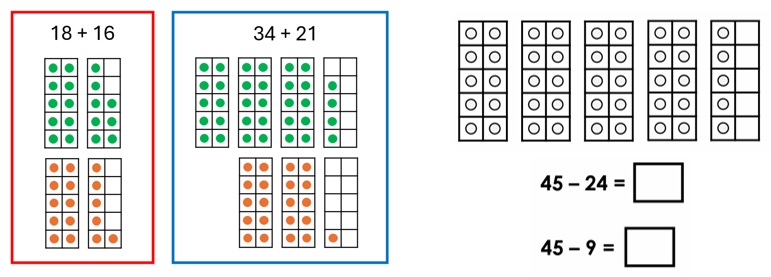
Highlight efficient calculation methods by asking ‘Which question is harder?’

The examples above are slightly different. In each instance, children consider two calculations. One of the questions involves larger numbers; the other involves a calculation that borders a ten. Children consider which question is more difficult and why, using the visuals to support their thinking and explanations. All children can participate by voting for the harder question – different valid perspectives can arise and can be discussed.

Compare non-examples or discuss misconceptions

Pairs of examples can also be used to highlight specific key ideas or misconceptions. The ‘discussion entry point’ is spotting the difference between the examples. The development comes from explaining which clock face is correct (clock examples) or explain the mistake (right-angles). This allows children to think deeply about the key concepts for each area of mathematics.

I would love to hear about how you use pairs of examples to deepen thinking, or other reasoning techniques that you us to open up conversations in your maths lessons. I’m very interested to know how you ensure that all children can participate in discussions, and how the thinking can be deepened. Thanks for reading.

Adapting ‘I-We-You’ to deepen mathematical thinking

The principles of ‘I-We-You’ are central to my maths teaching: give children the tools to think with clear models and examples; build understanding and address misconceptions in the guided practice; then children work with high success in their independent practice.

Issues can arise, though, if an ‘I-We-You’ approach leads to a more procedural approach to teaching. Mathematics is not about following a set of pre-determined instructions. I might need a prescriptive approach if you are teaching me to wire a plug. Step-by-step instruction can help me to learn how to do a column subtraction. But it isn’t how I can become a mathematician. And it won’t lead to me becoming emotionally invested in my mathematics. Maths lessons should allow children to play around with key ideas, become curious and make connections.

There is another big challenge in the ‘We’ phase of the lesson. How can we provide questions/tasks that build understanding and extend thinking for all children? If children are given a question to answer in the ‘We’, some children may finish almost immediately. Other children may need more time and more scaffolding.

How can we hold all these ideas together? Is it possible to provide high-quality modelling and engage children in effective guided practice, whilst allowing space for children to be curious and make their own discoveries? I believe we can! In the ‘I’, think about exploring concepts rather than modelling steps. For questions in the ‘We’, think about using the slow release of information (the subject of this blog) or the blog using pairs of examples/questions to engage all children in discussion. Consider the question below:

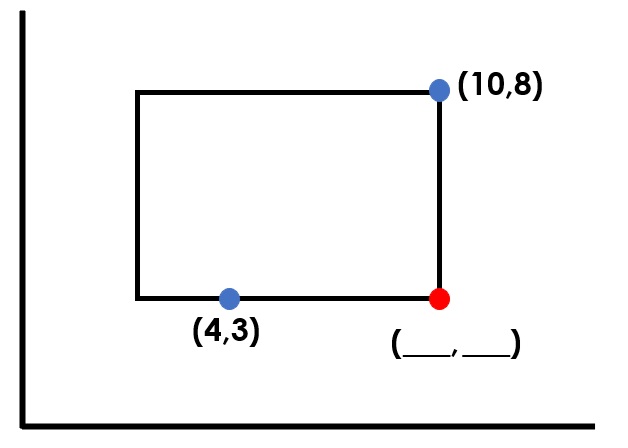
Following an ‘I-We-You’ approach could mean modelling two questions that are near-replicas of this one. Then, I could give this question to the children to answer on their whiteboards. What problems do I see? Firstly, some children will be able to answer this question within seconds. The rest of the class, then, feel a pressure to catch up. Speed is emphasised, the answer becomes the focus. Secondly, will the children be able to answer a different coordinates question when the ‘steps to success’ no longer apply?

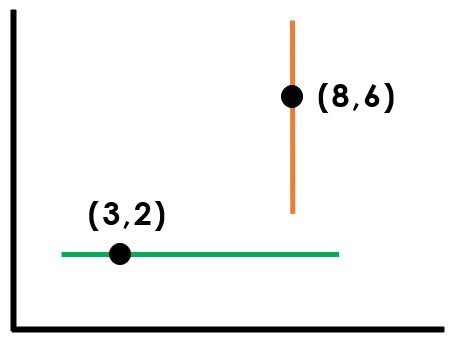
Here is a subtly different approach. In the ‘I’ phase, start by giving example coordinates that are and are not on the green and orange lines, noting the x/y coordinate that stays the same:

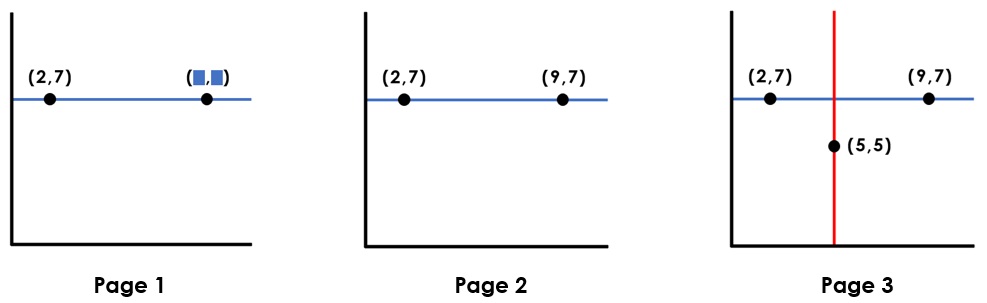
Then, looking at page 1 of the example below, I ask children to predict what the hidden coordinate could be, before revealing (9,7) and noting that the y coordinate is still 7. Next, introduce the red line (page 3). Ask children to predict which other coordinates could be on the red line. I could compare the positions of (6,4) and (4,6). Are they inside or outside of the bottom-left rectangle?

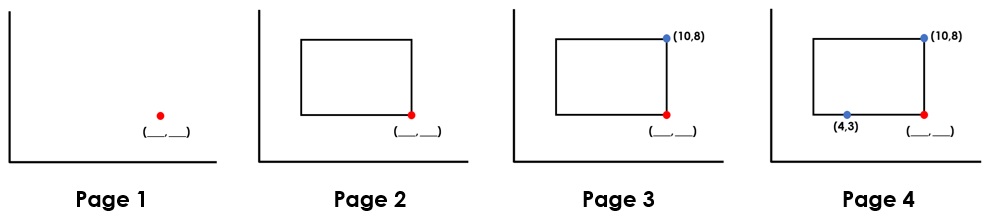
My main focus for this blog is to look at the slow release of the information for the question below, in the ‘We’ phase. Rather than presenting the whole question to the children, start at page 1. Ask the children what the red coordinate could/could not be. Note that x > y and spatially reason about the different possible coordinates. This acts as our estimate. Then, introduce the rectangle from the question (page 2) and ask the children ‘what information will we be given that will mean we can answer the question?’ Explore all possibilities. In doing so, children have the time and space to think about the structure of the task before the question itself is introduced. The necessary information is slowly revealed (pages 3 and 4) and children can now give the answer having had time to think about the structure of the question. To extend, coordinates on the vertices, edges and inside/outside the rectangle can be given.

The power of the slow reveal is that children get to ‘play around’ with the big ideas before they have to give an answer. Children have more time to process the information, which is revealed in stages. Challenge exists as we consider ‘is that definitely what the missing information will be?’ Reasoning is emphasised and children use their imaginations!

Please share your thoughts, objections or related examples! Is there another maths curriculum area that you would like me to consider on a future blog? Or other similar example tasks that you could share? I hope that this blog can spark some interesting conversations and collaborations!

I See Reasoning – Y1 and Y2: Exploring Concepts, Creating Reasoning Habits

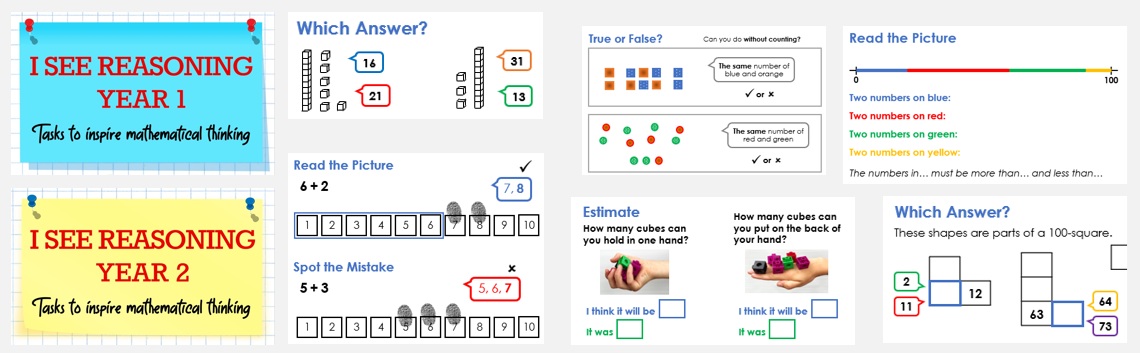
We want KS1 children to develop a deep understanding of Y1 & Y2 maths content. We also want young children to be able to explain their thinking, identify common errors, estimate, explore ideas and think creatively. The tasks in the I See Reasoning – Y1 and I See Reasoning – Y2 eBooks help to give children these experiences, inspiring a wide range of mathematical conversations and explorations.

These new eBooks have replaced I See Reasoning – KS1. They follow the same format as the original eBook, but include many, many more examples (365 tasks in the Y1 eBook and 392 tasks in the Y2 eBook) and they have a range of new types of reasoning questions. Here are some of the key ideas:

Non-counting strategies, estimation, reasoning

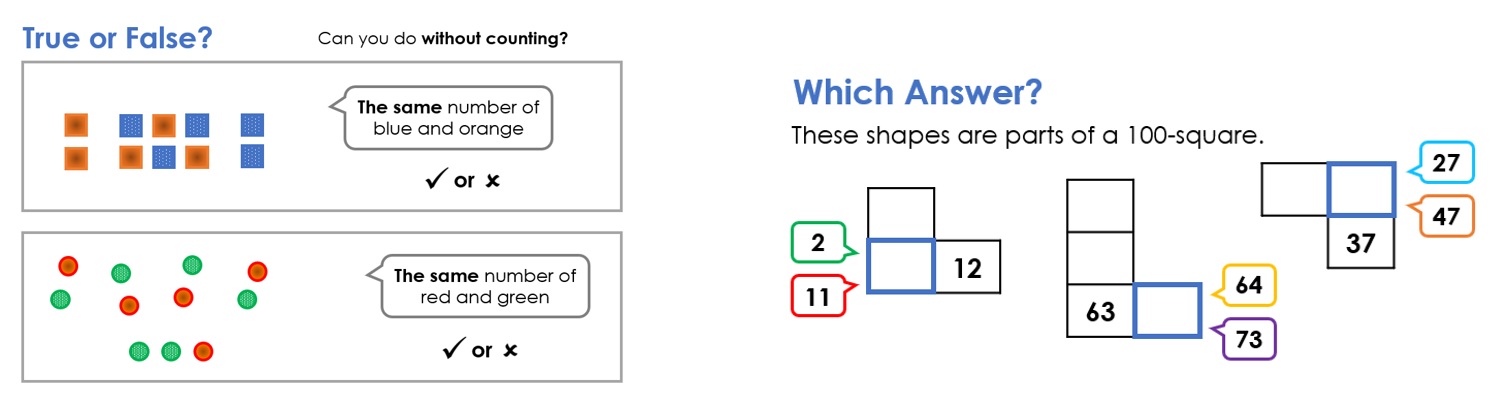
A HUGE focus is placed on children explaining answers using non-counting strategies. This includes ‘how many dots’ questions, where children describe their non-counting strategies. It involves calculations that border 10 or subtractions with small differences. The emphasis is not ‘what’s the answer?’ but instead ‘how did you know?’ or ‘what do you visualise?’ The questions are highly visual and don’t require too much reading.

Misconceptions, visuals, patterns

The questions introduce the key I See Reasoning question structures. Children will learn to spot mistakes, explain mistakes, compare questions and spot patterns. They will be challenged to explain what they noticed and find all of the answers. In doing so, children will be trained in the routines of thinking mathematically, routines that can be extended in KS2. This will help to build reasoning tasks into every maths lesson, giving schools a progressive approach to how reasoning is taught.

Exploration

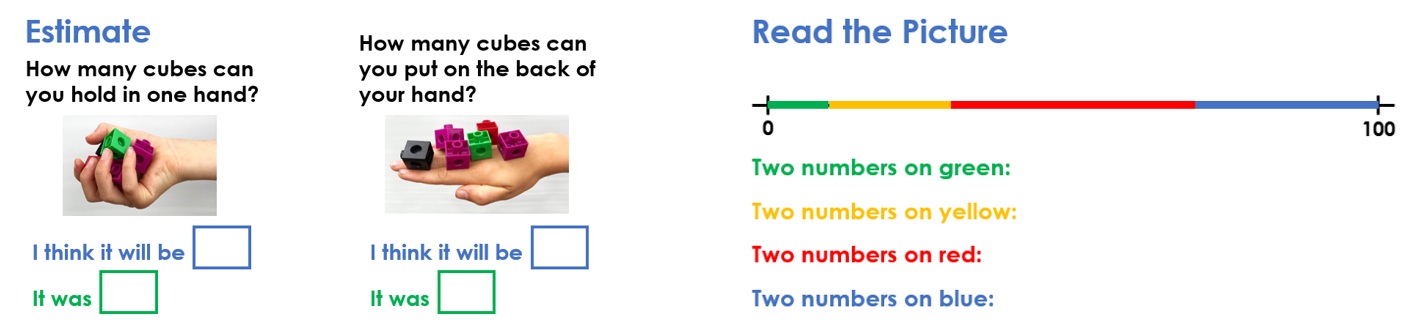
There are lots of questions, of many different forms, for exploring mathematics. This includes estimation tasks, open challenges or questions with different possible answers. There are also a range of spatial reasoning tasks, for children being able to visualise items from different perspectives.

Depth

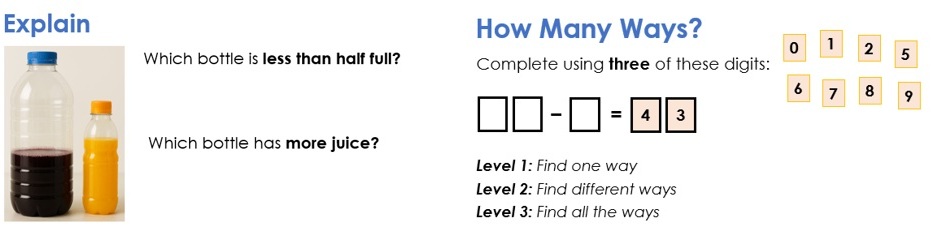
There are also a wide range of tasks to add challenge! These are very diverse and sometimes require children to find multiple answers or explain their thinking. These tasks are highly varied depending on the area of the maths curriculum that they cover.

The introductory price of the eBooks is £30 each (including VAT). From 1st January 2026, they will cost £35 each (including VAT).

I See Reasoning – Y1 and I See Reasoning – Y2 lay the foundations for children to experience maths as a thinking, exploring, explaining subject. If you click on the links, you can view a sample section of each resource. I hope that they inspire the children in your class and give you many fantastic classroom moments!

The New Deconstructing Word Questions – Y6

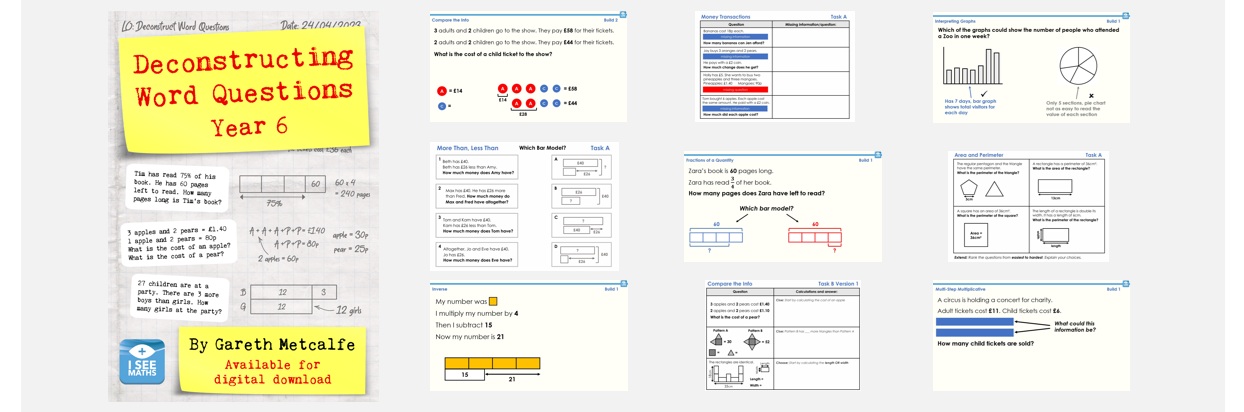
The updated version of Deconstructing Word Questions – Y6 is now completed! Full information about the resource, including a free sample task, can be found here. It provides a coherent, detailed approach to teaching children to answer word questions and gives a wide range of thought-provoking challenges.

This resource has been re-released in April 2025. If you purchased the original resource, you can have this new version for free! Just email iseemaths@hotmail.com and attach the original version of the resource (as proof of purchase) or give the order number for your original order. Then, we will reply by sending you the new resource.

Why has the resource been updated and re-released?
Since writing the original version, I have written Deconstructing Word Questions resources for Year 2, Year 3, Year 4 and Year 5. All of these resources followed a specific lesson structure:
Build 1 – teaching prompts
Task A – pair discussion task
Build 2 – teaching prompts
Task B (Version 1 and 2) – questions
Extend – deeper challenge
I have re-written the year 6 resource so that it also follows this lesson structure. This means that the resources give a totally consistent whole-school approach to teaching children to answer word questions. This video shows how the resources can be used to teach a lesson:

I want schools to have a whole-school vision for teaching children to answer multi-step word questions. Therefore, I am running 90-minute online INSET sessions on 1st and 2nd September to communicate this vision. It would be great to have you involved!

The ability to answer word questions is one part of how we can build children as mathematical problem-solvers. The full vision, including detailed guidance and video exemplification, can be found on this page. I believe it gives a practical, exciting vision for how we can build all children as mathematical problem-solvers!

Deconstructing Word Questions: the vision

Imagine this: you are asked to describe the strengths that the children in your school have as mathematicians. You say ‘they are brilliant at understanding and answering word questions!’ When asked to elaborate, you say ‘the children read questions carefully and pick out the important information.’ Or perhaps ‘the children are great at spotting multi-step questions.’ Maybe even ‘they show their understanding in different ways.’

In reality, so many children struggle to answer multi-step or non-standard word questions. So how do we go from giving children word questions to teaching all children to answer word questions? What does a consistent approach look like?

This has become my mission. For the last 3 years, I have been writing Deconstructing Word Questions for Y2 – Y6. Each task has been trialled in a number of different schools, being honed with the help of some amazing teachers. The eBooks are on sale here.

The golden thread that runs through every technique, every activity, is focusing children’s thinking on the deep structure of each question. It is about taking the attention away from calculating answers to understanding the steps involved. Here are four ways that this is achieved.

1. Slowly revealing information in questions
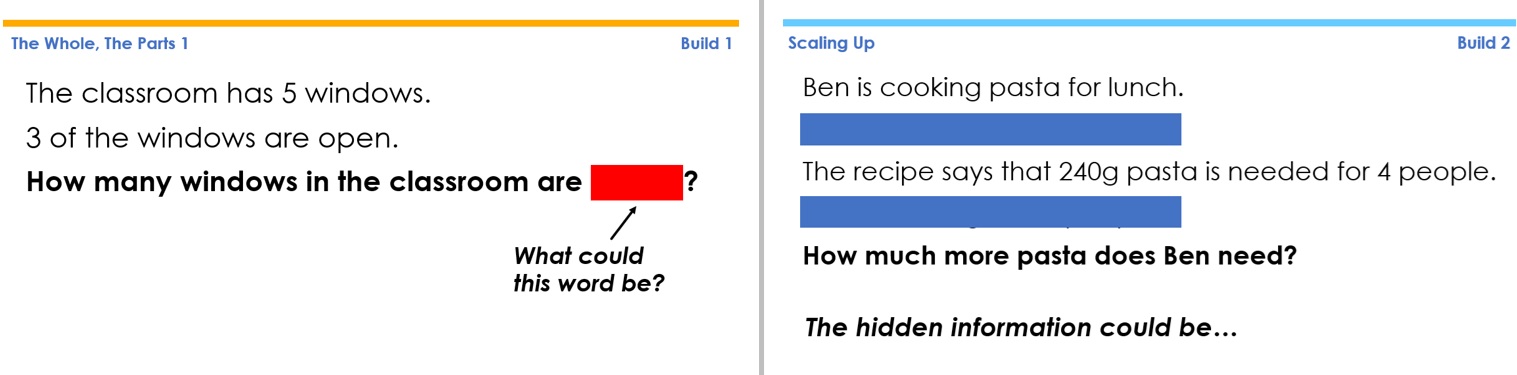
Children predict what the hidden words/information could be, as in the examples below (Y2 and Y5). Then, the information is revealed. This means children have thought about the structure of the question before they answer the question.

2. Using equipment or bar models
Sometimes, children are asked to represent questions with counters. Sometimes, children are asked ‘which bar model represents the question?’ (left-side example, Y3). For some questions, children are given part-complete bar models to fill which act as a scaffold (right-side example, Y4).


3. ‘Minimally different’ questions
Children analyse pairs of questions that are very subtly different. The children look at how the questions are the same/different. This helps children notice the subtle but all-important differences in the wording of questions (left-hand example, Y2). This variation is used in the questions that children answer (right example, Y3).


4. Depth
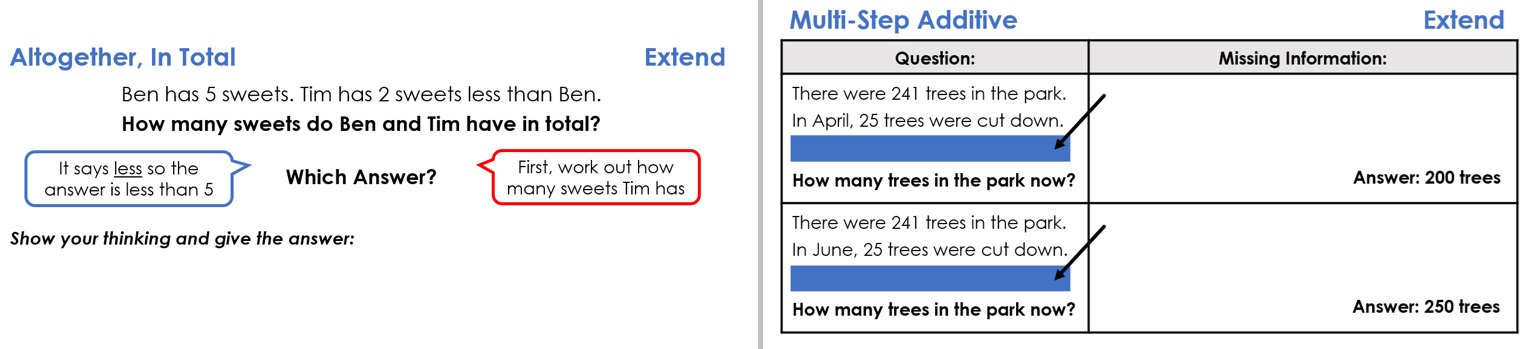
Lots of techniques are used to extend children’s thinking. This includes explaining which approach is correct (left example, Y2) or in giving the information that is missing in a question (right example, Y4).


There is a trial task for each year group to try out. Click on the links below for the resources and for the short ‘how to’ video:
Deconstructing Word Questions – Y2
Deconstructing Word Questions – Y3
Deconstructing Word Questions – Y4
Deconstructing Word Questions – Y5

Deconstructing Word Questions – Y6

The Vision: Building Problem-Solvers maps out a holistic vision for building children as problem-solvers. There are 10 videos to exemplify the key principles shared.

I hope Deconstructing Word Questions helps many children to grow as mathematical problem-solvers.

UPDATED BLOG: My 2023-2024 Writing Challenge

I have managed to post an example task for a streak of 107 days this academic year. However, at this point I’m going to redirect my efforts as I have decided to focus on writing Deconstructing Word Questions Y2-Y5. I see this as being my greatest possible contribution. It’s hard to properly communicate the vision for these resource using photos – it’s better done using short videos. I will spend the Spring term focusing on writing the resources and trialling them in lots of different classrooms. Then, in the summer term, I will post a video a week explaining how, I believe, we can transform the teaching of word questions. I will also send out lots of free resources to trial to the people on my mailing list. I am so excited about what is to come!

The resources will be released some time between September 2024 and January 2025, depending on the outcomes from the classroom trials.

Below is my original blog post:

Day 1: The Mountain Pass Logic Puzzle and The Mountain Pass Answers

I’m passionate that all children get to experience the true richness of mathematics and for maths to be an intellectually and emotionally rich pursuit. To this end, over the last 10 years I’ve strived to create maths tasks that generate conversations, give space for curiosity and provide opportunities for extended exploration. I hope that my resources are inspirational and simple to integrate with your maths curriculum.

I have so many plans for new resources! I See Reasoning – Y1 and I See Reasoning – Y2 are being written: they will be comprehensive resources for building number sense and embedding reasoning in daily lessons. Deconstructing Word Questions will be written for Y1-Y5 after the successful launch of the Y6 eBook. Then I will go back to my roots: writing a range of logic puzzles and problem-solving ‘task families’, so problem-solving skills can be built coherently.

To get into the routine of writing new resources every day, I have set myself a challenge: to post a new task every school day on social media for the whole of the 2023-2024 academic year. Images or videos will be posted at 7:30pm every day on Twitter, Facebook and on my NEW INSTAGRAM FEED. At the time of writing, I have exactly 0 Instagram followers!

I am actively seeking your feedback on all my posts. Specifically, what would you change about each task? Or if you use any of the tasks in the classroom, what age of children did you use the task with and what happened? I won’t always respond immediately – I can struggle with insomnia so I’m usually off social media after 8pm – but I will read every comment. Feedback can be emailed to iseemaths@hotmail.com

I have taken so much from the feedback given by teachers about my work – it helps me to reject my bad ideas and improve my half-baked ones! I love to receive any suggested improvements or comments.

The first post will be on 4th September. Until then, have a great summer – Gareth

Learning content, developing habits of thinking

I’ve taken a lot from listening to Dylan Wiliam speaking over the years. One of his insights has particularly resonated with me: the idea that the improvement in learning that a child derives from being in the class of a highly effective teacher extends well beyond the time that the child is in that teacher’s class. For example, if a child experiences expert teaching in Y3, they are likely to make more rapid progress in Y4 and beyond too.

It is, therefore, hard to judge the true effectiveness of teaching from end-of-year maths assessments. It might give an indication of progress made in the content goals for that year but it won’t give the full story of the long-term impact of that teaching. The lens is too narrow. If all our efforts are placed on getting children to achieve their ‘content goals’ for the current day/block/year, we may always be limited in our impact. We want out teaching to help children to learn the content and to build children’s capacity to learn other new content.

I have come to think of each maths lesson as an opportunity to develop a child’s content knowledge and their habits of thinking. Of course, surface knowledge is important as reasoning doesn’t happen in a vacuum. However, I generally look at the content of the lesson as the context through which I will build the mathematical habits of mind. This may involve helping children to represent ideas visually, explain misconceptions or spot patterns. Perhaps children will be challenged to create their own examples. Or maybe a task will require an element of perseverance and self-regulation. This approach may have a short-term cost in the speed at which content knowledge is acquired, but this is likely to be a worthwhile investment. It can give the children a richer experience of being a mathematician.

My simple encouragement is to be aware of the need to develop content knowledge and build mathematical habits of mind. To focus on the detail as well as being aware of the bigger picture. Content knowledge is more tangible and it is easier to assess. The habits of thinking that are developed, though, will play a powerful role in children’s long-term mathematical success. We want all children to develop these habits, not just pupils whose attainment is already relatively strong. It will also require us to make thoughtful choices about what we don’t teach. Where time is limited, content is usually prioritised.

A starting point might be to establish What, as a school, do you consider to be your ‘mathematical habits of mind’. What are the characteristics that you want to build within children over time? How are they explicitly taught and made visible? And how do we promote and celebrate children’s progress is developing these habits? My aim, of course, with the I See Reasoning eBooks is to write questions and tasks that help children to develop these habits. Schools generally have a clear plan for how children learn their number bond facts. I want schools to have the same clarity in how children reason mathematically and grow as creative, independent thinkers.

If you have any thoughts on this blog, please share them with me by emailing iseemaths@hotmail.com or commenting below – Gareth.

Emotional Regulation in Learning Mathematics

We all know, from personal experience, that mathematics evokes a broad range of emotions. In maths lessons, we’ve probably all had to navigate through frustration and confusion, doubt and even embarrassment; but then we may have also experienced the joy of a new discovery and the immense satisfaction that maths can bring.

For so many people, though, the uncomfortable emotions involved in learning maths are so dominant. We know how destructive this can be. And we know how common it is for adults to admit to children that ‘I was never any good at maths.’

Much has been done. Mistakes are embraced as opportunities to grow our brain; learning is broken into small steps so working memory isn’t overwhelmed; extra support helps children to keep pace. I wonder, though, if there’s still more ground to take in terms of helping children to self-regulate their emotional response in maths lessons.

Acknowledge the uncomfortable emotions that come with learning maths.
Firstly, I think it’s important to recognise that learning maths is, biologically, uncomfortable. Our bodies are always looking to maintain homeostasis. However, to prime us for learning, our brains release a chemical called epinephrine (adrenaline released in the brain). This heightens our focus and therefore supports learning, but it means that learning can be uncomfortable. Also, at a very primitive level, we are a social species. The desire to maintain our status ‘in the group’ is wired deep within us. Whilst I can encourage children to not compare themselves to their friends, at a very basic level it’s natural that doing maths could make us feel somewhat threatened. I think we should be open about this. Normalise it. Help children to see that they are not ‘doing it wrong’ if sometimes they feel this way! It’s just a product of our human wiring.

Recognise the physical manifestations of different emotions
Also, I think I could have been much more granular about the different emotions that can be experienced when learning maths. Consider the emotions frustration, embarrassment and apathy. All three are very different, with very different physical manifestations. For example, frustration could be thought of as being uncomfortable but helpful: it might drive us towards action and to a deeper level of focus. Embarrassment (which is experienced by children of across the attainment spectrum) has a much stronger social component. Processing embarrassment may require children to step away momentarily and regain their normal perspective. In contrast, apathy may be more associated with a reduction in psychological arousal: stepping out of apathy may require more action.

How can we help children to transition through some of these emotional states? By noting the physical sensations. By explaining that these responses are natural. And by emphasising that these emotions are temporary.

Helping children to transition through emotions
I love to celebrate the breadth of emotions that doing maths can generate. Before a lesson starts, I like to give an example emotion that children might experience (either an uncomfortable or a pleasant emotion). We can note how that emotion feels, why we have that response and what we can do if we feel that way. This dialogue helps children to see that these emotions are normal and that they are passing. Children shouldn’t feel ‘like they are doing it wrong’ if they experience a certain emotion in a maths lesson. It’s NORMAL to feel anxiety when learning maths! But, of course, we want children to transition through that state of feeling anxious, not to remain stuck in that emotional experience.

And, of course, there’s so much to enjoy on the other side! Relief, satisfaction, creativity, pride, motivation, surprise, joy, discovery…

The next steps
I am always looking for ways to outwork these ideas into something tangible that teachers can use in the classroom. Of course, the way in which we have these conversations will depend on the age, maturity and nature of the children. But maybe there are some prompts that I could create that would open up some great discussions in your classroom around emotional regulation in maths lessons? Or maybe you have a different perspective on this topic, or different insights to offer? I would love to know! Highlight my ignorance, help me to understand your context, raise your questions, give me your best ideas.

I want all children to experience the true emotional richness of learning mathematics.

Deconstructing Word Questions in UKS2: see the vision, share your views!

I’m passionate about helping all children to become effective problem-solvers. Over the last 3 years, I’ve done a huge amount of work on helping children to deconstruct multi-step word questions using techniques similar to those described here by Brian Bushart or here by The Erikson Institute for Early Math.

The focus is all about getting children to focus on the deep structure of a question by removing the need for children to find the single definitive answer. It’s far too big a topic for me to write about in a blog, but this video gives an insight by showing how a SATS question can be deconstructed:

I’m going to embark on a big project to give teachers the resources to outwork these ideas in the classroom, initially in UKS2, and I’d like to get input/inspiration from as many people as possible before I start work on the resource.

As such, I’m holding two free 30-minute Zoom sessions where I will spend 15 minutes explaining my ideas, then I will provide an open forum for people to give their thoughts and suggestions. And no pressure to contribute! You are very welcome to join in without having to interact. I will also share lots of free resources in the upcoming months to everyone on my mailing list as I create and trial the resource:
Register for the session on Tuesday 25th January, 12:30pm-1:00pm
Register for the session on Wednesday 26th January, 6:30pm-7:00pm

I hope this project will help children to flourish as mathematical problem-solvers. I’d love to see you there!

I See Problem-Solving – Y2 has now been released!