
In the process of learning, we are quite literally making links between, building on and extending what we already know. Our existing schemas are slowly being adapted in the light of new experiences. As such, when I’m trying to introduce a new mathematical concept – or when addressing a misconception – I often try to progress very slowly and explicitly between what children already know and what I want them to learn.
Below are two examples. In example 1 I look at addressing the misconception £10 – £6.99 = £4.01, and in example 2 at introducing letters to replace unknown numbers.
Example 1 – subtraction misconception:
Ask the children to explain the misconception in red. How has the (fictitious) child ended up with this answer? How do you know this is incorrect?
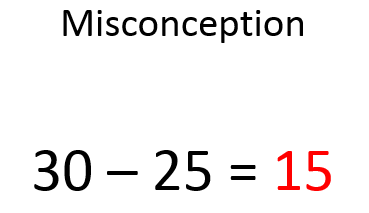
In my experience, children intuitively know that the answer is wrong, and with support can explain the misunderstanding. Then I make an exact copy of the screen, then subtly change the example:
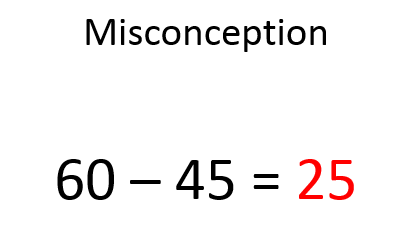
The process from before is repeated but using an example where the misconception is less glaring. Having discussed these two examples, with the key learning points unpicked, the children are now in a position to tackle the original misconception:
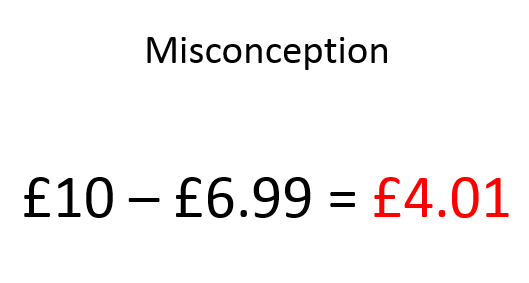
Hopefully the children now have a deeper understanding of the link between addition and subtraction.
This structure can also be used when introducing a new concept. In example 2, I was moving the class on from calculating the inside and outside angles of a triangle to using letters to replace unknown numbers.
Example 2 – introducing algebraic notation:
By this point, the children had a secure understanding of how to find the two missing angles below.

Again, I copy and pasted the screen and made small adaptations so that the angles were changed into shapes. The children were then asked to write number sentences using the shapes (I used shapes as a ‘bridging’ jump to using letters):
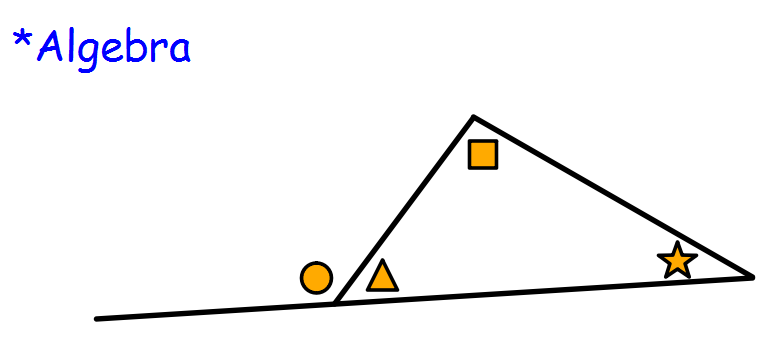
By the time the third image was introduced, the children were no longer overawed by the idea of using letters to represent unknowns:
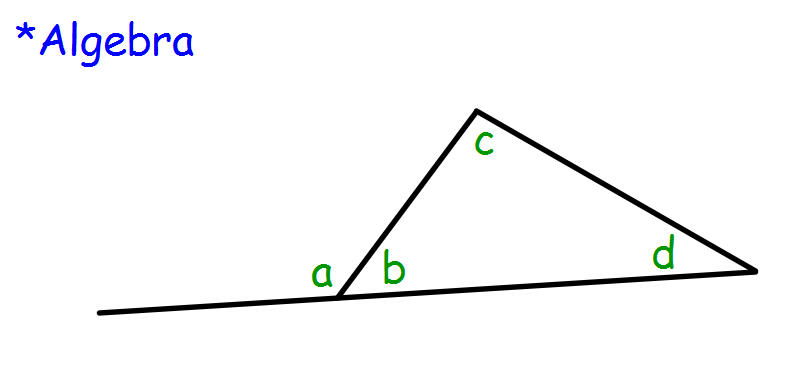
Of course, with algebra there are lots of routes ‘in’ – I just found this one timely with the structure of our units of work.
Once concepts are more embedded, I would expect children to make wider and more advanced links between different areas of mathematics. But to introduce potentially challenging subjects, or as a means to address specific misconceptions, this ‘slow movement’ approach can be particularly effective.

 Gareth Metcalfe Primary Maths