In this final blog in the ’embedding reasoning’ series, I am sharing some of my favourite strategies for deepening learning. I love the back end of a sequence of lessons, where you can build on children’s growing understanding. Rich conversations emerge and children can apply their skills with increasing flexibility.
Nowadays, there is an increased emphasis on looking for the different ways children might find an answer. I think this is great, assuming we have given children enough tools to find different strategies (and discern the most efficient). Initially I often provide some scaffolds to point children towards different methods (see below-left). I also love ‘rank by difficulty’ as a tool for generating discussion. It helps to draw out the different ways children approach questions and focuses their conversations on key learning points.
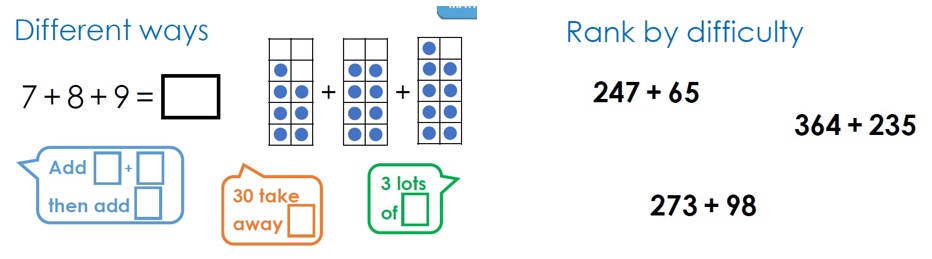
To deepen learning, I’m always thinking about ways of stripping back the information that is given within a question. I can always put extra information back in where needed (or specifically requested), but by starting with less I can often have a more open dialogue. Consider the below-right example: I can always add in the squares to the 100-square, or other numbers. But by starting with less information I have a more open discussion about the possible values in the red boxes.

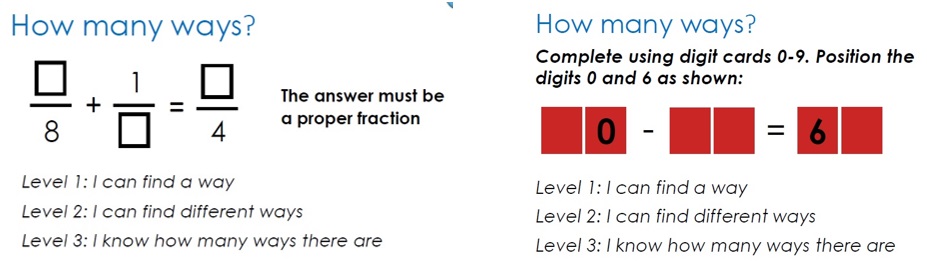
Finally, I love using ‘how many ways?’ as my final question type. Children can access a how many ways task at level 1 (I can find a way) or level 2 (I can find different ways), but the step to be working at level 3 (I know how many ways there are) creates a different kind of challenge. We may have to model how to order thinking systematically as children strive to find all possible answers. Previously taught calculation skills are becoming automated and rich opportunities for reasoning emerge.
All the examples in this blog are from the ‘I See Reasoning’ eBook range:
I See Reasoning – KS1
I See Reasoning – LKS2
I See Reasoning – UKS2
Also check out the other blogs from the series.

 Gareth Metcalfe Primary Maths