In my blog Adapting ‘I-We-You’ to Deepen Mathematical Thinking I describe how we can provide high-quality modelling whilst enabling children to form their own thinking in the ‘We’ phase of a lesson. I described how slowly revealing information can engage all children in deep mathematical discussions, taking the focus away from finding an answer to understanding a concept.
There is another technique that I often use for opening up mathematical conversations: using pairs of examples/questions. This is one of the simplest, most effective ways of highlighting specific ideas, in a way that is accessible for all children. Again, it emphasises understanding over answers. Here are some examples.
‘Spot the difference, rank by difficulty’ for missing digit questions:
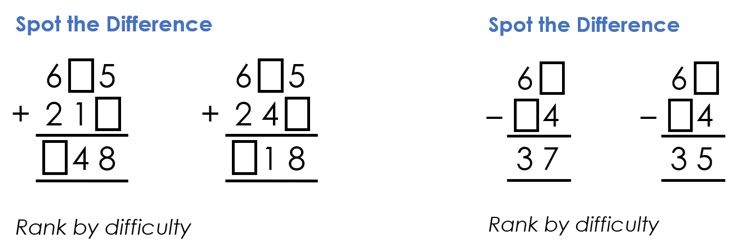
Consider these pair of examples (only use one pair at a time!). The key to unlocking these questions is for children to understand what happens when a calculation borders over 10. For the addition examples, this is in the tens columns for the right-hand question, but not the left-hand question. This is due to the positions of the digits 1 and 4. For the subtraction examples, a regroup is only needed in the left-hand example (___ – 4 = 7, must be 11). When a pair of examples is shown, all children can access the discussion if they can spot the difference between the questions. Then, as children think about which of the two questions is more difficult, attention is being drawn to the significance of these small differences. The teacher can then answer the questions.
Highlight efficient calculation methods by asking ‘Which question is harder?’
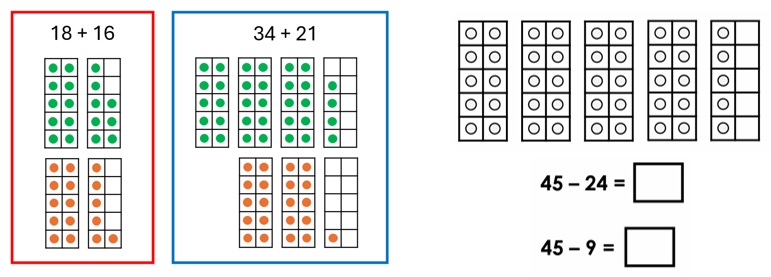
The examples above are slightly different. In each instance, children consider two calculations. One of the questions involves larger numbers; the other involves a calculation that borders a ten. Children consider which question is more difficult and why, using the visuals to support their thinking and explanations. All children can participate by voting for the harder question – different valid perspectives can arise and can be discussed.
Compare non-examples or discuss misconceptions

Pairs of examples can also be used to highlight specific key ideas or misconceptions. The ‘discussion entry point’ is spotting the difference between the examples. The development comes from explaining which clock face is correct (clock examples) or explain the mistake (right-angles). This allows children to think deeply about the key concepts for each area of mathematics.
I would love to hear about how you use pairs of examples to deepen thinking, or other reasoning techniques that you us to open up conversations in your maths lessons. I’m very interested to know how you ensure that all children can participate in discussions, and how the thinking can be deepened. Thanks for reading.

 Gareth Metcalfe Primary Maths
One thought on “Reasoning for all in the ‘We’ of a maths lesson”