Promoting Reasoning Part 4: Depth

In this final blog in the ’embedding reasoning’ series, I am sharing some of my favourite strategies for deepening learning. I love the back end of a sequence of lessons, where you can build on children’s growing understanding. Rich conversations emerge and children can apply their skills with increasing flexibility.

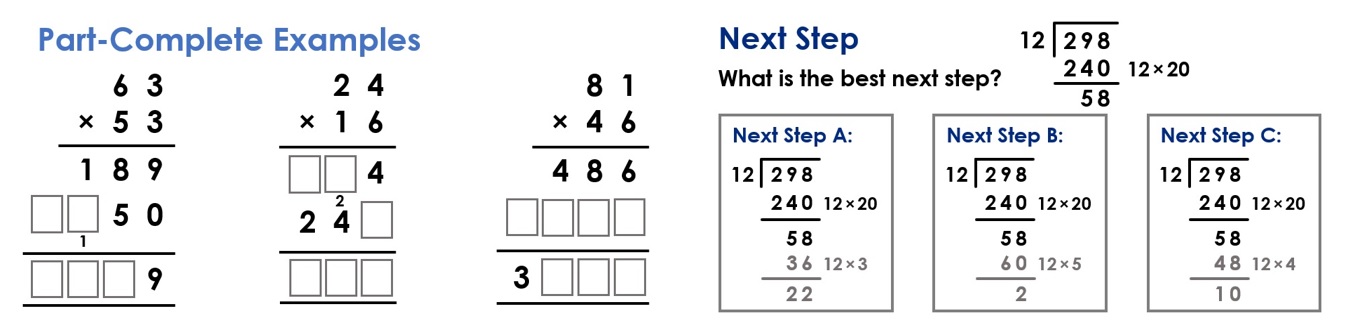
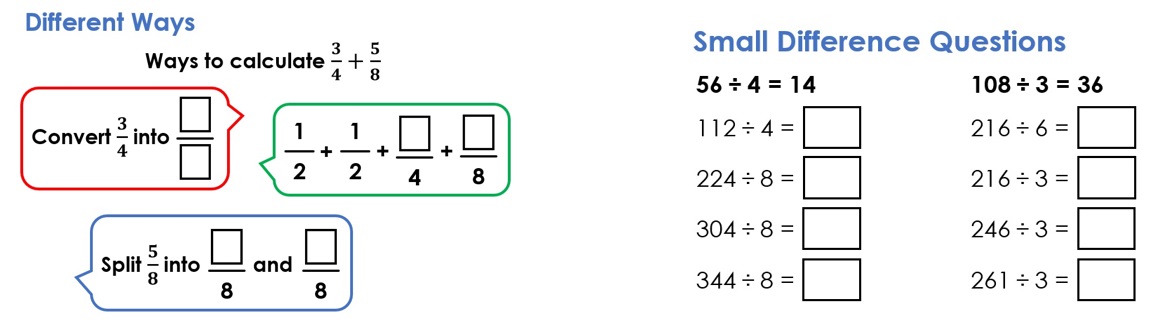
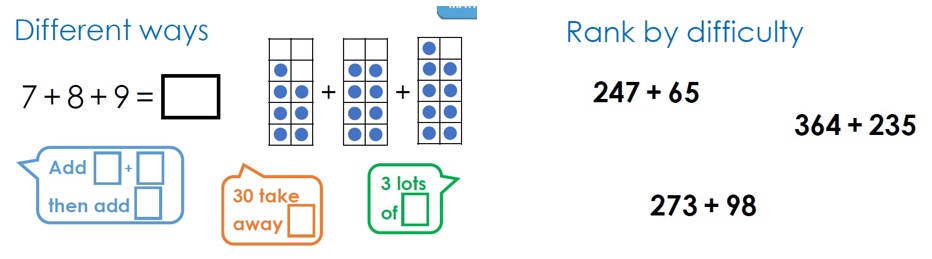
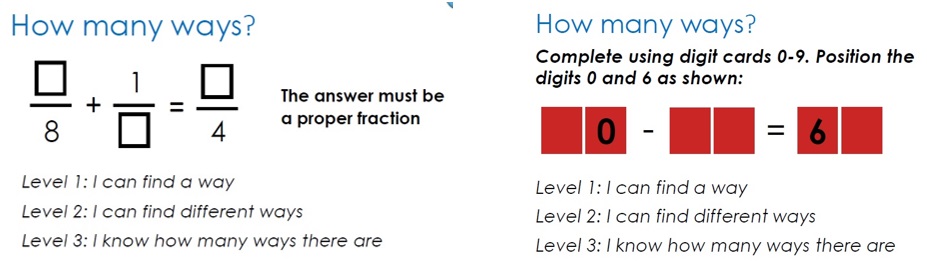
Nowadays, there is an increased emphasis on looking for the different ways children might find an answer. I think this is great, assuming we have given children enough tools to find different strategies (and discern the most efficient). Initially I often provide some scaffolds to point children towards different methods (see below-left). I also love ‘rank by difficulty’ as a tool for generating discussion. It helps to draw out the different ways children approach questions and focuses their conversations on key learning points.

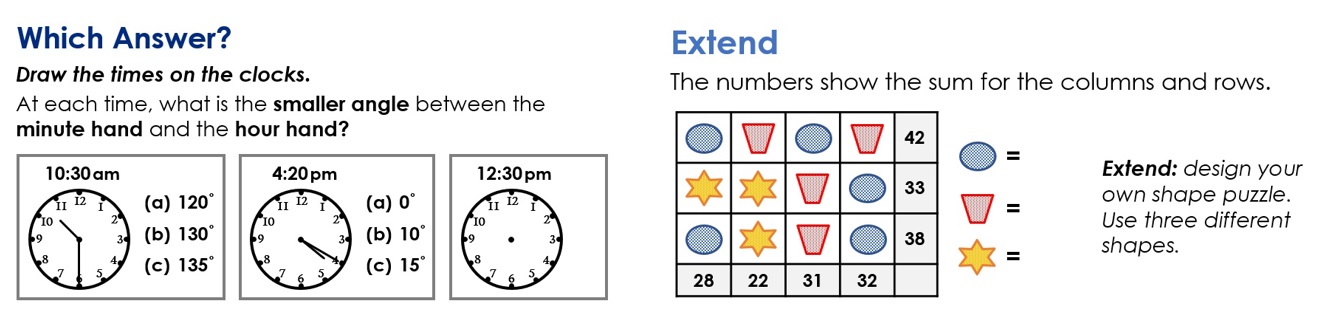
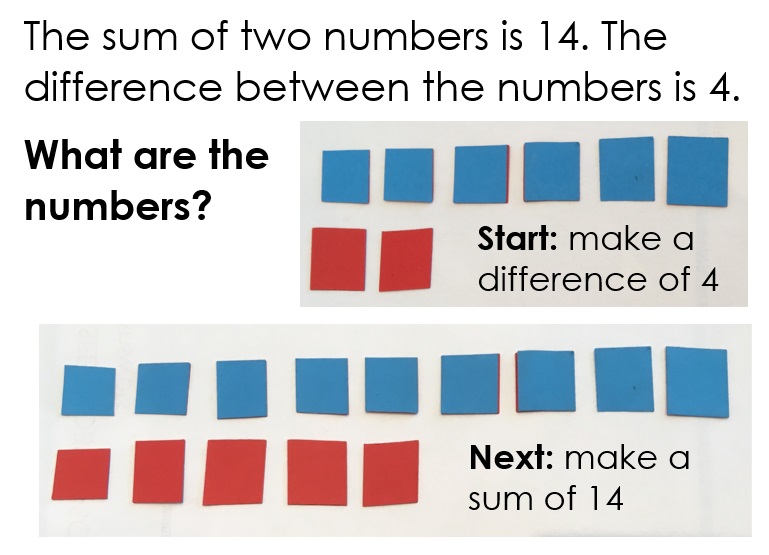
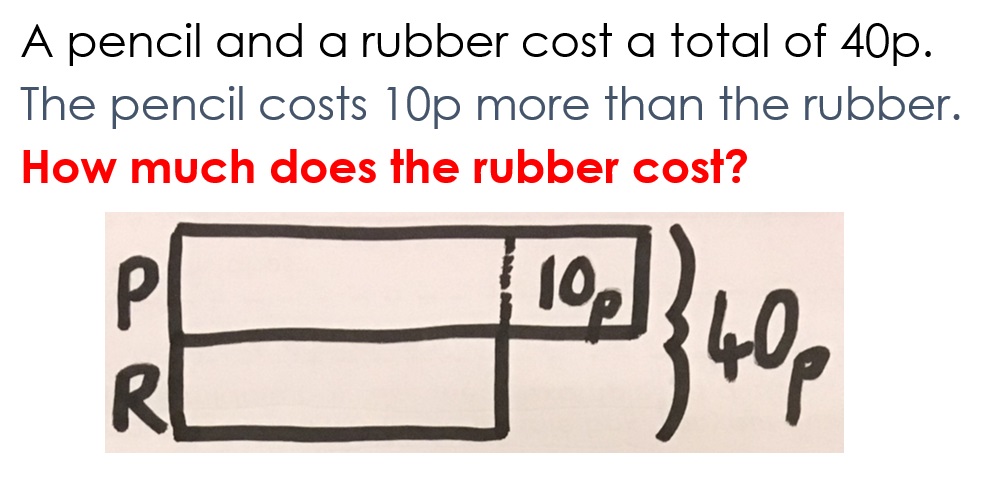
To deepen learning, I’m always thinking about ways of stripping back the information that is given within a question. I can always put extra information back in where needed (or specifically requested), but by starting with less I can often have a more open dialogue. Consider the below-right example: I can always add in the squares to the 100-square, or other numbers. But by starting with less information I have a more open discussion about the possible values in the red boxes.

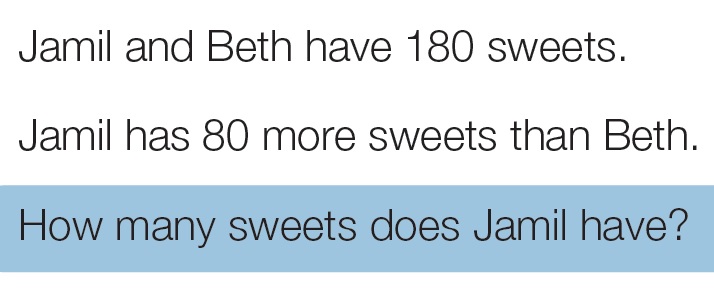
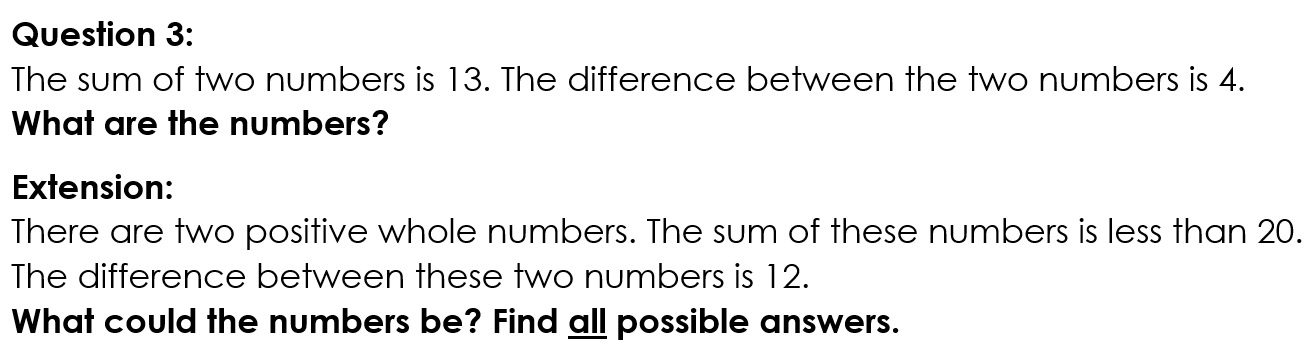
Finally, I love using ‘how many ways?’ as my final question type. Children can access a how many ways task at level 1 (I can find a way) or level 2 (I can find different ways), but the step to be working at level 3 (I know how many ways there are) creates a different kind of challenge. We may have to model how to order thinking systematically as children strive to find all possible answers. Previously taught calculation skills are becoming automated and rich opportunities for reasoning emerge.

All the examples in this blog are from the ‘I See Reasoning’ eBook range:
I See Reasoning – KS1
I See Reasoning – LKS2
I See Reasoning – UKS2

Also check out the other blogs from the series. 

Promoting Reasoning Part 3: Variation

This blog post, the next in the ‘promoting reasoning’ series, features question types that help children to build on their current knowledge and notice important similarities and differences between questions.

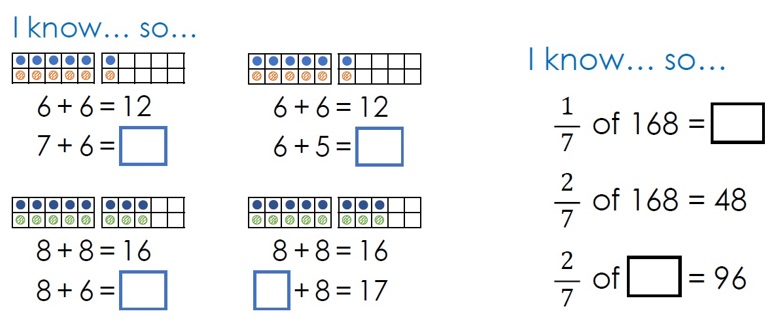
I’m always looking for ways to promote non-counting calculation (there are overlaps here with my ‘visuals’ blog). Prompts like the below-left example helps children to make connections between doubles and near-doubles facts. Children can edit the image to help them see those relationships. Similarly, I love using ‘I know… so…’ question strings. In the below-right example, I hope children will either perform the calculation using the related fact, or they will see the relationship between the three questions.

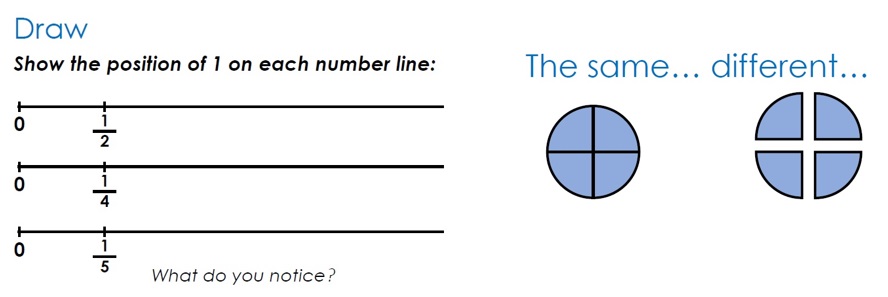
The examples below probably fit the criteria of ‘variation’ more tightly. Specifically, by keeping all but one aspect of a question/image the same, children’s attention is drawn to the key difference. Consider the below-right example: the left hand image the dominant idea is likely to be ‘one circle’; the right hand image emphasises ‘four quarters’ more. Used together, children’s attention is drawn to four quarters being the same as one whole.

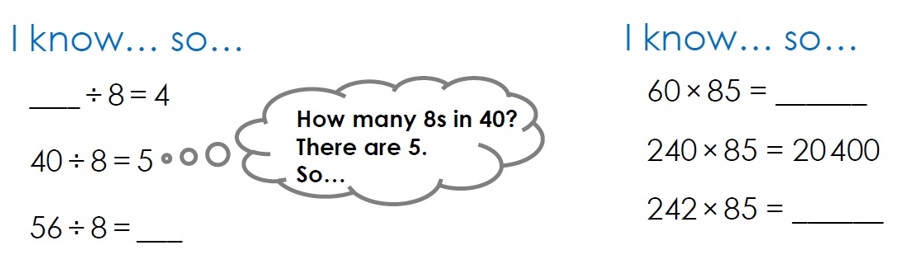
When using the ‘I know… so…’ prompt, I might adjust the amount of variation between the examples depending on where children are up to in their learning. That’s all about knowing your children, the magic ingredient that every great teacher has up their sleeve!

All the examples in this blog are from the ‘I See Reasoning’ eBook range:
I See Reasoning – KS1
I See Reasoning – LKS2
I See Reasoning – UKS2

Also check out the other blogs from the series. 

Promoting Reasoning Part 2: Visual

This is the second blog post in a series looking at building reasoning within the maths curriculum. Here I’m looking at the using visuals in maths questions.

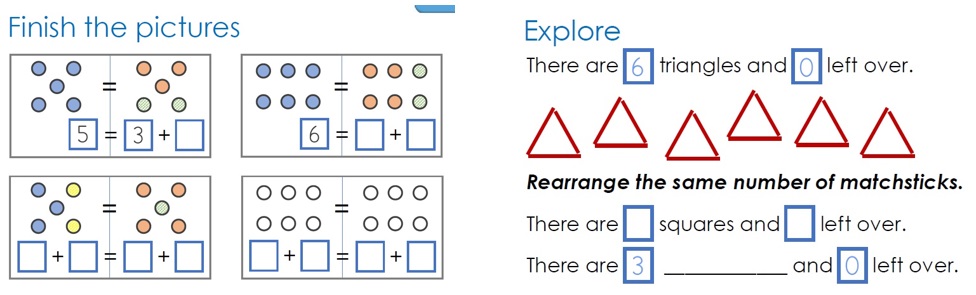
I’m always thinking about the best way to represent maths concepts practically to build understanding. The visual questions I use, therefore, are designed to correspond with the practical/visual models I have already used. The below-left example is one way that I represent the concept of ‘= means the same as’. The below-right example is a prompt that can be used to launch a practical investigation using matchsticks, developing the thought process of ‘how many [divisor] in [dividend]’ as children learn to do division by grouping.

By using questions that correspond directly with children’s practical experiences, the transition between concrete/pictorial to abstract is smoother. I might also use the visual to address common misconceptions (below-right example).

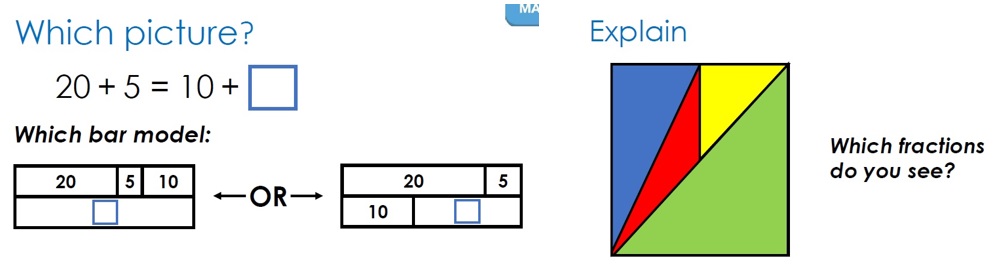
Below are two of my favourite types of visual reps questions to generate discussion. I like using ‘which picture’, where children have to consider which bar model represents a question correctly, and which bar model is showing a common error. Can children explain the mistake? I also love open-ended visuals: the bottom-right example is a particular favourite. More similar examples on this theme on the next blog!

All the examples in this blog are from the ‘I See Reasoning’ eBook range:
I See Reasoning – KS1
I See Reasoning – LKS2
I See Reasoning – UKS2

Also check out the other blogs from the series. 

Promoting Reasoning Part 1: Misconceptions

In this series of blog posts I wanted to share some of my ‘go to’ strategies for interweaving reasoning throughout the maths curriculum. This post is all about specifically addressing common misconceptions.

When planning a sequence of lessons, I tend to spend an eternity considering two things: how to represent each mathematical idea to build children’s conceptual understanding, and the possible misconceptions children may have. Initially I try to break learning down into small, easy-to-digest steps (more about this phase in future blogs).

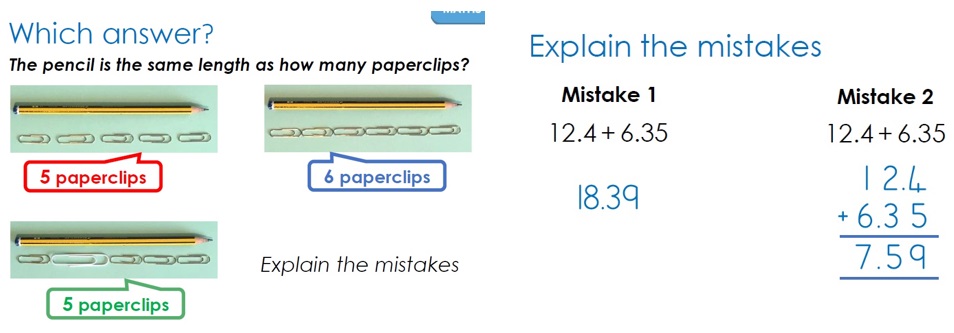
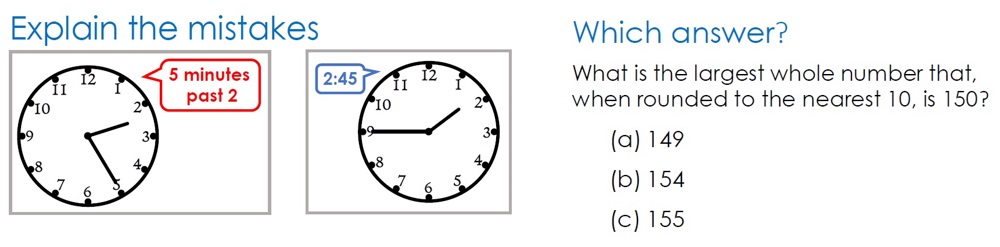
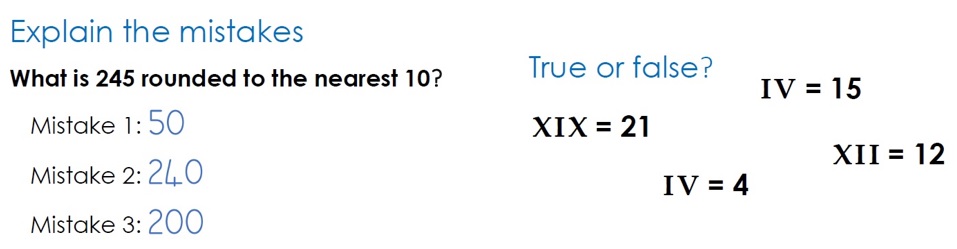
Then, when I think the children are ready, I try to address those misconceptions directly. I want to focus thinking on the key points that discern right from ‘likely wrong’, deliberately highlighting common errors. Sometimes, like the example below, I might show three possibilities and ask ‘which answer?’. Alternatively, I might ask children to explain given mistakes.

I find that these questions generate great discussion and explanation. I use these examples at different points within a lesson: sometimes as a way of addressing errors from yesterday; often as a final task before children work independently; occasionally as a plenary (although only if very confident that the children will take the correct conclusion away). Having read ‘How I Wish I’d Taught Maths’ by Craig Barton I will start using a couple of them mid-lesson to assess children’s understanding and signpost pupils to appropriate follow-up activities.

Predicting those errors is very much a skill in itself, developed over years of experience. And the process of coming to understand children’s incorrect responses, I find fascinating. Hopefully this technique will help your children to focus on those key learning points, and solidify their conceptual understanding in a range of areas of mathematics.

All the examples in this blog are from the ‘I See Reasoning’ eBook range:
I See Reasoning – KS1
I See Reasoning – LKS2
I See Reasoning – UKS2

Also check out the other blogs from the series. 

All-New CPD for 2018!

I’m delighted to announce a new range of maths CPD opportunities available for 2018, all with the aim of making my work high-impact and as cost-efficient as possible.

I’m particularly excited to advertise my teaching and staff training days support. Here, I am proposing coming into schools and teaching up to three example lessons per day, allowing teachers to see visual, deep maths learning in action! I would also, if requested, run a staff meeting after school.

I’ve found that my training has had the greatest impact where schools have been immersed in a combination of example lessons and training, so I’m delighted to be able to make this offer. Not that I can promise perfect lessons: I’m very happy, though, for people to learn from both my successes and my failures in the classroom!
Click here for more details about in-school support

Over the last four years I have ran a series of conference training events. However, with school budgets increasingly tight (and the cost of hiring venues becoming increasingly expensive), this no longer seems like a cost-efficient way of delivering training. Instead, I’m looking for schools, teaching schools and organisations that would like to host a conference. This will minimise costs, especially for the host school/organisation.
Click here for more details about hosting a conference

I’m also looking forward to running more whole-school INSET and twilight training events, giving schools a collective, exciting vision for developing rich maths learning experiences. The new pricing structure discounts training for smaller schools and provides significant discounts for cluster training events.
Click here for more details about INSET & Twilight training

At the time of writing I have space for eight more bookings this school year (one day left in May, three in June, four in July) then I am taking bookings for 2018-2019.

I love my work. I teach more maths lessons than ever, meet more passionate teachers every week and have plans to create so many more new resources. I hope, in one way or another, I can help you to deliver great maths lessons!

For more information, email gareth.metcalfe@hotmail.co.uk 

Chance favours the connected mind…

My vision is to help children experience maths – visual, deep maths – in all its richness. To this end, I’m passionate about creating a range of user-friendly resources that will help time-pressured teachers to deliver great maths lessons on a day-to-day basis. And to make these resources truly outstanding I need your help!

Future plans, your help
I’ve recently finished writing the range of I See Reasoning eBooks. Much to my amazement, over 800 people signed up to trial I See Reasoning – KS1. The feedback that people gave was extremely helpful. Over the next few years I will write many more resources, and I want to involve as many teachers as possible in the creation of these products (this time with trial materials being sent from the earliest conception of a product). You tell me which tasks really work, and how each idea could be better. I’m working on these ideas next:

  • A resource which represents maths concepts visually using a sequence of clearly constructed, step-by-step images. The first versions of this will be aimed at KS2.
  • A resource helping children to become effective problem-solvers. It will be made up of my favourite problem-solving tasks, broken down with the necessary scaffolds and supports that help children to see the underlying mathematical structure of each problem.
  • A resource for EYFS that is a follow-up to the I See Reasoning range, but delivered in a format more suited to an Early Years provision.

I’m after a team of people who will trial these ideas in their classrooms, let me know what they think of them and tell me how they can be improved. No strings attached, it’s all free, there’s no obligation to reply. The ideas will be plentiful and thought-provoking. You may well get lots of free, useful tasks that never end up being published!

If you are up for it sign up here. Please share this blog too, it would be great to get as many educators on board as possible. Thanks!

For me to improve… September ’17

This is my first blog post in the ‘For me to improve…’ series in which I explain what I’m doing to be a better maths teacher. This blog explains the thought process behind the series.

I’m always looking to use equipment and images to represent concepts, and I like my maths lessons collaborative and open. This makes my classroom management skills important so lessons teeter on the healthy side of organised chaos. My partner Y1 teacher last year was the maestro in seeing a logistical detail that I’d missed. I learnt a lot from her, and I also came across some interesting ideas reading Visible Learning for Mathematics. So here are my five targets for the new term:

Promote a learning action
In each lesson, identify one key ‘learning action’ to promote. My thought process will be ‘Which learning behaviour will improve the outcomes in this particular lesson?’ It could be as simple as turning your body to face your partner; it may be more complex like asking clarifying questions; it might be a maths-specific thing like finding different ways to answer a question.

Prepare individuals for the social demands of lessons
I’m a big fan of small-group pre-teaching to help all children access the big ideas of a lesson, breaking down barriers and predisposing misconceptions. It’s helped me to facilitate mixed-attainment groupings. However, for some children the barriers may be the social demands of a lesson. Perhaps Harry finds it harder to share resources; maybe Jade dominates group discussions. A quick conversation or organisational change beforehand might make a big difference.

Make discussions active
I liked this idea from VL for Mathematics: during a whole-class discussion, put your thumb up on your chest if you agree with the speaker and want to add something; put your fist against your chest if you have a different viewpoint. This encourages children to actively participate in discussions without being intrusive to the speaker.

Exit tickets
I’m going to make a clearer distinction between most questions and tasks, used to generate discussions, and short ‘exit ticket’ tasks that are completed independently and used to give more accurate AfL information. The nature of the marking may also vary depending on the conditions in which the work is completed. I’m hoping that this will help to keep children accountable for their own progress and avoid social loafing in group tasks.

Cognitive load and challenge in calculation
In some lessons, particularly early in a unit, I want the challenge to come from understanding the concept so I will minimise the challenge in the calculation. Consider 14 = 6 + ___ (WR Progress Check, Aut Y1, q4). We can learn the concept ‘= means same as’ using numbers within 5. Once that concept has been secured (a concept which tends to need more than a little reinforcement), the challenge within the calculation can be set at an age-appropriate level.

And as ever this year, I make the same vow to the children in my care:
‘I promise to learn alongside you.’

Training and Resources for Summer ’17

I set up I See Maths to help time-limited teachers create powerful learning experiences in maths, engaging children intellectually and emotionally. To that end, here’s what I’m offering this summer:

Training
I’m delighted to announce four new conference dates this summer: full conference details can be found here. Early Number Sense: Beyond Counting  will give a clear Nursery-Y2 vision for how children build a strong feel for number and learn to calculate using non-counting strategies. We will explore how mathematical play can be extended and how reasoning can be embedded. Reasoning and Depth in KS2 Maths will give an exciting and practical vision for deepening mathematical learning, including how images and resources can be used to build understanding.

If you are interested in this training, you may consider arranging a conference event at your school – all that is needed is a spare room. This is a very cost-effective and popular way of running training – for full details click on the top two links on this page.

Resources to Buy
I’m working hard on the I See Reasoning eBook range and hope to write the UKS2, LKS2 and KS1 versions this term (I may be dreaming!). This will give teachers a massive bank of questions and tasks that will open up discussions and encourage reasoning. I’m extremely excited about this project – this blog gives more detail.

The iPad app I See Calculation is also in the final stages of being built. It will show standard written methods for calculation one step at a time. A child could check their answer to a question with a calculator; with I See Calculation they will be able to check each step of their written calculation.

Free Resources
I’m intending to create a series of free ‘flipbook’ dot pattern games that will help children to visualise addition, subtraction and multiplication, opening up discussions about calculation strategies.

Full details about my INSET training and in-school support can be found by clicking the links. I’m a NCETM Charter Standard provider of CPD and, being a class teacher, still very au fait with the realities of teaching in the classroom.

I hope that, in some way, my work can help you in the daily challenge of delivering great maths lessons. Enjoy the summer term!

Help! Long Multiplication

So it turns out that I’m not 100% sure how to do long multiplication. I really should be, you probably are. Please help.

I want to make a resource that will support children doing long multiplication so but first I want to make sure I’ve got my method straight. Here’s the issue: when you are multiplying by the tens value in a 2-digit number, where are you supposed to position the digit being carried? Here, I’ve done 80×3=240 and have put down 40. Where should the 2 hundreds go?

multiplication-which

A shows where the 2 hundreds will be added to (but it could make the calculation messy). B shows the 2 above the hundreds column, the column that it will be added to (but two places along from the 3 we’ve just multiplied by). puts the 2 above the next number to be multiplied, but in the same column as the 4 tens.

The example on the national curriculum (below) somewhat ducks the issue in that there are no carries from the 20, and the examples in the mark scheme for the 2016 SATS don’t show the position of carried digits.
nc-multiplication

I inferred from this it’s up to schools to decide which way is best. Is there a ‘right’ way? What do you do? I’d love to know. Just to repeat, this isn’t me trying to make a point, rather I’m in the process of designing a resource that will model this calculation process, but I want to do it right. I’d love to know what you think, or from any ‘higher power’ if they can give a definitive stance.

All input welcome!

Enrichment in mathematics

In the early 20th century, psychologist Lewis Terman carried out a now-famous research project: he aimed to prove that by knowing a person’s IQ at an early age, you are able to accurately predict his or her life success. Using a series of intelligence tests, he identified an elite group of 1,470 children to study. Terman believed that it was these children (and others of extraordinary IQ) that ‘we must look for production of leaders who advance science, art, government, education and social welfare generally.’

Terman carefully monitored the progress of the ‘Termites’ over a period of 35 years to ascertain their life success. The results surprised many, including Terman himself. The group thrived in many ways, most notably being healthier, taller and more socially adept than the average American. However, their achievements were far from remarkable. In fact, a later study concluded that a random sample of people, given the same socio-economic status, would have achieved just as well. Terman himself reluctantly concluded that ‘intellect and achievement are far from perfectly correlated.’

Later studies went on to explore this idea more thoroughly, as explained in Malcolm Gladwell’s book Outliers. Generally speaking, people who achieve great professional success have an above average IQ: usually 115 or above. However, beyond this ‘intelligence threshold’, a person’s success is determined far more powerfully by other skills and attributes rather than the full extent of their IQ. Gladwell argued that it is hard to be highly successful without above average intelligence; however, beyond the intelligence threshold success is determined by other factors, for example the character and inter-personal skills of the individual.

Pupils who grasp concepts rapidly should be challenged through being offered rich and sophisticated problems before any acceleration through new content.
National Curriculum, Maths

This led me to think about the nature of the ‘rich and sophisticated problems’ that we should be providing. In order to equip children for long-term success, tasks should help children to develop personal and social skills as well as subject-specific expertise. Easier said than done for a busy and pressurised teacher!

That’s what I’m going to dedicate my working life towards: creating learning experiences in maths that engage children intellectually and emotionally; tasks create curiosity and lead to collaboration. I hope that this characterises First Class Maths, Maths Outside the Box and The Maths Apprenticeship.

I’m convinced that, if the system allows, these are the kinds of learning experiences that we as teachers want to provide for our children.

Personal Skills