Plans for maths, 2016-2017

This is a great time to be involved in maths education: there’s a collective movement towards developing deep, conceptual and varied learning experiences; teachers are being proactive in promoting positive attitudes towards maths; maths hubs are growing in their influence.

I’m excited to play my part in this movement. Put simply, I spend hours thinking about and trialling ways to get children involved in maths tasks that are collaborative, open and (wherever possible) visual. I want children to become engrossed in maths; to experience its agonies and thrills, engaging emotionally as well as intellectually.
mission

Here’s what you can expect from me in 2016-2017:

Resources:
I can’t wait to release Maths Outside the Box, the natural follow-up to First Class Maths. The 15 tasks (logic puzzles, multi-dimensional tasks and investigations) will give children challenging, quirky contexts in which to apply their learning. The perfect way to end a unit of work – it’s been SO much fun writing and trialling.
motb

I See Multiplication and Division for iPad is also coming soon. It allows teachers to create a range of visual images to represent calculations, including proportionally sized bar models, area models, dot patterns and arrays. It’s the natural follow-on to ‘I See Addition and Subtraction’.

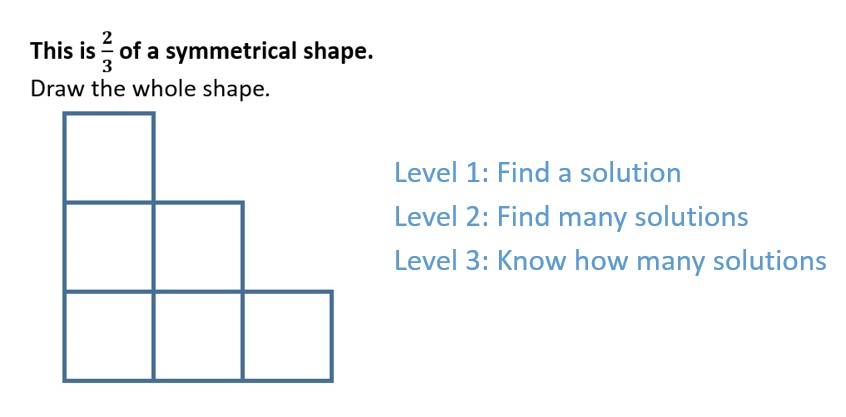
I hope to write a range of open, visual questions that allow children to explore maths ideas in depth. Questions a bit like this:
shape-two-thirds

I’m also planning on sharing lots of free resources, including (time permitting) videos for improving the quality of parent interaction in maths. Watch this space.

Training:
It’s a privilege being able to visit schools to share this passion. Here is the information about my training.

Conference events are scheduled for Manchester and Dudley with a KS2 focus. Expect future dates for bith KS2 and EYFS/KS1 training in the Spring and Summer terms. I am also soon to announce a 2-day training event in London (mid-November) and my first half-day TA training event in South Manchester.

Otherwise:
I’m totally committed to my 2 days teaching my amazing Y1 class this year: I hope they can learn as much from me as I will from them. I’m always happy to promote the good work of other people & look for ways to collaborate, so be in touch.

I’ve got more plans than time, and more ambition than realism, but hopefully in one way or another I can play my part in enriching primary maths. I will also keep posting as many bits as possible on my social media feeds in the distant hope that it will inspire someone somewhere.

Have a great 2016-2017 school year!

Questions and Images for Deepening, part 4

Each half-term I’ve been blogging questions and images used to deepen learning in maths (hope they’ve been useful). Next year I’m going to write a resource for each year group made up of lots of these types of questions. I hope they’ll be the ultimate ‘go to’ tool for building deep mathematical thinking into daily lessons, enabling teachers to stretch children’s thinking in all areas of the curriculum.

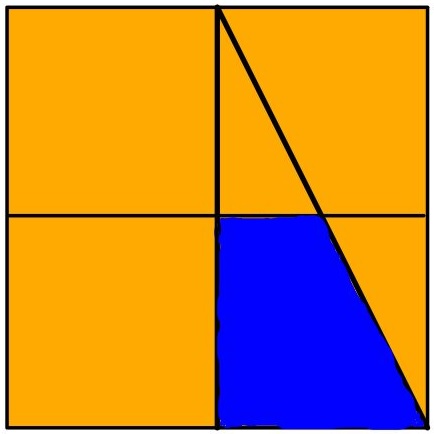
This half-term I’ve been mainly based in my class, so the questions here are primarily from year 6.  To begin with, finding the fraction of the shape that is blue where the shape is divided into differently sized pieces:
fraction shape

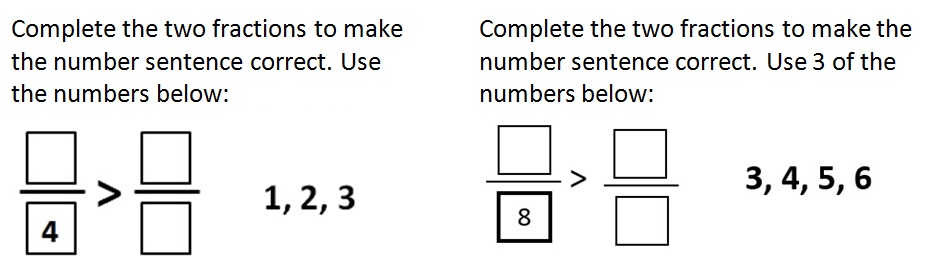
Then a question structure, used in two ways, that allows children to explore the size of fractions:
fractions qs

With negative numbers, we used spatial reasoning to estimate the size of the covered numbers:
-ve 1

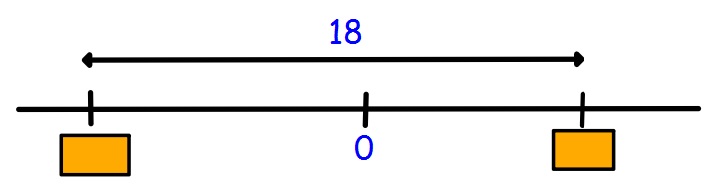
Here is a simple negative number question structure:
-18 difference 1

And a visual representation to provide a scaffold where necessary:
-18 difference 2

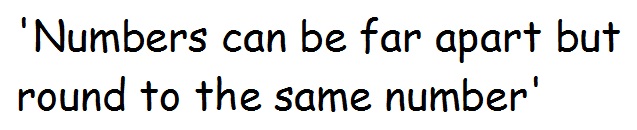
Looking at rounding numbers, here’s a simple statement that children can explore and exemplify:
Rounding 7

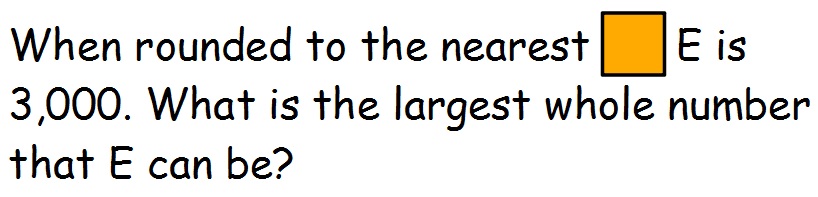
And another that leads to exploring patterns in rounding (adjust the number under the orange box):
Rounding 4

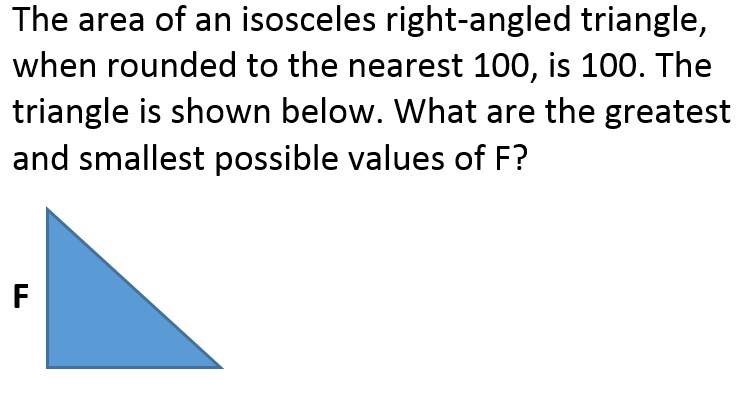
To deepen, a question drawing together an understanding of rounding and finding the area of a right-angled triangle:
Rounding 9

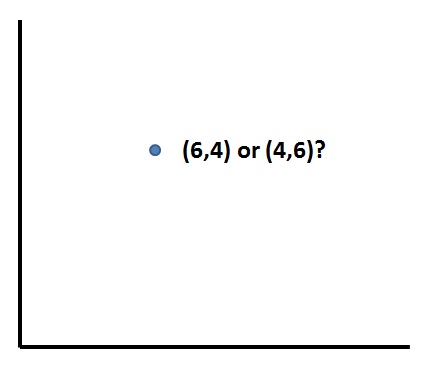
Finally, a question used in year 4 where spatial reasoning is used to identify a coordinate point:
Coordinates

This link gives information about the INSET training and school support that I can offer.

Improving reasoning at the point of answer

Here’s a simple, cost-free, whole-school idea for improving mathematical reasoning – when children give an answer to a question, don’t tell them (or infer to them) in that moment whether the answer right or wrong.

Here are two reasons. First of all, we want to communicate that what we value is children’s thinking, their justification, their strategy; not simply whether they have the correct answer. In doing so, especially when this is a whole-staff approach, I believe that children become less anxious about making mistakes.

Also, by creating a moment of doubt at the ‘point of answer’ we give children the space to check their thinking and explain their thought process. Generally speaking, the greater the child’s certainty, the greater the seed of doubt I try to plant. This can be great fun, and it certainly gives children an incentive to justify and explain.

I always liked Jo Boaler’s three levels of reasoning:

I can convince myself
I can convince a friend
I can convince a sceptic

And don’t be surprised if more able children can find it harder to explain their thinking in certain contexts. I remember Mike Askew saying that if children have found an answer without much of a ‘grapple’, they are likely to have almost automatised that thought process. This can make it harder (but still very important) for a child to explain their solution.

I hope this principle gives you many great classroom moments – it certainly has for me!


Introducing the Challenging Concept

In the process of learning, we are quite literally making links between, building on and extending what we already know. Our existing schemas are slowly being adapted in the light of new experiences. As such, when I’m trying to introduce a new mathematical concept – or when addressing a misconception – I often try to progress very slowly and explicitly between what children already know and what I want them to learn.

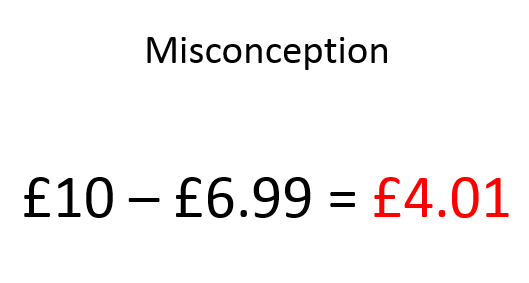
Below are two examples. In example 1 I look at addressing the misconception £10 – £6.99 = £4.01, and in example 2 at introducing letters to replace unknown numbers.

Example 1 – subtraction misconception:
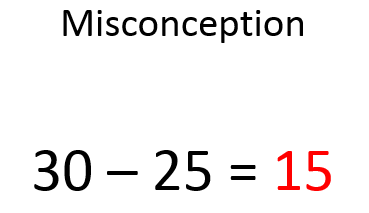
Ask the children to explain the misconception in red. How has the (fictitious) child ended up with this answer? How do you know this is incorrect?
Misc1

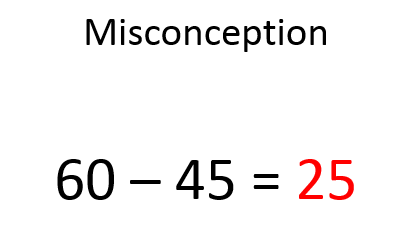
In my experience, children intuitively know that the answer is wrong, and with support can explain the misunderstanding. Then I make an exact copy of the screen, then subtly change the example:
Misc2
The process from before is repeated but using an example where the misconception is less glaring. Having discussed these two examples, with the key learning points unpicked, the children are now in a position to tackle the original misconception:
Misc3
Hopefully the children now have a deeper understanding of the link between addition and subtraction.

This structure can also be used when introducing a new concept. In example 2, I was moving the class on from calculating the inside and outside angles of a triangle to using letters to replace unknown numbers.

Example 2 – introducing algebraic notation:
By this point, the children had a secure understanding of how to find the two missing angles below.
Tri 1

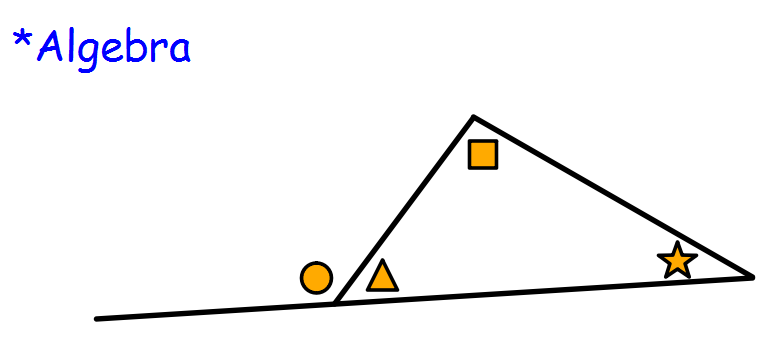
Again, I copy and pasted the screen and made small adaptations so that the angles were changed into shapes. The children were then asked to write number sentences using the shapes (I used shapes as a ‘bridging’ jump to using letters):
Tri 2

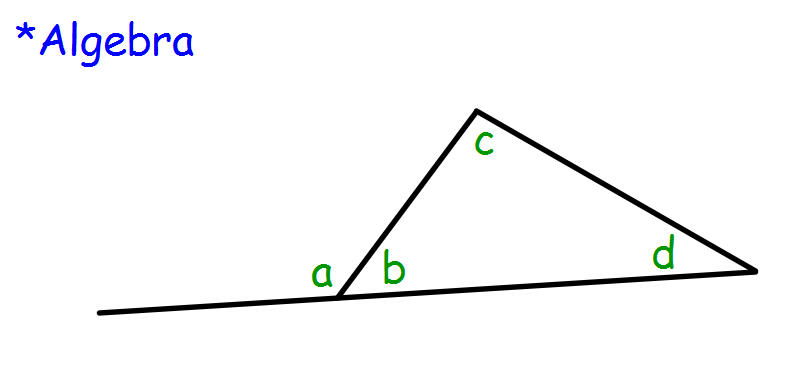
By the time the third image was introduced, the children were no longer overawed by the idea of using letters to represent unknowns:
Tri 3

Of course, with algebra there are lots of routes ‘in’ – I just found this one timely with the structure of our units of work.

Once concepts are more embedded, I would expect children to make wider and more advanced links between different areas of mathematics. But to introduce potentially challenging subjects, or as a means to address specific misconceptions, this ‘slow movement’ approach can be particularly effective.

A Shift in Primary Maths: England and America

It’s an interesting time to be involved in primary mathematics. In September 2014, at the same time as teachers in England were getting their heads around the changes to the curriculum, our colleagues in America were being asked to embrace a new, much-debated approach to teaching math – the Common Core State Standards.

The common core represented an idealogical shift in approach to math teaching in response to the criticism that American math curricula was ‘a mile wide and an inch deep’. Fundamentally, it was about making math a more conceptual, interconnected and deep subject, rather than a procedural one. The standards mandate that the following eight principles are taught:

IMG_0477.PNG

The changes to the maths curriculum in England were also built on an ideological shift to a ‘mastery’ curriculum, with  calculation concepts being developed through conceptual understanding, children able to reason mathematically and solve a range of problems. The parallels between the changes made in England and America were clear.

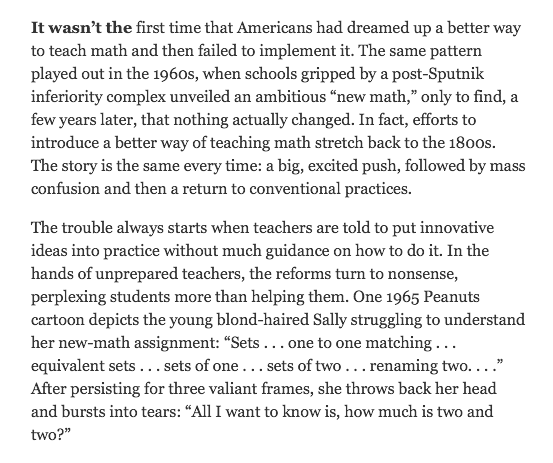
Will these curricula changes result in improved learning outcomes? Curriculum change is nothing new, as this article from the New Tork Times points out:

IMG_0478.PNG

If the reforms are to have a lasting and significant impact, I believe the following two points are crucial:

HOW > WHAT
Changing curriculum content rarely has a significant impact on attainment; improving teaching pedagogy, though, has much greater power. The launch of the new maths curriculum is therefore only the start of the change process – more significant are the processes that are put in place now to allow teachers to develop their teaching. The maths community needs to provide a clear and exciting vision for the new maths curriculum; there need to be better maths resources available, especially in relation to non-standard problems; and a culture of challenge and trust needs to be instilled between school leaders and staff to allow teachers to develop their practice. The process of implementing the new maths curriculum is very much in its infancy, and patience is needed. It needs to be brought to life for teachers in vivid colour.

CHANGING IDEOLOGIES
The alterations to the curriculum, both in America and in the UK, are designed to fundamentally change the perception of what mathematics is. We are selling a change in mindset, and as such a strong and convincing narrative must be provided if people are to understand and buy into this new philosophy. Children need to understand (and be able to articulate) what it means to think mathematically. Included in this is the fundamental belief that we all have the capacity to succeed in maths given the right experiences. All too often, children who have had fewer, or less effective, early maths experiences develop negative perceptions of mathematics and become labelled ‘lower ability’. The challenge for us all, therefore, is about how we ‘sell’ mathematics as well as how we teach it.

I hope that, as a profession, we can enable children to experience the true joy of mathematics, rather than the watered-down version that so many adults experienced in their own school days.

Cultural legacy and achievement in maths

This is an exciting time to be involved in maths education, with positive steps being taken to make the curriculum deeper and more conceptual. There’s also a growing awareness that children need to develop a positive self-concept of themselves  as mathematicians and problem-solvers. Our ambition to replicate the mathematical success of East Asian countries has been the driver behind these changes; without doubt there’s a lot that we can learn (and have learnt) from the teaching and learning of maths in these countries.

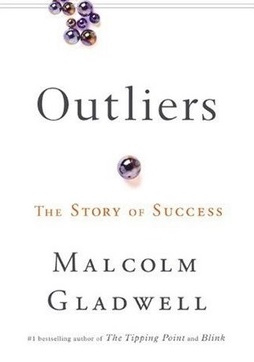
However, I believe that we can’t look at the success of these Asian nations in mathematics in isolation, without also considering the powerful influence of cultural norms within these countries. This was highlighted very thoughtfully by Malcolm Gladwell in Outliers, a book which studies the roots of success for individuals or groups of people whose achievements sit beyond normal parameters.

Outliers

Gladwell looked specifically at six nations whose results topped the TIMSS international comparison tests for maths – Singapore, South Korea, China, Taiwan, Hong Kong and Japan. Historically, the culture of these five nations were built, Gladwell described, by the tradition and legacy of wet rice agriculture.

Growing rice required extraordinarily precise management of a paddy: irrigation systems needed to be built; water levels had to be precisely managed; the ground must be perfectly flat; seedlings had to be planted and cultivated with great precision. The variability of a yield could be great, and it would be determined by the management of the rice paddy. Gladwell argued that it was this legacy – a culture rooted in the principle of hard, complex work leading to rich rewards – that has led to the phenomenal subsequent success of these Asian countries in mathematics. But how was Gladwell able to draw these conclusions based on the results from the TIMMS tests?

The TIMMS international comparison tests are long and tiresome, being made up of 120 questions. As part of this analysis, the number of questions completed by participants from each country was also analysed. The results were startling. There was an incredibly strong correlation between the number of questions attempted and mathematical attainment. In fact, the results were almost identical: countries with the most successful mathematicians were those who persevered for the longest when completing the test, and vice versa. The data suggested that the willingness to persevere was an unbelievably powerful predictor of success, specifically in maths.

And which countries’ students persevered for the longest? Those whose tradition and culture were shaped by the lessons of rice cultivation. This attitude is neatly exemplified by the Chinese proverb ‘If a man works hard, the land will not be lazy.’ And how richly this principle applies to success in mathematics.

We clearly have a lot to learn pedagogically from the highest performing nations in maths. Importantly, though, I believe that we must also become increasingly proactive in developing positive attitudes towards maths, even if it’s just within our own small circles. After all, we might not be able to control attitudes towards maths at a macro level – but we do have a powerful influence within our own schools. Ultimately, this is a critical factor in determining the extent of children’s achievement in mathematics.

The blog below shows how we have tried to develop a positive mathematical culture within our own school: https://garethmetcalfe.wordpress.com/2014/08/25/establishing-a-mathematical-culture/

Developing reasoning in daily maths lessons

The new maths curriculum requires children to become fluent with number whilst developing the ability to reason mathematically and problem-solve. To achieve this, children will need a broad range of mathematical experiences. Here, I will share a small piece of this jigsaw: how a ‘traditional’ maths lesson – a lesson aimed at developing fluency – can be tweaked to incorporate reasoning and problem-solving skills.

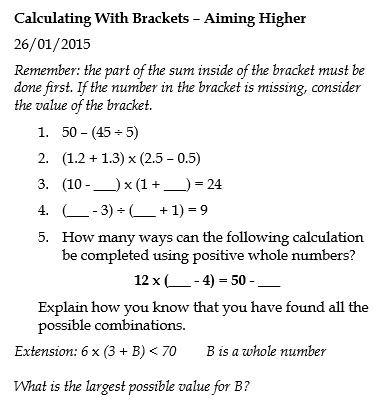
The procedural skill introduced in the lesson centred around the use of brackets. However, there are two fundamental mathematical principles that are also being developed here: the use of inverse, and the understanding of the = sign meaning ‘same as’ rather than ‘makes’. This is reflected by the questioning (mid level of difficulty) as shown below. There is a gradual progression in the structure and depth of the questions, challenging the children’s understanding of the concepts in a non-routine way.

Aiming HigherQuestion 5 is then used to extend the reasoning element by using the ‘how many ways?’ structure. This challenges the children to work systematically to find all possible solutions.

These principles can be used for children of all ages. For example, presenting subtraction calculations in the following order will encourage children to reason about the underlying structure of subtraction:

13 – 8

12 – 7

11 – 6

Equally, consider how the following equation helps a child to develop their conceptual understanding of multiplication and of the = sign:

4 x 5 = 4 + 4 + 4 + 8

Also, the ‘how many ways…’ question structure is enormously adaptable, allowing you to build reasoning into maths lessons on a daily basis. I hope it’s a little technique that some people may find useful!


The rounding question

Yesterday I presented some of the children in my class with this question:

The news reported today that 2000 people have contracted a rare tropical illness. This figure is known to have been rounded to the nearest 100 people. What is the largest possible number of people that could have the condition?

It was fascinating to see the thought progression that so many of the children went through. It looked something like this:

Preliminary idea (in some cases): 1900 or 2100
Idea 1: 1999
Realisation that you can go above 2000
Idea 2: 2040
Realisation that units column can increase
Idea 3: 2044
Realisation that the units column does not determine whether rounding up or down
Idea 4: 2049
Occasional error: 2049.999999
Awareness, in this context, that the answer must be whole number.

It was amazing to see how uniform this pattern of thinking was with different groups of children, particularly as children came to the counter-intuitive realisation that you have to find a number that will round down In order to find the maximum number of people.

There’s no place quite like the classroom!

Establishing a Mathematical Culture

How can we learn well in maths? Why do some people find mathematics difficult? What does it mean think and act like a mathematician? These are fundamental questions; the way children answer these questions will to a large extent determine their success as mathematicians. I believe, therefore, that we need to have a stronger dialogue with children about the learning process, specific to maths, that will encourage positive learning dispositions. This is what I call ‘Creating a Mathematical Culture’.

Becoming a successful mathematician is far from being a purely mechanical process. Many people (children and adults) are unable to fulfil their potential specifically because of their inability to deal with their emotional response to the challenge/threat posed by mathematics. The importance of mindset to learning outcomes in maths is supported by neuroscience, the analysis of PISA tests (see below) and, I dare say, the personal experience of many of our teachers.

IMG_0339.PNG

In my classroom, I aim to establish the following five principles at the start of the year. These are the tenants that I believe are important to building positive attitudes and habits in maths lessons:

IMG_0474.PNG

Firstly, the children must be convinced that by working hard they can develop their mathematical ability. Any notion that mathematical intelligence is genetically determined, or unchangeable, must be addressed.

In my maths training, I go into the detail of how I introduce these five principles to the children: what exactly each statement means, evidence to show the importance of each statement and how they can work in this way in daily maths lessons. These principles will be referred to, exemplified and celebrated constantly throughout the year, and no doubt amended also. They give the children the framework for thinking about the learning process in maths (metacognition), and critically help pupils to embrace challenge and learn from mistakes.

I also see my ‘Mathematical Culture’ as being like a promise that I am making to my class: that I am promising them a rich mathematical diet, set in a climate of support and trust. Not only is it a guide for the children, but it is a vision for me as a teacher: setting out explicitly what I value, and a standard that I will aspire to fulfil.