How can we learn well in maths? Why do some people find mathematics difficult? What does it mean think and act like a mathematician? These are fundamental questions; the way children answer these questions will to a large extent determine their success as mathematicians. I believe, therefore, that we need to have a stronger dialogue with children about the learning process, specific to maths, that will encourage positive learning dispositions. This is what I call ‘Creating a Mathematical Culture’.
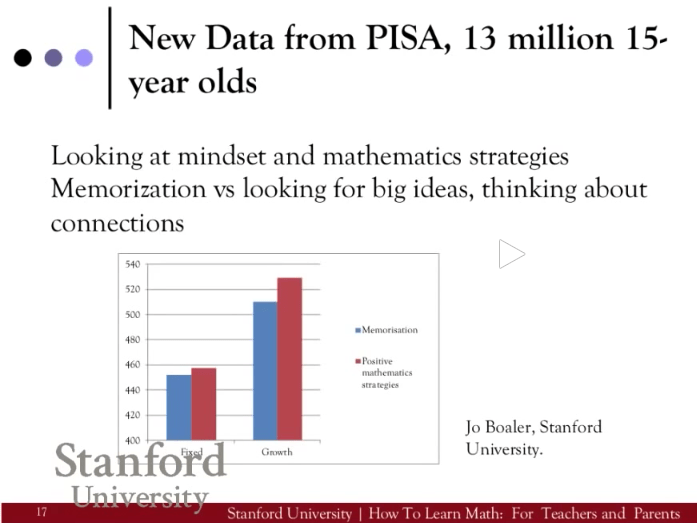
Becoming a successful mathematician is far from being a purely mechanical process. Many people (children and adults) are unable to fulfil their potential specifically because of their inability to deal with their emotional response to the challenge/threat posed by mathematics. The importance of mindset to learning outcomes in maths is supported by neuroscience, the analysis of PISA tests (see below) and, I dare say, the personal experience of many of our teachers.
In my classroom, I aim to establish the following five principles at the start of the year. These are the tenants that I believe are important to building positive attitudes and habits in maths lessons:

Firstly, the children must be convinced that by working hard they can develop their mathematical ability. Any notion that mathematical intelligence is genetically determined, or unchangeable, must be addressed.
In my maths training, I go into the detail of how I introduce these five principles to the children: what exactly each statement means, evidence to show the importance of each statement and how they can work in this way in daily maths lessons. These principles will be referred to, exemplified and celebrated constantly throughout the year, and no doubt amended also. They give the children the framework for thinking about the learning process in maths (metacognition), and critically help pupils to embrace challenge and learn from mistakes.
I also see my ‘Mathematical Culture’ as being like a promise that I am making to my class: that I am promising them a rich mathematical diet, set in a climate of support and trust. Not only is it a guide for the children, but it is a vision for me as a teacher: setting out explicitly what I value, and a standard that I will aspire to fulfil.


 Gareth Metcalfe Primary Maths