Cultural legacy and achievement in maths

This is an exciting time to be involved in maths education, with positive steps being taken to make the curriculum deeper and more conceptual. There’s also a growing awareness that children need to develop a positive self-concept of themselves  as mathematicians and problem-solvers. Our ambition to replicate the mathematical success of East Asian countries has been the driver behind these changes; without doubt there’s a lot that we can learn (and have learnt) from the teaching and learning of maths in these countries.

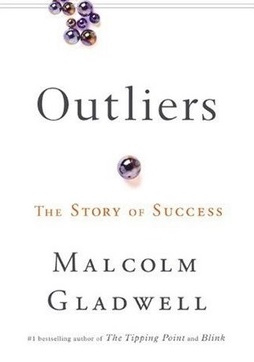
However, I believe that we can’t look at the success of these Asian nations in mathematics in isolation, without also considering the powerful influence of cultural norms within these countries. This was highlighted very thoughtfully by Malcolm Gladwell in Outliers, a book which studies the roots of success for individuals or groups of people whose achievements sit beyond normal parameters.

Outliers

Gladwell looked specifically at six nations whose results topped the TIMSS international comparison tests for maths – Singapore, South Korea, China, Taiwan, Hong Kong and Japan. Historically, the culture of these five nations were built, Gladwell described, by the tradition and legacy of wet rice agriculture.

Growing rice required extraordinarily precise management of a paddy: irrigation systems needed to be built; water levels had to be precisely managed; the ground must be perfectly flat; seedlings had to be planted and cultivated with great precision. The variability of a yield could be great, and it would be determined by the management of the rice paddy. Gladwell argued that it was this legacy – a culture rooted in the principle of hard, complex work leading to rich rewards – that has led to the phenomenal subsequent success of these Asian countries in mathematics. But how was Gladwell able to draw these conclusions based on the results from the TIMMS tests?

The TIMMS international comparison tests are long and tiresome, being made up of 120 questions. As part of this analysis, the number of questions completed by participants from each country was also analysed. The results were startling. There was an incredibly strong correlation between the number of questions attempted and mathematical attainment. In fact, the results were almost identical: countries with the most successful mathematicians were those who persevered for the longest when completing the test, and vice versa. The data suggested that the willingness to persevere was an unbelievably powerful predictor of success, specifically in maths.

And which countries’ students persevered for the longest? Those whose tradition and culture were shaped by the lessons of rice cultivation. This attitude is neatly exemplified by the Chinese proverb ‘If a man works hard, the land will not be lazy.’ And how richly this principle applies to success in mathematics.

We clearly have a lot to learn pedagogically from the highest performing nations in maths. Importantly, though, I believe that we must also become increasingly proactive in developing positive attitudes towards maths, even if it’s just within our own small circles. After all, we might not be able to control attitudes towards maths at a macro level – but we do have a powerful influence within our own schools. Ultimately, this is a critical factor in determining the extent of children’s achievement in mathematics.

The blog below shows how we have tried to develop a positive mathematical culture within our own school: https://garethmetcalfe.wordpress.com/2014/08/25/establishing-a-mathematical-culture/

Developing reasoning in daily maths lessons

The new maths curriculum requires children to become fluent with number whilst developing the ability to reason mathematically and problem-solve. To achieve this, children will need a broad range of mathematical experiences. Here, I will share a small piece of this jigsaw: how a ‘traditional’ maths lesson – a lesson aimed at developing fluency – can be tweaked to incorporate reasoning and problem-solving skills.

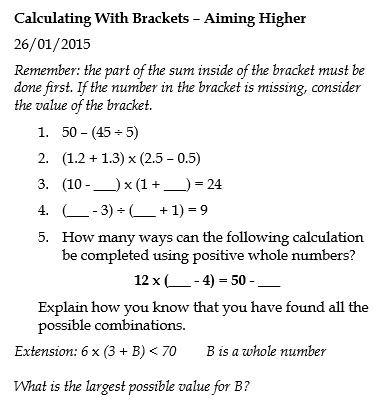
The procedural skill introduced in the lesson centred around the use of brackets. However, there are two fundamental mathematical principles that are also being developed here: the use of inverse, and the understanding of the = sign meaning ‘same as’ rather than ‘makes’. This is reflected by the questioning (mid level of difficulty) as shown below. There is a gradual progression in the structure and depth of the questions, challenging the children’s understanding of the concepts in a non-routine way.

Aiming HigherQuestion 5 is then used to extend the reasoning element by using the ‘how many ways?’ structure. This challenges the children to work systematically to find all possible solutions.

These principles can be used for children of all ages. For example, presenting subtraction calculations in the following order will encourage children to reason about the underlying structure of subtraction:

13 – 8

12 – 7

11 – 6

Equally, consider how the following equation helps a child to develop their conceptual understanding of multiplication and of the = sign:

4 x 5 = 4 + 4 + 4 + 8

Also, the ‘how many ways…’ question structure is enormously adaptable, allowing you to build reasoning into maths lessons on a daily basis. I hope it’s a little technique that some people may find useful!


Can education learn from memory champions?

Three and a half years ago I was given a book, ‘Moonwalking with Einstein’, as a leaving present from a year 6 child who knew me too well.

IMG_0937.PNG

It chronicles the journey of Joshua Foer, a journalist who became fascinated in the seemingly inhuman achievements of the world’s greatest memory champions. He met serial competitor Ed Cooke, who was convinced that by learning well known memory techniques, and with high quality practice, Josh himself could become a memory champion. Within a year, Josh was transformed from a journalist (with a distinctly average memory) to the U.S. Memory Champion.

The book explains that we can all vastly improve our ability to memorise by converting information into vivid, personal and most importantly visual images. By characterising inanimate objects and information, and visualising these images in familiar settings – memory palaces – we can recall vastly more information.

I trialled these techniques by memorising a 15-item shopping list that my wife wrote during a long motorway journey. I imagined each item being used in various unusual ways during my mother’s 50th birthday party at my childhood family home. More recently, I was able to memorise my class register by picturing the children doing various unusual things in different places within the school.

Without doubt, these memory techniques (essential skills in the ancient world before the widespread use of reading and writing) are freakishly effective for improving our ability to recall information. This leads to the inevitable questions: should these techniques be being taught in schools? And are there other principles from memory training that have an application within education? The techniques are excellent for memorising vast amounts of information, out of context and without understanding. Is there any place for this kind of learning within our schools?

Research indicates that learning is optimised when it encompasses lower and higher order levels of thinking. Deep learning is enriched by having a knowledge of basic facts and ideas, and vice versa. For example, knowing a range of historical facts enriches deep thinking and learning, which in turn makes information more memorable. Therefore, by giving children a powerful tool for memorising basic information, perhaps their learning outcomes could improve.

I believe that this book highlights the importance of being able to represent concepts and ideas in visual forms. Also, I believe that there are huge benefits from children having a better understanding and experience of how we learn. I have had great fun with my class (and in an assembly) creating memory palaces. I suspect that these techniques could, given consideration about their use, be used to improve learning outcomes for many children.

My favourite properties of number question

‘Do all odd square numbers greater than 1 have 3 factors?’

I love this question. Let me explain why, and the train of thought that it can generate.

Children usually start by generating the odd square numbers, identifying that square numbers have an odd number of factors (1, the number and the square root). This helps to underline the uniqueness of square numbers. Nothing new here, really.

So children tend to identify the first two or three odd squares greater than one (9, 25 and 49) and realise that these numbers only have 3 factors. This, I tend to find, is enough evidence to convince most children that the answer to the question must be ‘yes’.

However, this is of course a false presumption, and by making it children realise a crucial mathematical principle: that finding examples to support a theory is not the same as finding a proof. There must be reasoning as well as examples to generate a proof!

So I then ask the children to consider 81. And they soon realise that it is also divisible by 3. What’s happened to the pattern? And why?

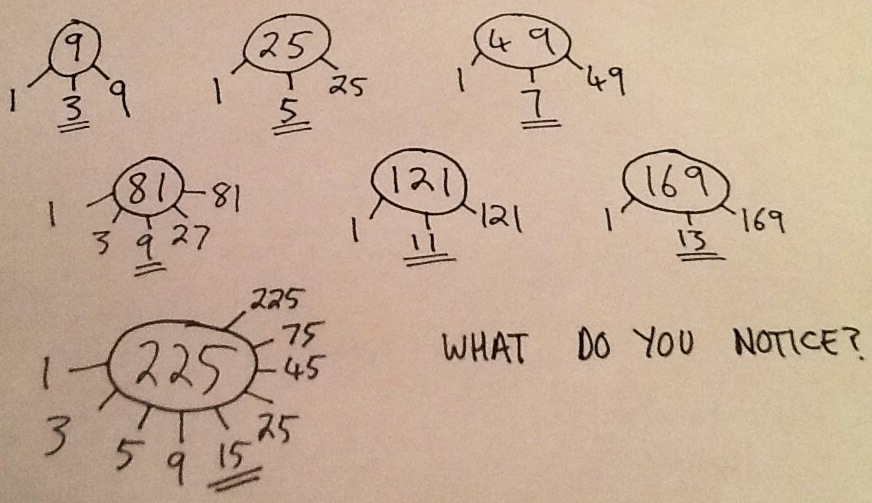
Children then investigate further examples, noting that 5 of the first 6 odd square numbers greater than 1 (9, 25, 49, 121, 169) have only 3 factors. But then 225, the square of 15, has 9 factors! There must be some logic here, and of course there is. I ask the children to consider the square roots of each number, as underlined below:

IMG_0647.JPG

After much discussion and deliberation, and a healthy dollop of struggle, someone makes the breakthrough: the numbers with prime square roots have 3 factors; other numbers can be further divided by the factors of the square.

But does this pattern continue for all odd squares? And why was 1 excluded from the list?

It’s an amazing question for exploring the very nature of the properties of number, and particularly primes and squares. And, in my opinion, for experiencing the joy and beauty of mathematics!

The rounding question

Yesterday I presented some of the children in my class with this question:

The news reported today that 2000 people have contracted a rare tropical illness. This figure is known to have been rounded to the nearest 100 people. What is the largest possible number of people that could have the condition?

It was fascinating to see the thought progression that so many of the children went through. It looked something like this:

Preliminary idea (in some cases): 1900 or 2100
Idea 1: 1999
Realisation that you can go above 2000
Idea 2: 2040
Realisation that units column can increase
Idea 3: 2044
Realisation that the units column does not determine whether rounding up or down
Idea 4: 2049
Occasional error: 2049.999999
Awareness, in this context, that the answer must be whole number.

It was amazing to see how uniform this pattern of thinking was with different groups of children, particularly as children came to the counter-intuitive realisation that you have to find a number that will round down In order to find the maximum number of people.

There’s no place quite like the classroom!

Books as context for maths

I recently tweeted a request for people to let me know about books that they have used as a context for maths with nursery, reception and KS1 children. The response was fantastic, thanks to everyone who replied. Here is the final list:

None the Number, a counting adventure
The Hungry Caterpillar (the most mentioned book)
A Place for Zero
How Big is a Million
Ladder to the Moon
Guess How Much I Love You (I read this book to my 2 y-o daughter!)
Ten on the Sled
One is a snail, ten is a crab
Benny’s Pennys
Ten Black Dots
Jim and the Beanstalk
George’s Marvellous Medicine
Dear Zoo
Kipper’s Birthday
Percy the Park Keeper (series)
Farmer Duck
Goldilocks
Jasper’s Beanstalk
We’re going on a bear hunt
Six Dinner Did
Bad Tempered Ladybird
The Great Pet Sale
Titch
You’ll Soon Grow Into Them

Again, a huge thanks to everyone! I will try to tweet about how these books get used in my school. It shows the power of twitter as an ideas-sharing forum; it’s great to be linked up with so many passionate, knowledgeable people!

Establishing a Mathematical Culture

How can we learn well in maths? Why do some people find mathematics difficult? What does it mean think and act like a mathematician? These are fundamental questions; the way children answer these questions will to a large extent determine their success as mathematicians. I believe, therefore, that we need to have a stronger dialogue with children about the learning process, specific to maths, that will encourage positive learning dispositions. This is what I call ‘Creating a Mathematical Culture’.

Becoming a successful mathematician is far from being a purely mechanical process. Many people (children and adults) are unable to fulfil their potential specifically because of their inability to deal with their emotional response to the challenge/threat posed by mathematics. The importance of mindset to learning outcomes in maths is supported by neuroscience, the analysis of PISA tests (see below) and, I dare say, the personal experience of many of our teachers.

IMG_0339.PNG

In my classroom, I aim to establish the following five principles at the start of the year. These are the tenants that I believe are important to building positive attitudes and habits in maths lessons:

IMG_0474.PNG

Firstly, the children must be convinced that by working hard they can develop their mathematical ability. Any notion that mathematical intelligence is genetically determined, or unchangeable, must be addressed.

In my maths training, I go into the detail of how I introduce these five principles to the children: what exactly each statement means, evidence to show the importance of each statement and how they can work in this way in daily maths lessons. These principles will be referred to, exemplified and celebrated constantly throughout the year, and no doubt amended also. They give the children the framework for thinking about the learning process in maths (metacognition), and critically help pupils to embrace challenge and learn from mistakes.

I also see my ‘Mathematical Culture’ as being like a promise that I am making to my class: that I am promising them a rich mathematical diet, set in a climate of support and trust. Not only is it a guide for the children, but it is a vision for me as a teacher: setting out explicitly what I value, and a standard that I will aspire to fulfil.