Imagine this: you are asked to describe the strengths that the children in your school have as mathematicians. You say ‘they are brilliant at understanding and answering word questions!’ When asked to elaborate, you say ‘the children read questions carefully and pick out the important information.’ Or perhaps ‘the children are great at spotting multi-step questions.’ Maybe even ‘they show their understanding in different ways.’
In reality, so many children struggle to answer multi-step or non-standard word questions. So how do we go from giving children word questions to teaching all children to answer word questions? What does a consistent approach look like?
This has become my mission. For the last 3 years, I have been writing Deconstructing Word Questions for Y2 – Y6. Each task has been trialled in a number of different schools, being honed with the help of some amazing teachers. The eBooks are on sale here.
The golden thread that runs through every technique, every activity, is focusing children’s thinking on the deep structure of each question. It is about taking the attention away from calculating answers to understanding the steps involved. Here are four ways that this is achieved.
1. Slowly revealing information in questions
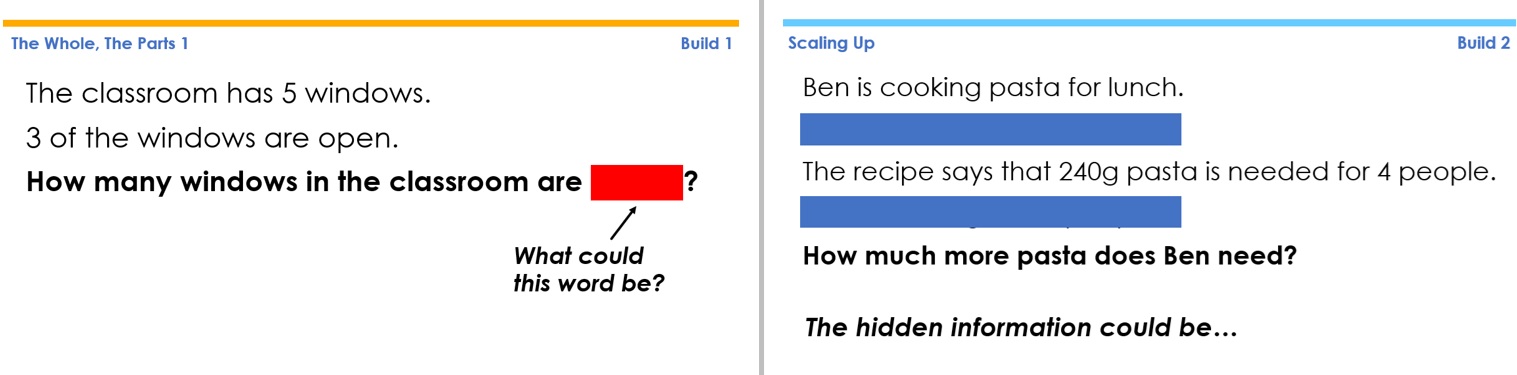
Children predict what the hidden words/information could be, as in the examples below (Y2 and Y5). Then, the information is revealed. This means children have thought about the structure of the question before they answer the question.
2. Using equipment or bar models
Sometimes, children are asked to represent questions with counters. Sometimes, children are asked ‘which bar model represents the question?’ (left-side example, Y3). For some questions, children are given part-complete bar models to fill which act as a scaffold (right-side example, Y4).

3. ‘Minimally different’ questions
Children analyse pairs of questions that are very subtly different. The children look at how the questions are the same/different. This helps children notice the subtle but all-important differences in the wording of questions (left-hand example, Y2). This variation is used in the questions that children answer (right example, Y3).

4. Depth
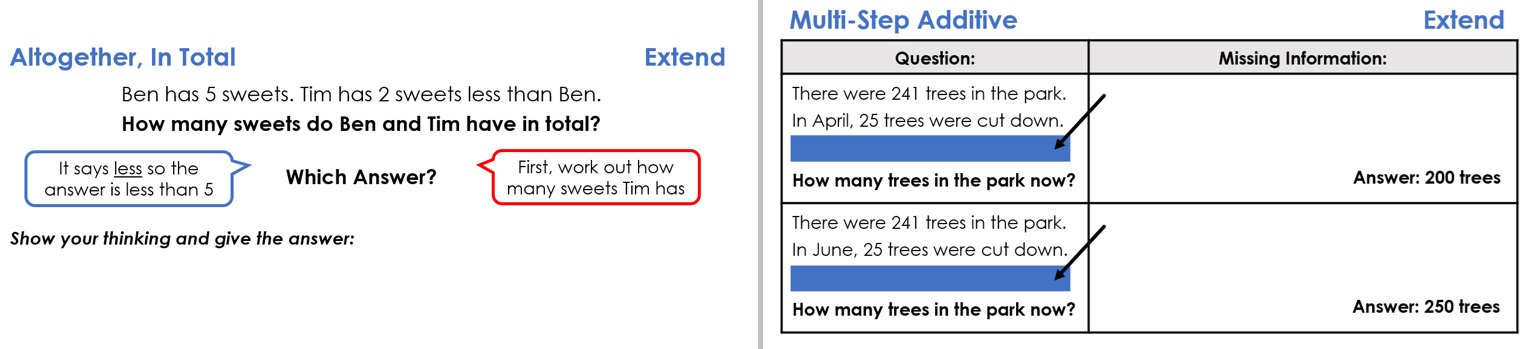
Lots of techniques are used to extend children’s thinking. This includes explaining which approach is correct (left example, Y2) or in giving the information that is missing in a question (right example, Y4).
There is a trial task for each year group to try out. Click on the links below for the resources and for the short ‘how to’ video:
Deconstructing Word Questions – Y2
Deconstructing Word Questions – Y3
Deconstructing Word Questions – Y4
Deconstructing Word Questions – Y5
Deconstructing Word Questions – Y6
The Vision: Building Problem-Solvers maps out a holistic vision for building children as problem-solvers. There are 10 videos to exemplify the key principles shared.
I hope Deconstructing Word Questions helps many children to grow as mathematical problem-solvers.
 Gareth Metcalfe Primary Maths