
Online Training: the present and the future

From next week, I will run my first online training sessions for teachers  – it will be great connecting with educators again! Initially there are four different training events, each with 10am and 7:30pm sessions, so everyone can join in. I’m really excited to explore the opportunities that online CPD can provide.

Sessions will be 90 minutes long, with perhaps 60-70 minutes of content and 20-30 minutes of Q&A and discussion to unpick the themes of the training. This will give us time to explore key ideas in depth whilst leaving participants with a manageable number of take-aways. Future sessions will then develop these themes further. I hope that teams of people join in so they can work alongside their colleagues to implement the ideas.

I’ve already run five parent sessions on Zoom: I’m slowly learning to navigate the technology! So far, everything that can be shown at a training event can also be shown online. And with the ongoing chat and Q&A features, people have been able to interact well and ask questions as we go.
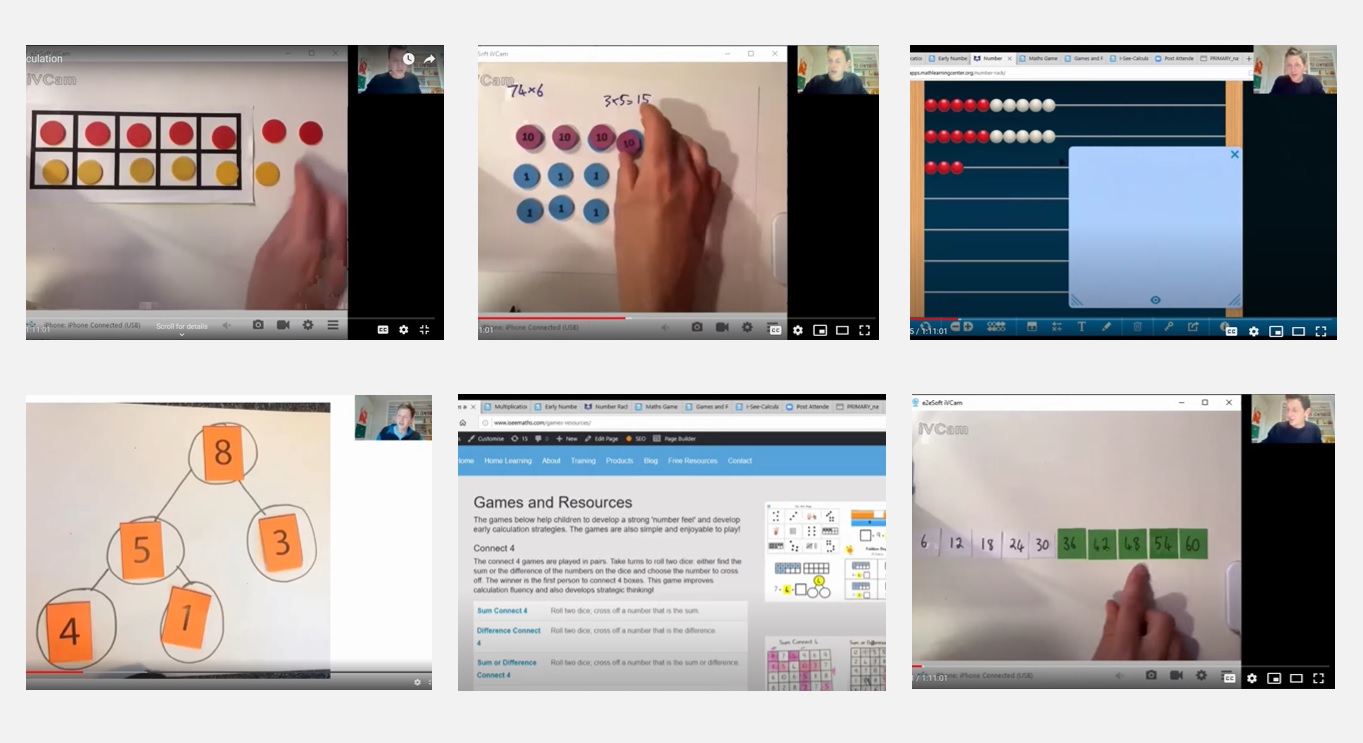
I’m particularly looking forward to the ongoing dialogue that will be created with myself and between participants both during and after. With people joining in from diverse settings, including teachers from overseas, we will learn a lot from each other! As the online training develops, I intend to run a wider variety of sessions and to build future training around the areas that people want to explore further. Sessions can be targeted to specific year groups, topics or aspects of teaching. Online training brings cost and time efficiencies. A recording can be viewed by participants afterwards too.

This form of training is new to me. I’d love to get your ideas on how I can expand or improve my online CPD offering (email iseemaths@hotmail.com). This could be about the logistics of accessing sessions, thoughts on the content of training or anything else. At what time would you like sessions to run? What would your dream course title be? And how can we ensure that the impact continues long after the sessions? I would absolutely welcome your feedback. I will plan my training sessions for May soon.

I also regularly send out resources for teachers to trial to people on my mailing list so that I can get teachers’ feedback on my products as they are being written. At the moment I’m writing three new resources. I’m planning to run some free sessions in May where I’ll show some of these resources and ask for people to say what they like and what they would add/change. I’d love to get as many people joining in with these sessions as possible. The more viewpoints I can get the better!

I can’t wait to get started. Hopefully you’ll join me!
Gareth

Click here to book and for full details about April online training.

A career of improving teaching skills

Over the summer I read ‘Peak’ by Anders Ericsson, a fascinating book that examines the training that leads to expert performance in various fields. Ericsson studied world class performers (chess players, musicians, sportspeople, doctors etc) and describes the ‘deliberate practice’ that they have engaged in to develop their skill.

Ericsson argued that once we have achieved competence in something, simply ‘doing it more’ rarely leads to improved performance. Instead, a tennis player practises by hitting hundreds of backhands from kicking serves; chess masters train by studying key moves from previous games; a radiologist looks at difficult-to-interpret scans from previous cases to improve their diagnoses.

With my teacher hat on, I took away two main reflections from this book:

1. Focus on improving one small aspect of my teaching at a time
Teaching is wonderfully complex. So many things can affect the success of a lesson – there are so many variables! At any one time, though, I try to have one very specific thing that I focus on improving, and spend an extended period of time developing that one skill.

I remember once focusing for a half-term on having the best possible routine during the morning register. I analysed everything, from the logistics of my classroom layout to the little games and activities that were provided for the children. I would secretly time how long it would take children to be settled, pick through how children engaged with our little morning tasks and constantly make small tweaks to that part of the day. In 6 weeks I had a routine that I used successfully (without much further thought) for many years.

2. When making changes to my teaching, seek specific feedback
I love reading research and getting new ideas. When I first try out a new technique, it’s common that my first attempt(s) don’t go that well. For example, after reading ‘How I Wish I’d Taught Maths’ (Craig Barton) I tried out using ‘hinge-point’ questions as short mid-lesson assessments. At first I wasn’t skilled at exactly when/how to use these questions. I’d always arrange for another teacher to be in my class at those moments (even for just 5 minutes) so after we could unpick what worked and what could be improved.

Equally, I remember my first term in year 1. I would plan lessons with my partner Y1 teacher, but knew that her class were getting better outcomes from those lessons than mine. I learnt so much from popping my head in her classroom and watching what she was doing differently to me at specific moments. Or let’s say my focus is on the engagement of a target group of children during the plenary. I might use a TA to make specific observations about the actions of those children so I have better feedback on the success of a particular approach.

By constantly making small improvements to specific parts of my teaching, I hope that in 20 years’ time I will still be getting a bit better at doing my job every day!

All-New CPD for 2018!

I’m delighted to announce a new range of maths CPD opportunities available for 2018, all with the aim of making my work high-impact and as cost-efficient as possible.

I’m particularly excited to advertise my teaching and staff training days support. Here, I am proposing coming into schools and teaching up to three example lessons per day, allowing teachers to see visual, deep maths learning in action! I would also, if requested, run a staff meeting after school.

I’ve found that my training has had the greatest impact where schools have been immersed in a combination of example lessons and training, so I’m delighted to be able to make this offer. Not that I can promise perfect lessons: I’m very happy, though, for people to learn from both my successes and my failures in the classroom!
Click here for more details about in-school support

Over the last four years I have ran a series of conference training events. However, with school budgets increasingly tight (and the cost of hiring venues becoming increasingly expensive), this no longer seems like a cost-efficient way of delivering training. Instead, I’m looking for schools, teaching schools and organisations that would like to host a conference. This will minimise costs, especially for the host school/organisation.
Click here for more details about hosting a conference

I’m also looking forward to running more whole-school INSET and twilight training events, giving schools a collective, exciting vision for developing rich maths learning experiences. The new pricing structure discounts training for smaller schools and provides significant discounts for cluster training events.
Click here for more details about INSET & Twilight training

At the time of writing I have space for eight more bookings this school year (one day left in May, three in June, four in July) then I am taking bookings for 2018-2019.

I love my work. I teach more maths lessons than ever, meet more passionate teachers every week and have plans to create so many more new resources. I hope, in one way or another, I can help you to deliver great maths lessons!

For more information, email gareth.metcalfe@hotmail.co.uk