I See Reasoning – Y1 and Y2: Exploring Concepts, Creating Reasoning Habits

We want KS1 children to develop a deep understanding of Y1 & Y2 maths content. We also want young children to be able to explain their thinking, identify common errors, estimate, explore ideas and think creatively. The tasks in the I See Reasoning – Y1 and I See Reasoning – Y2 eBooks help to give children these experiences, inspiring a wide range of mathematical conversations and explorations.

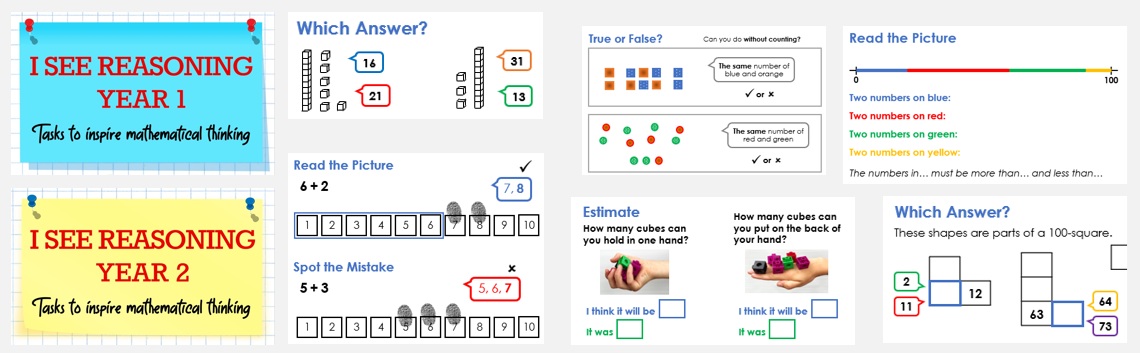
These new eBooks have replaced I See Reasoning – KS1. They follow the same format as the original eBook, but include many, many more examples (365 tasks in the Y1 eBook and 392 tasks in the Y2 eBook) and they have a range of new types of reasoning questions. Here are some of the key ideas:

Non-counting strategies, estimation, reasoning

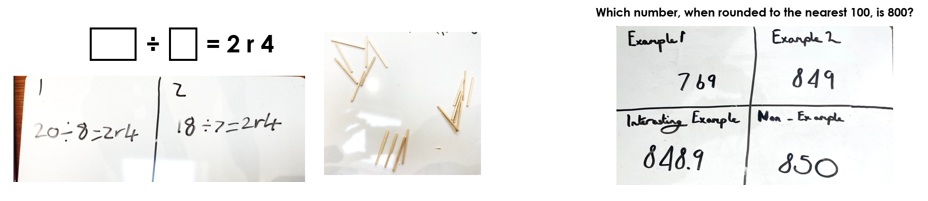
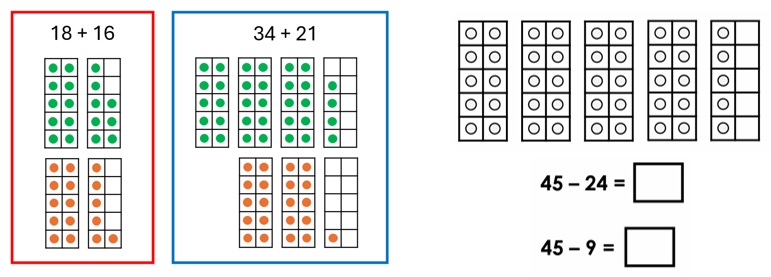
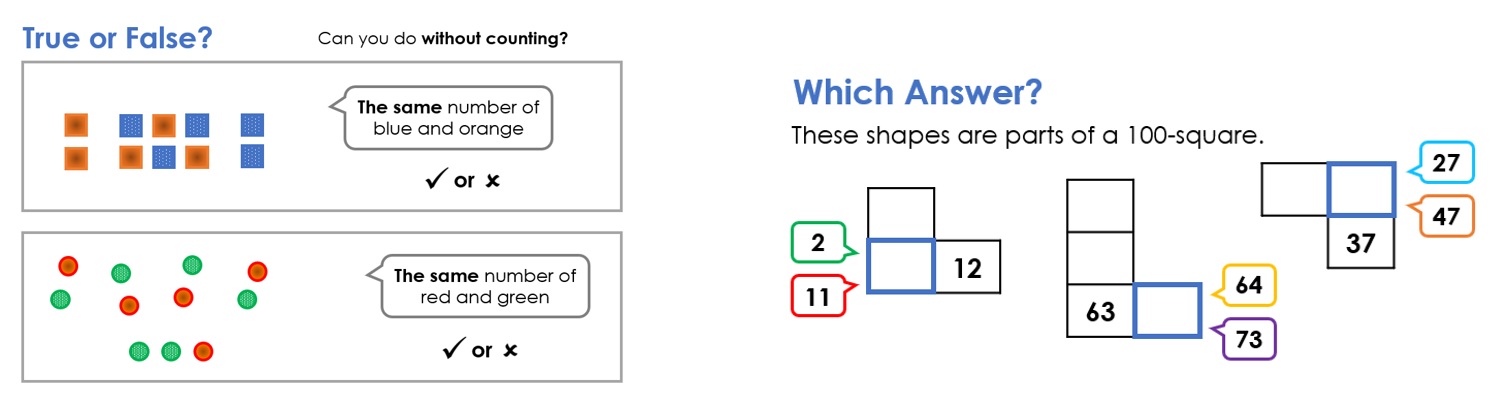
A HUGE focus is placed on children explaining answers using non-counting strategies. This includes ‘how many dots’ questions, where children describe their non-counting strategies. It involves calculations that border 10 or subtractions with small differences. The emphasis is not ‘what’s the answer?’ but instead ‘how did you know?’ or ‘what do you visualise?’ The questions are highly visual and don’t require too much reading.

Misconceptions, visuals, patterns

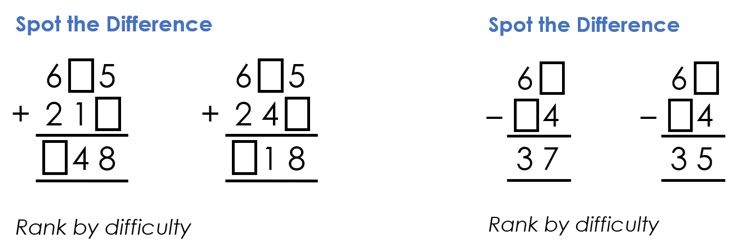
The questions introduce the key I See Reasoning question structures. Children will learn to spot mistakes, explain mistakes, compare questions and spot patterns. They will be challenged to explain what they noticed and find all of the answers. In doing so, children will be trained in the routines of thinking mathematically, routines that can be extended in KS2. This will help to build reasoning tasks into every maths lesson, giving schools a progressive approach to how reasoning is taught.

Exploration

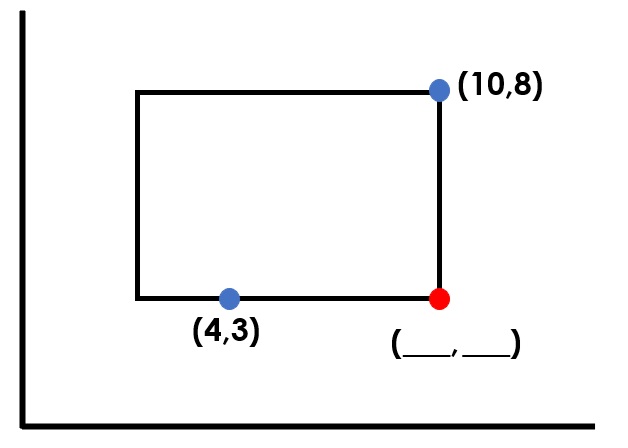
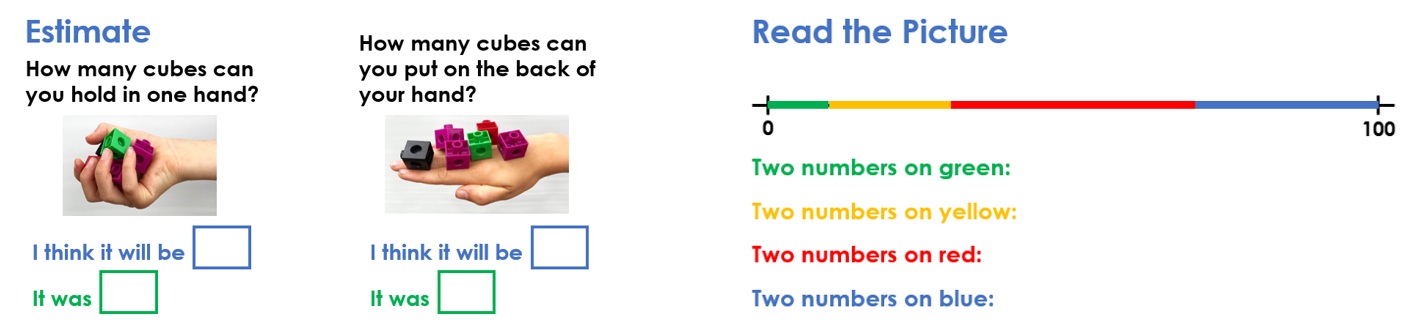
There are lots of questions, of many different forms, for exploring mathematics. This includes estimation tasks, open challenges or questions with different possible answers. There are also a range of spatial reasoning tasks, for children being able to visualise items from different perspectives.

Depth

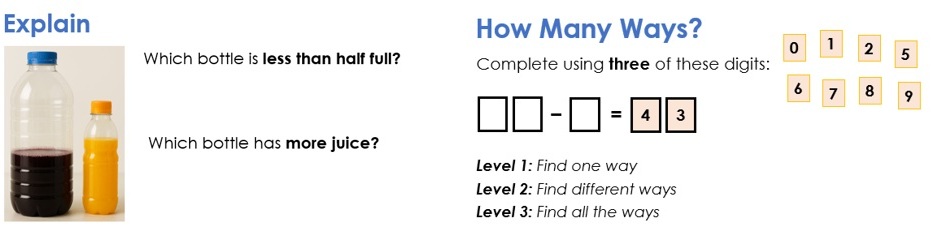
There are also a wide range of tasks to add challenge! These are very diverse and sometimes require children to find multiple answers or explain their thinking. These tasks are highly varied depending on the area of the maths curriculum that they cover.

The introductory price of the eBooks is £30 each (including VAT). From 1st January 2026, they will cost £35 each (including VAT).

I See Reasoning – Y1 and I See Reasoning – Y2 lay the foundations for children to experience maths as a thinking, exploring, explaining subject. If you click on the links, you can view a sample section of each resource. I hope that they inspire the children in your class and give you many fantastic classroom moments!

The New Deconstructing Word Questions – Y6

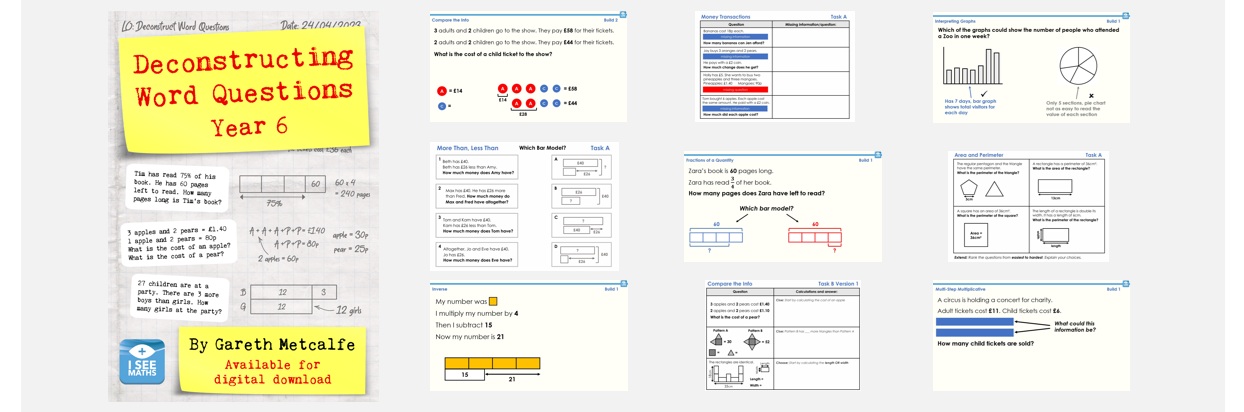
The updated version of Deconstructing Word Questions – Y6 is now completed! Full information about the resource, including a free sample task, can be found here. It provides a coherent, detailed approach to teaching children to answer word questions and gives a wide range of thought-provoking challenges.

This resource has been re-released in April 2025. If you purchased the original resource, you can have this new version for free! Just email iseemaths@hotmail.com and attach the original version of the resource (as proof of purchase) or give the order number for your original order. Then, we will reply by sending you the new resource.

Why has the resource been updated and re-released?
Since writing the original version, I have written Deconstructing Word Questions resources for Year 2, Year 3, Year 4 and Year 5. All of these resources followed a specific lesson structure:
Build 1 – teaching prompts
Task A – pair discussion task
Build 2 – teaching prompts
Task B (Version 1 and 2) – questions
Extend – deeper challenge
I have re-written the year 6 resource so that it also follows this lesson structure. This means that the resources give a totally consistent whole-school approach to teaching children to answer word questions. This video shows how the resources can be used to teach a lesson:

I want schools to have a whole-school vision for teaching children to answer multi-step word questions. Therefore, I am running 90-minute online INSET sessions on 1st and 2nd September to communicate this vision. It would be great to have you involved!

The ability to answer word questions is one part of how we can build children as mathematical problem-solvers. The full vision, including detailed guidance and video exemplification, can be found on this page. I believe it gives a practical, exciting vision for how we can build all children as mathematical problem-solvers!

Deconstructing Word Questions: the vision

Imagine this: you are asked to describe the strengths that the children in your school have as mathematicians. You say ‘they are brilliant at understanding and answering word questions!’ When asked to elaborate, you say ‘the children read questions carefully and pick out the important information.’ Or perhaps ‘the children are great at spotting multi-step questions.’ Maybe even ‘they show their understanding in different ways.’

In reality, so many children struggle to answer multi-step or non-standard word questions. So how do we go from giving children word questions to teaching all children to answer word questions? What does a consistent approach look like?

This has become my mission. For the last 3 years, I have been writing Deconstructing Word Questions for Y2 – Y6. Each task has been trialled in a number of different schools, being honed with the help of some amazing teachers. The eBooks are on sale here.

The golden thread that runs through every technique, every activity, is focusing children’s thinking on the deep structure of each question. It is about taking the attention away from calculating answers to understanding the steps involved. Here are four ways that this is achieved.

1. Slowly revealing information in questions
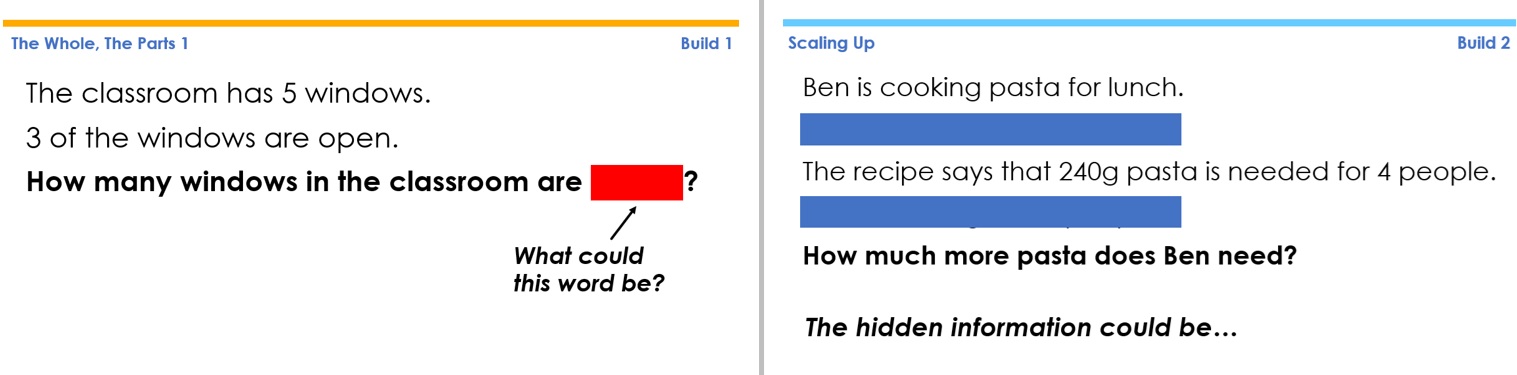
Children predict what the hidden words/information could be, as in the examples below (Y2 and Y5). Then, the information is revealed. This means children have thought about the structure of the question before they answer the question.

2. Using equipment or bar models
Sometimes, children are asked to represent questions with counters. Sometimes, children are asked ‘which bar model represents the question?’ (left-side example, Y3). For some questions, children are given part-complete bar models to fill which act as a scaffold (right-side example, Y4).


3. ‘Minimally different’ questions
Children analyse pairs of questions that are very subtly different. The children look at how the questions are the same/different. This helps children notice the subtle but all-important differences in the wording of questions (left-hand example, Y2). This variation is used in the questions that children answer (right example, Y3).


4. Depth
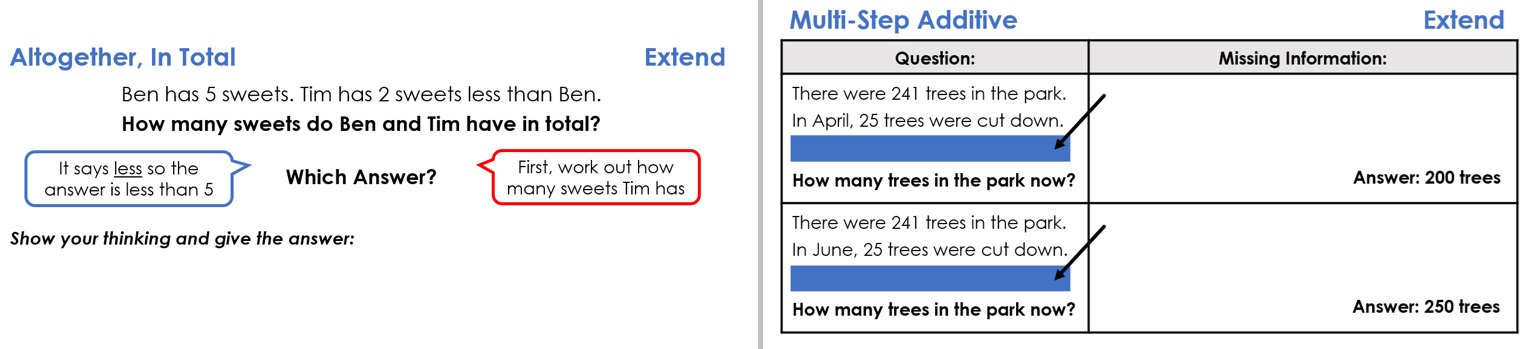
Lots of techniques are used to extend children’s thinking. This includes explaining which approach is correct (left example, Y2) or in giving the information that is missing in a question (right example, Y4).


There is a trial task for each year group to try out. Click on the links below for the resources and for the short ‘how to’ video:
Deconstructing Word Questions – Y2
Deconstructing Word Questions – Y3
Deconstructing Word Questions – Y4
Deconstructing Word Questions – Y5

Deconstructing Word Questions – Y6

The Vision: Building Problem-Solvers maps out a holistic vision for building children as problem-solvers. There are 10 videos to exemplify the key principles shared.

I hope Deconstructing Word Questions helps many children to grow as mathematical problem-solvers.

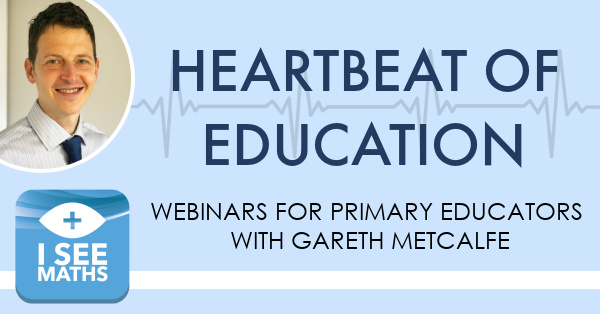
Heartbeat of Education Webinar Series

I’m delighted to announce the launch of the Heartbeat of Education Webinar Series. In these free webinar sessions, held fortnightly on Thursdays at 6-7pm via Zoom, I will host discussions between a panel of experts on some of the most pressing issues in Primary education.

There’s a specific agenda for each session and the four panellists will hold discussions that that will be relevant for teachers, school leaders and parents alike.

I can’t wait to introduce you to the panellists: they are people I have been challenged and inspired by in my 15 years in Primary education. Whilst we are being joined by top authors and esteemed professors, panellists also include some of the UNSUNG HERO teachers, headteachers and home-school mothers that I have learnt so much from. They are wonderful people, the kind of people who you want by your side in the middle of a challenge! And they all bring very different skills and experiences.

More than anything, we want to interact with YOU. We want to understand your challenges, respond to your needs and engage in a personal, practical way. We want our exchanges to be honest and meaningful. You are very welcome to join the sessions and observe in the background. But you are invited to become an active partner as we work through these issues. That’s why I’m so excited about this format!

Click on the links below to register for the free sessions:
Heartbeat of Education: Leading Emotionally Healthy Schools and Homes in a Pandemic, Thursday 25th February, 6pm-7pm
In this webinar, a panel of leading thinkers, school leaders and parents talk about how we can best support the emotional wellbeing of the children and staff in our care. We will have a 360 degree look at the different challenges that children have faced during the pandemic and how, as educators, we can respond in 2021. With author, educational researcher and leader Emma Turner, headteacher of two schools Mandy Jones and inspirational home-school mother of six children Katy Nyman.

Heartbeat of Education: How Expert Teachers Will Rebuild Mathematical Understanding, Thursday 11th March, 6pm-7pm
In this webinar we will consider how primary teachers can best rebuild children’s mathematical understanding when schools reopen to lay the foundations for long-term success. We will discuss how lesson design, planning and teaching pedagogy may be different post-lockdown as well as a range of other issues including subject leadership, accountability systems and differentiation. I’m delighted to be joined by Y6 teacher and STEM professional development leader Alison Hogben, expert maths consultant Vicki Giffard and Infant School leader and award-winning teacher Toby Tyler.

Heartbeat of Education: Building Children as Mathematical Problem-Solvers, Thursday 25th March, 6pm-7pm
In this webinar we will explore how we can enable all children to flourish as mathematical problem-solvers. We will consider the challenges children face in learning to problem-solve and how, as teachers, we can help to deconstruct and build these crucial skills. The panellists will share their various experiences in building mathematical problem-solving skills and developing problem-solving in other contexts. We will try to offer some light on how schools can support all children to become skilful, resilient, logical thinkers! With London SW maths hub lead and teacher Kate Mole, former school advisor and Deputy Headteacher teaching in Y1/2 James Jones and teacher of 38 years, teaching Headteacher of 23 years, former maths consultant and current Camden maths leader Kate Frood OBE.

Heartbeat of Education: Adapting School Life Post-Lockdown, Thursday 22nd April, 6pm-7pm
In this webinar we discuss how school life can best meet the needs of children post-lockdown. We will consider the different challenges, both academically and personally, that children have experienced and how we can respond to meet the needs of every individual. We are joined by Professor in Child Mental Health Jess Deighton, the phenomenal Salford-based Headteacher Jane Garner and Dr Lynne Bianchi who is the Director of the Science & Engineering Education Research and Innovation Hub (SEERIH) at The University of Manchester who specialises in primary science and engineering education.

Please sign up, join in and please spread the word by telling your friends and sharing this post on any relevant pages. Thanks, Gareth

If you are unable to attend live, a recording of each session will be shared with people registered for the session only. This recording will be available for 4 days after the event. Details of how to access the recording will be shared via a Zoom email the day after the event.