I See Reasoning – Y1 and Y2: Exploring Concepts, Creating Reasoning Habits

We want KS1 children to develop a deep understanding of Y1 & Y2 maths content. We also want young children to be able to explain their thinking, identify common errors, estimate, explore ideas and think creatively. The tasks in the I See Reasoning – Y1 and I See Reasoning – Y2 eBooks help to give children these experiences, inspiring a wide range of mathematical conversations and explorations.

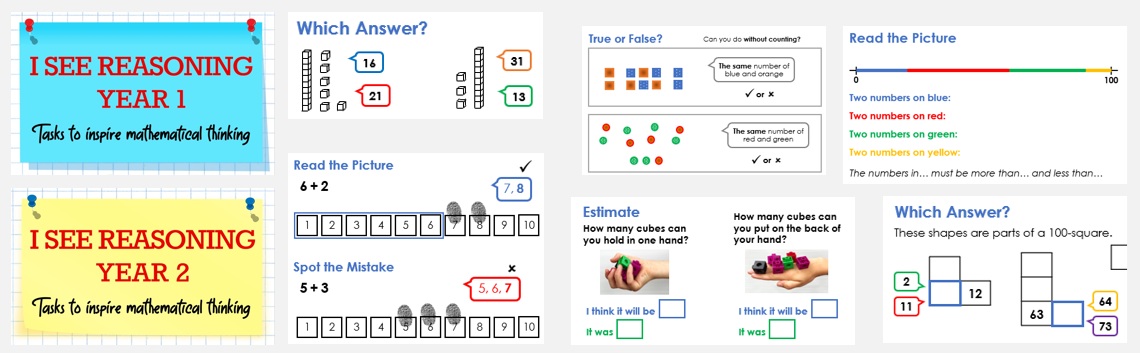
These new eBooks have replaced I See Reasoning – KS1. They follow the same format as the original eBook, but include many, many more examples (365 tasks in the Y1 eBook and 392 tasks in the Y2 eBook) and they have a range of new types of reasoning questions. Here are some of the key ideas:

Non-counting strategies, estimation, reasoning

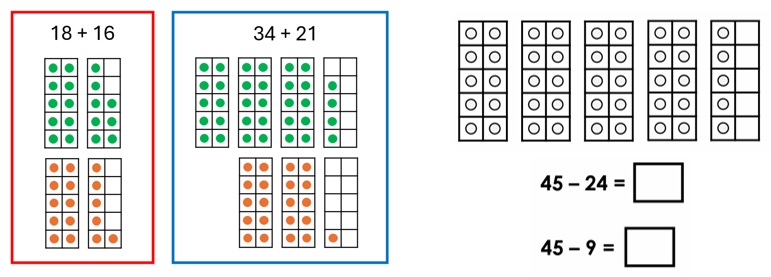
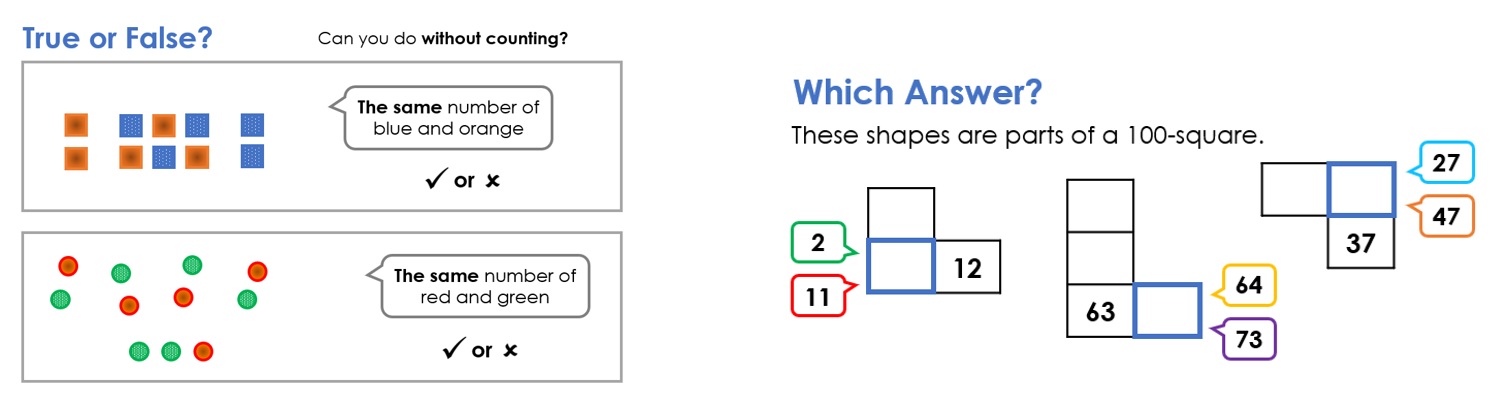
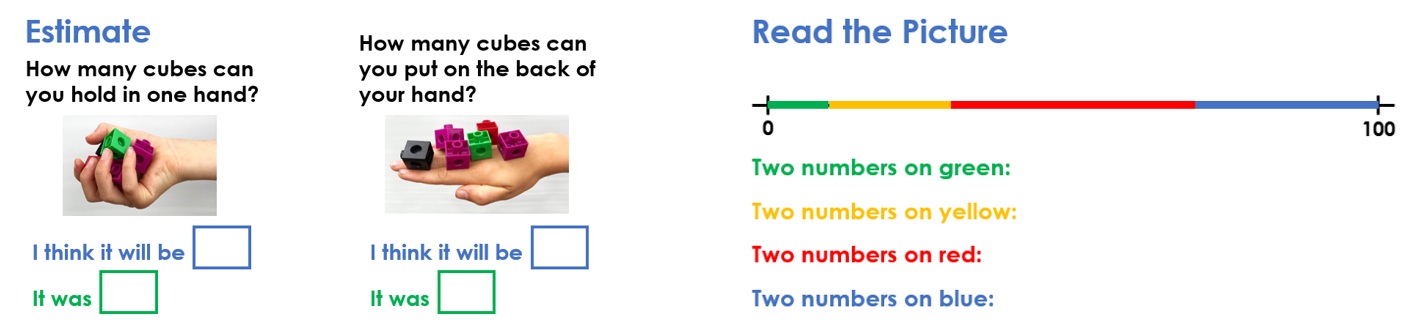
A HUGE focus is placed on children explaining answers using non-counting strategies. This includes ‘how many dots’ questions, where children describe their non-counting strategies. It involves calculations that border 10 or subtractions with small differences. The emphasis is not ‘what’s the answer?’ but instead ‘how did you know?’ or ‘what do you visualise?’ The questions are highly visual and don’t require too much reading.

Misconceptions, visuals, patterns

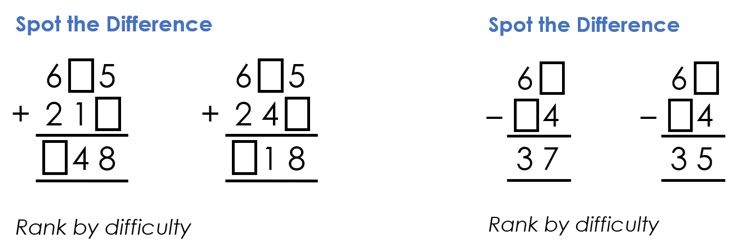
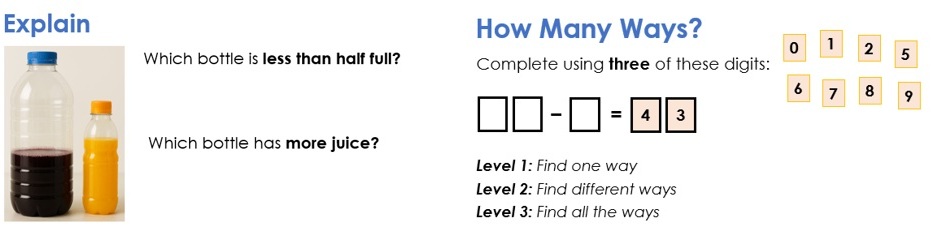
The questions introduce the key I See Reasoning question structures. Children will learn to spot mistakes, explain mistakes, compare questions and spot patterns. They will be challenged to explain what they noticed and find all of the answers. In doing so, children will be trained in the routines of thinking mathematically, routines that can be extended in KS2. This will help to build reasoning tasks into every maths lesson, giving schools a progressive approach to how reasoning is taught.

Exploration

There are lots of questions, of many different forms, for exploring mathematics. This includes estimation tasks, open challenges or questions with different possible answers. There are also a range of spatial reasoning tasks, for children being able to visualise items from different perspectives.

Depth

There are also a wide range of tasks to add challenge! These are very diverse and sometimes require children to find multiple answers or explain their thinking. These tasks are highly varied depending on the area of the maths curriculum that they cover.

The introductory price of the eBooks is £30 each (including VAT). From 1st January 2026, they will cost £35 each (including VAT).

I See Reasoning – Y1 and I See Reasoning – Y2 lay the foundations for children to experience maths as a thinking, exploring, explaining subject. If you click on the links, you can view a sample section of each resource. I hope that they inspire the children in your class and give you many fantastic classroom moments!

The New Deconstructing Word Questions – Y6

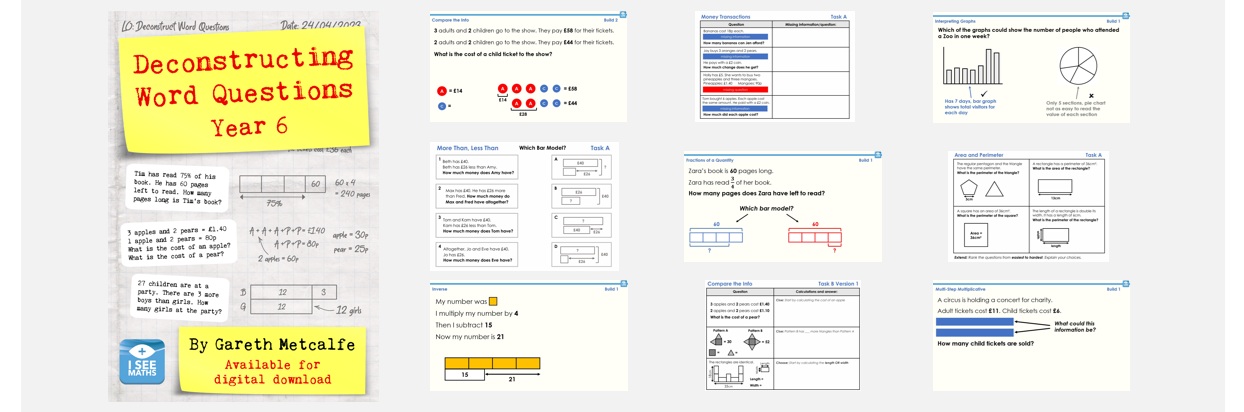
The updated version of Deconstructing Word Questions – Y6 is now completed! Full information about the resource, including a free sample task, can be found here. It provides a coherent, detailed approach to teaching children to answer word questions and gives a wide range of thought-provoking challenges.

This resource has been re-released in April 2025. If you purchased the original resource, you can have this new version for free! Just email iseemaths@hotmail.com and attach the original version of the resource (as proof of purchase) or give the order number for your original order. Then, we will reply by sending you the new resource.

Why has the resource been updated and re-released?
Since writing the original version, I have written Deconstructing Word Questions resources for Year 2, Year 3, Year 4 and Year 5. All of these resources followed a specific lesson structure:
Build 1 – teaching prompts
Task A – pair discussion task
Build 2 – teaching prompts
Task B (Version 1 and 2) – questions
Extend – deeper challenge
I have re-written the year 6 resource so that it also follows this lesson structure. This means that the resources give a totally consistent whole-school approach to teaching children to answer word questions. This video shows how the resources can be used to teach a lesson:

I want schools to have a whole-school vision for teaching children to answer multi-step word questions. Therefore, I am running 90-minute online INSET sessions on 1st and 2nd September to communicate this vision. It would be great to have you involved!

The ability to answer word questions is one part of how we can build children as mathematical problem-solvers. The full vision, including detailed guidance and video exemplification, can be found on this page. I believe it gives a practical, exciting vision for how we can build all children as mathematical problem-solvers!

Using lessons from neurobiology to enhance learning

I’ve always been fascinated by cognitive psychology. I remember, perhaps 6 years into my teaching career, thinking that I should really know more about the science of our brains and how we learn. Since then, so much more is known about optimising learning, like the relationship between working memory and long-term memory or the importance of spaced practice.

Over the last few months, I have been listening to a fascinating podcast by Professor Andrew Huberman who works at the Stanford University School of Medicine called The Huberman Lab. A number of things from the podcast have really resonated with me, and I wondered if they could have application in our schools to further enhance learning. Here are just a few of them.

Among the many science-based tools and protocols shared, Professor Huberman describes how important it is after a bout of learning – and ideally immediately after – for deep rest to take place to improve the transfer into long-term memory. After a 90-minute bout of piano practice, for example, learning can be enhanced by having just a few minutes of resting with your eyes closed. I know that this exact protocol won’t apply directly in primary schools. But might another protocol take its place?

He also describes the importance of utilising the visual system, including having at least some periods of time each day for looking into the far distance. As well as being important for eyesight, your brain has significant rest when you are not focusing on things that are close up. Looking into the distance after a lesson could potentially enhance the transfer of learning into long-term memory. This is also why looking at an electronic device is unlikely to give your brain a good break after a bout of learning. A large proportion of our brain activity is generated by the visual system, so knowing how to optimise it to enhance learning is perhaps a less explored aspect of learning.

I was also fascinated by Professor Huberman talking about adult learning. He describes how, before the age of about 25, we are wired for brain plasticity. However, after that age we need to work harder for our brain to adapt. At the start of a bout of learning, our brain releases Epinephhrine – the name given to adrenalin in the brain. This increases alertness but can initially feel uncomfortable. Learning new things is hugely rewarding and joyful. However, in terms of our brain chemistry, it also comes with some discomfort. My current belief is that we need to recognise that learning is both enriching and uncomfortable. This is the biological experience of learning.

One final example. I listened to Professor Tim Spector, on the Feel Better, Live More podcast, questioning how frequently children should be eating snacks. He talked about the benefits that can be gained from stabilising children’s insulin response from them not eating too regularly and how that can improve concentration. He talked about how Italian and French children have different patterns for eating within a day. Do we know the optimal approach in this regard for maximising learning and improving health?

I don’t claim to be an expert on any of these subjects. I don’t suggest that you implement any changes based on this blog post either: I’m not knowledgeable enough on any of these subjects to be a prominent voice. However, I think there is scope for improving learning by listening to the real experts in the respective fields. I’m sure that there will be so many other lessons that we can take away too.

I’d love to hear your opinions on any of these subjects. All comments are welcome: what you agree with, disagree with, other possible areas of interest and other sources of information that I can learn from. I pick up my messages on social media and my email address is iseemaths@hotmail.com. I can be slow to respond, but I read every message! I would love to hear your thoughts.