Care is not only pastoral – it’s also about task design.

As educators, we are acutely aware of the need to develop positive attitudes towards maths. The way that children view maths, and view themselves as mathematicians, are crucially important. In the blog Emotional Regulation in Learning Mathematics, I explore how we can help children to navigate the emotional experience of being a mathematician.

However, caring for children as mathematicians is far more than providing emotional support: it is about the nature of the tasks that we put in front of children. This is how we show what we value and what we believe mathematics is. On this subject, I have been inspired by the work of the wonderful Anne Watson. She has written and spoken extensively on this topic, both in the UK and internationally.

I had the fortune to spend a day with Anne. When we met, talked about my daughters school play. After the performance, a parent said how wonderful it was for the children to have this experience, where they can flourish personally (I totally agree). This is different to learning maths, I was told, which is academic. This felt so jarring! Anne said that we would never think that way about a child writing a poem. Writing poetry requires academic skills, but we also think of it as a personally expansive act. And so is mathematics. Maths can be such a powerful lever for personal development, when children engage in rich mathematical tasks.

In the last decade, I we have developed more awareness of educational research and of best practices in mathematics teaching internationally. This has added real rigour to mathematics teaching in the UK, it has been very positive. I also believe that the true nature of mathematics is for children to be playful, curious and engage with their classmates in a shared pursuit. I believe that these two things – rigour and playfulness – can sit together. They are not opposing forces.

It has made me think about how we can design a curriculum that is mathematically rigorous and mathematically playful. It has made me think about how mathematics can also be a tool for connection, how it can be socially enriching.

The actual task design, I believe, is not something to dump at the feet of teachers. It is for those of us involved in leading mathematics and who design mathematics. We must care about children’s emotional and intellectual engagement in mathematics. This must be the unmissable hallmark of the tasks that we provide for children.

My default has always been to focus on the ‘how’ and I will share some examples below. But more than anything, I would love to engage in a global conversation on how mathematics can be playful and rigorous. I would love to hear your thoughts, ideas and examples. I want to broaden my view and build upon my own repertoire as a task designer. I would love to work alongside different people locally and internationally as part of this shared pursuit.

A few examples…

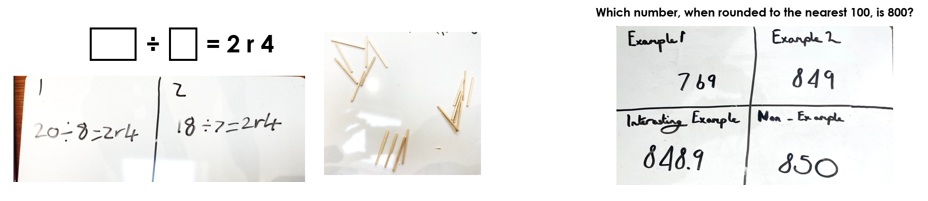
One technique that can be used are the ‘odd one out’ tasks below (akin to the Which One Doesn’t Belong examples). Children can access the task if they can give an answer; the challenge is to come up with a reason for each example.

I also love questions with different possible answers. Prior to the left-hand example question being given, the children explored dividing by 3 by making triangles with matchsticks (e.g. with 20 matchsticks, 6 triangles can be made and the remainder is 2). We understood that the there remainder is always smaller than the divisor. Then, children found answers to the question ___ / __ = 2 r 4. Answers included 68 / 32 = 2 r 4. For the example on the right, we modelled the process of rounding using number lines. Misconceptions were highlighted and discussed. Then, children found a range of different answers to the question and could identify common wrong answers.
I’d love to hear your thoughts and your own examples – Gareth.
Reasoning for all in the ‘We’ of a maths lesson

In my blog Adapting ‘I-We-You’ to Deepen Mathematical Thinking I describe how we can provide high-quality modelling whilst enabling children to form their own thinking in the ‘We’ phase of a lesson. I described how slowly revealing information can engage all children in deep mathematical discussions, taking the focus away from finding an answer to understanding a concept.

There is another technique that I often use for opening up mathematical conversations: using pairs of examples/questions. This is one of the simplest, most effective ways of highlighting specific ideas, in a way that is accessible for all children. Again, it emphasises understanding over answers. Here are some examples.

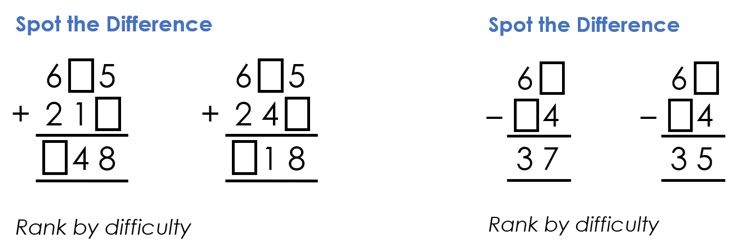
Spot the difference, rank by difficulty’ for missing digit questions:

Consider these pair of examples (only use one pair at a time!). The key to unlocking these questions is for children to understand what happens when a calculation borders over 10. For the addition examples, this is in the tens columns for the right-hand question, but not the left-hand question. This is due to the positions of the digits 1 and 4. For the subtraction examples, a regroup is only needed in the left-hand example (___ – 4 = 7, must be 11). When a pair of examples is shown, all children can access the discussion if they can spot the difference between the questions. Then, as children think about which of the two questions is more difficult, attention is being drawn to the significance of these small differences. The teacher can then answer the questions.

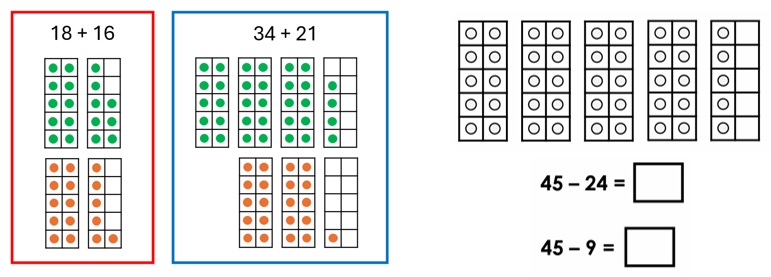
Highlight efficient calculation methods by asking ‘Which question is harder?’

The examples above are slightly different. In each instance, children consider two calculations. One of the questions involves larger numbers; the other involves a calculation that borders a ten. Children consider which question is more difficult and why, using the visuals to support their thinking and explanations. All children can participate by voting for the harder question – different valid perspectives can arise and can be discussed.

Compare non-examples or discuss misconceptions

Pairs of examples can also be used to highlight specific key ideas or misconceptions. The ‘discussion entry point’ is spotting the difference between the examples. The development comes from explaining which clock face is correct (clock examples) or explain the mistake (right-angles). This allows children to think deeply about the key concepts for each area of mathematics.

I would love to hear about how you use pairs of examples to deepen thinking, or other reasoning techniques that you us to open up conversations in your maths lessons. I’m very interested to know how you ensure that all children can participate in discussions, and how the thinking can be deepened. Thanks for reading.

Adapting ‘I-We-You’ to deepen mathematical thinking

The principles of ‘I-We-You’ are central to my maths teaching: give children the tools to think with clear models and examples; build understanding and address misconceptions in the guided practice; then children work with high success in their independent practice.

Issues can arise, though, if an ‘I-We-You’ approach leads to a more procedural approach to teaching. Mathematics is not about following a set of pre-determined instructions. I might need a prescriptive approach if you are teaching me to wire a plug. Step-by-step instruction can help me to learn how to do a column subtraction. But it isn’t how I can become a mathematician. And it won’t lead to me becoming emotionally invested in my mathematics. Maths lessons should allow children to play around with key ideas, become curious and make connections.

There is another big challenge in the ‘We’ phase of the lesson. How can we provide questions/tasks that build understanding and extend thinking for all children? If children are given a question to answer in the ‘We’, some children may finish almost immediately. Other children may need more time and more scaffolding.

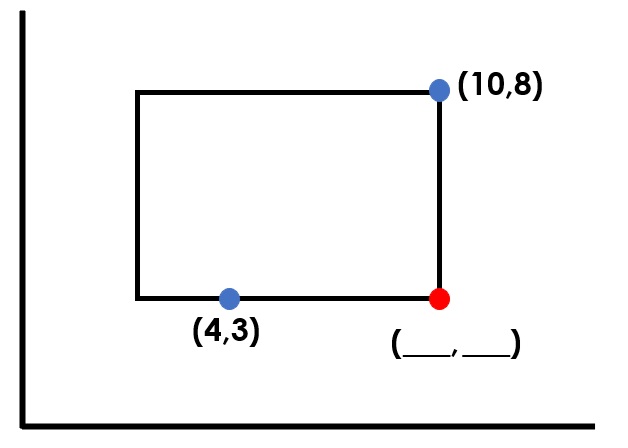
How can we hold all these ideas together? Is it possible to provide high-quality modelling and engage children in effective guided practice, whilst allowing space for children to be curious and make their own discoveries? I believe we can! In the ‘I’, think about exploring concepts rather than modelling steps. For questions in the ‘We’, think about using the slow release of information (the subject of this blog) or the blog using pairs of examples/questions to engage all children in discussion. Consider the question below:

Following an ‘I-We-You’ approach could mean modelling two questions that are near-replicas of this one. Then, I could give this question to the children to answer on their whiteboards. What problems do I see? Firstly, some children will be able to answer this question within seconds. The rest of the class, then, feel a pressure to catch up. Speed is emphasised, the answer becomes the focus. Secondly, will the children be able to answer a different coordinates question when the ‘steps to success’ no longer apply?

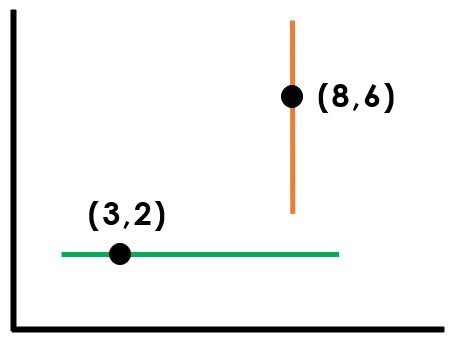
Here is a subtly different approach. In the ‘I’ phase, start by giving example coordinates that are and are not on the green and orange lines, noting the x/y coordinate that stays the same:

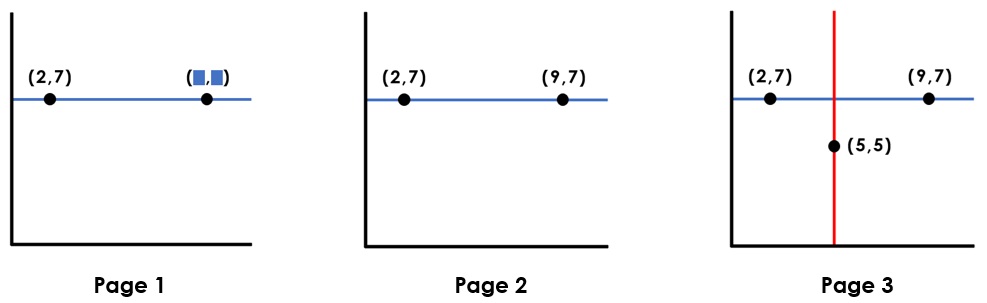
Then, looking at page 1 of the example below, I ask children to predict what the hidden coordinate could be, before revealing (9,7) and noting that the y coordinate is still 7. Next, introduce the red line (page 3). Ask children to predict which other coordinates could be on the red line. I could compare the positions of (6,4) and (4,6). Are they inside or outside of the bottom-left rectangle?

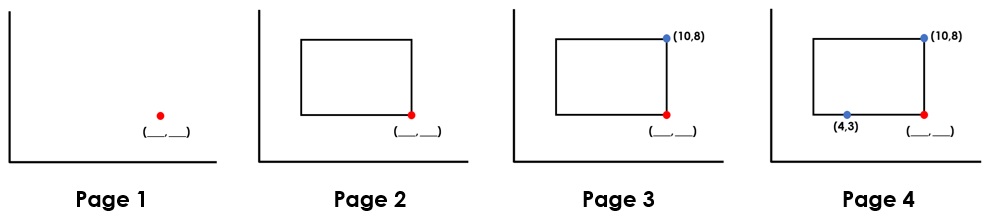
My main focus for this blog is to look at the slow release of the information for the question below, in the ‘We’ phase. Rather than presenting the whole question to the children, start at page 1. Ask the children what the red coordinate could/could not be. Note that x > y and spatially reason about the different possible coordinates. This acts as our estimate. Then, introduce the rectangle from the question (page 2) and ask the children ‘what information will we be given that will mean we can answer the question?’ Explore all possibilities. In doing so, children have the time and space to think about the structure of the task before the question itself is introduced. The necessary information is slowly revealed (pages 3 and 4) and children can now give the answer having had time to think about the structure of the question. To extend, coordinates on the vertices, edges and inside/outside the rectangle can be given.

The power of the slow reveal is that children get to ‘play around’ with the big ideas before they have to give an answer. Children have more time to process the information, which is revealed in stages. Challenge exists as we consider ‘is that definitely what the missing information will be?’ Reasoning is emphasised and children use their imaginations!

Please share your thoughts, objections or related examples! Is there another maths curriculum area that you would like me to consider on a future blog? Or other similar example tasks that you could share? I hope that this blog can spark some interesting conversations and collaborations!