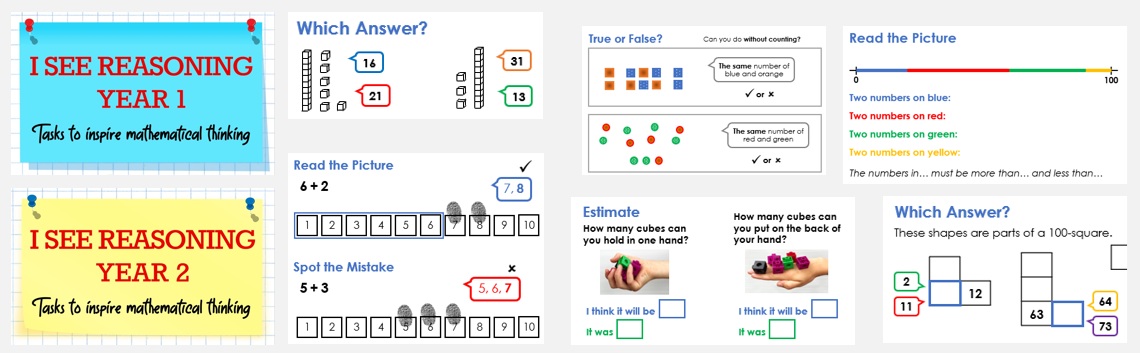
I See Reasoning – Y1 and Y2: Exploring Concepts, Creating Reasoning Habits

We want KS1 children to develop a deep understanding of Y1 & Y2 maths content. We also want young children to be able to explain their thinking, identify common errors, estimate, explore ideas and think creatively. The tasks in the I See Reasoning – Y1 and I See Reasoning – Y2 eBooks help to give children these experiences, inspiring a wide range of mathematical conversations and explorations.

These new eBooks have replaced I See Reasoning – KS1. They follow the same format as the original eBook, but include many, many more examples (365 tasks in the Y1 eBook and 392 tasks in the Y2 eBook) and they have a range of new types of reasoning questions. Here are some of the key ideas:

Non-counting strategies, estimation, reasoning

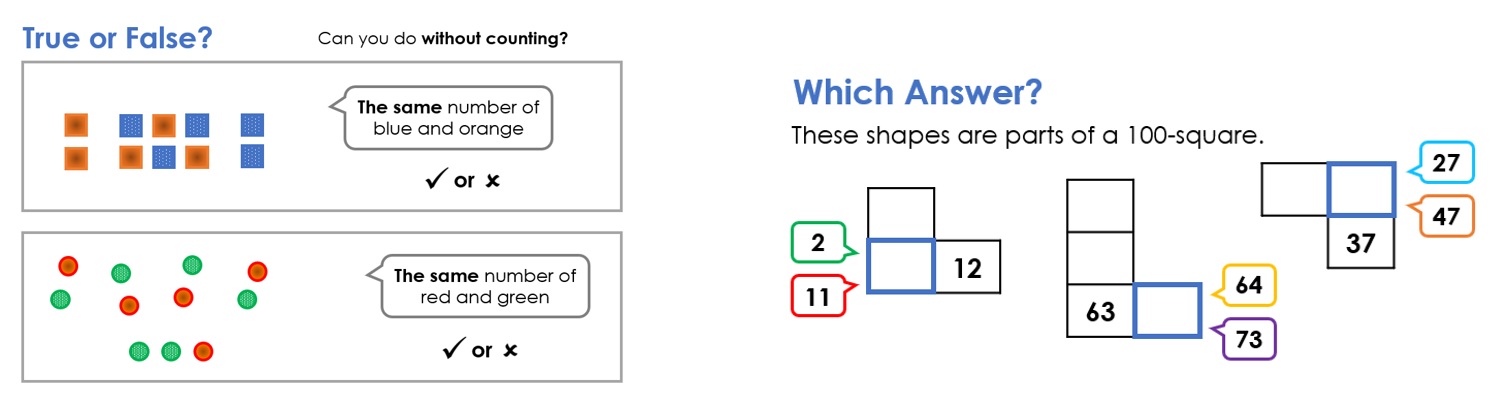
A HUGE focus is placed on children explaining answers using non-counting strategies. This includes ‘how many dots’ questions, where children describe their non-counting strategies. It involves calculations that border 10 or subtractions with small differences. The emphasis is not ‘what’s the answer?’ but instead ‘how did you know?’ or ‘what do you visualise?’ The questions are highly visual and don’t require too much reading.

Misconceptions, visuals, patterns

The questions introduce the key I See Reasoning question structures. Children will learn to spot mistakes, explain mistakes, compare questions and spot patterns. They will be challenged to explain what they noticed and find all of the answers. In doing so, children will be trained in the routines of thinking mathematically, routines that can be extended in KS2. This will help to build reasoning tasks into every maths lesson, giving schools a progressive approach to how reasoning is taught.

Exploration

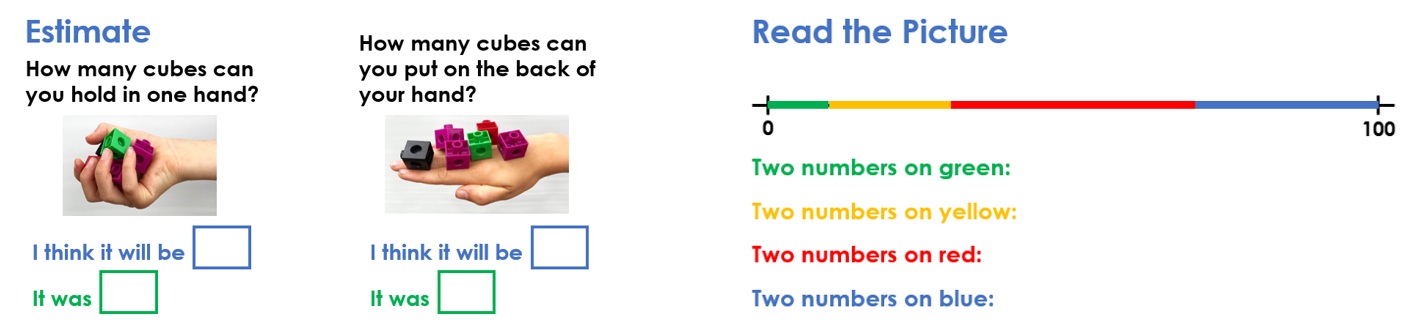
There are lots of questions, of many different forms, for exploring mathematics. This includes estimation tasks, open challenges or questions with different possible answers. There are also a range of spatial reasoning tasks, for children being able to visualise items from different perspectives.

Depth

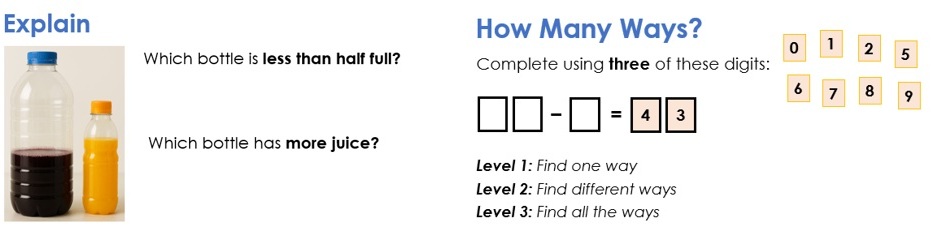
There are also a wide range of tasks to add challenge! These are very diverse and sometimes require children to find multiple answers or explain their thinking. These tasks are highly varied depending on the area of the maths curriculum that they cover.

The introductory price of the eBooks is £30 each (including VAT). From 1st January 2026, they will cost £35 each (including VAT).

I See Reasoning – Y1 and I See Reasoning – Y2 lay the foundations for children to experience maths as a thinking, exploring, explaining subject. If you click on the links, you can view a sample section of each resource. I hope that they inspire the children in your class and give you many fantastic classroom moments!

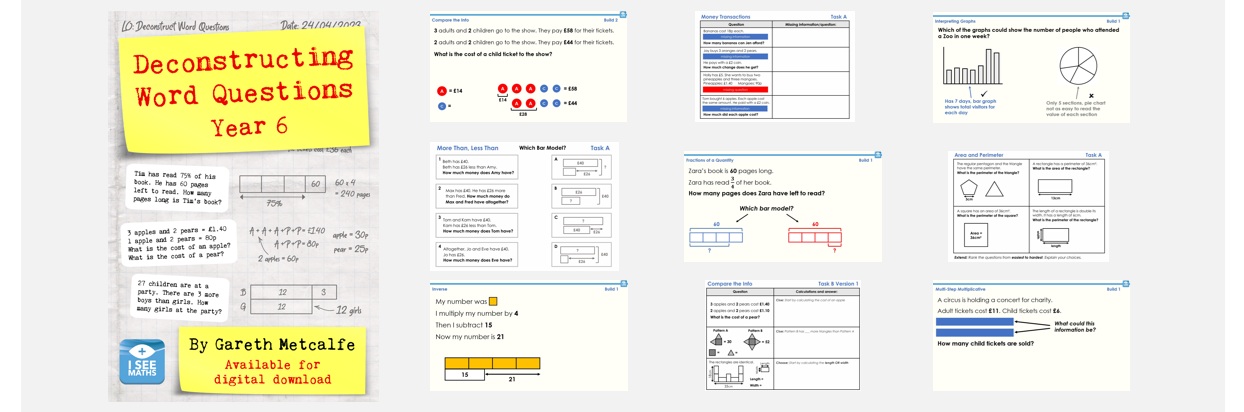
The New Deconstructing Word Questions – Y6

The updated version of Deconstructing Word Questions – Y6 is now completed! Full information about the resource, including a free sample task, can be found here. It provides a coherent, detailed approach to teaching children to answer word questions and gives a wide range of thought-provoking challenges.

This resource has been re-released in April 2025. If you purchased the original resource, you can have this new version for free! Just email iseemaths@hotmail.com and attach the original version of the resource (as proof of purchase) or give the order number for your original order. Then, we will reply by sending you the new resource.

Why has the resource been updated and re-released?
Since writing the original version, I have written Deconstructing Word Questions resources for Year 2, Year 3, Year 4 and Year 5. All of these resources followed a specific lesson structure:
Build 1 – teaching prompts
Task A – pair discussion task
Build 2 – teaching prompts
Task B (Version 1 and 2) – questions
Extend – deeper challenge
I have re-written the year 6 resource so that it also follows this lesson structure. This means that the resources give a totally consistent whole-school approach to teaching children to answer word questions. This video shows how the resources can be used to teach a lesson:

I want schools to have a whole-school vision for teaching children to answer multi-step word questions. Therefore, I am running 90-minute online INSET sessions on 1st and 2nd September to communicate this vision. It would be great to have you involved!

The ability to answer word questions is one part of how we can build children as mathematical problem-solvers. The full vision, including detailed guidance and video exemplification, can be found on this page. I believe it gives a practical, exciting vision for how we can build all children as mathematical problem-solvers!

Deconstructing Word Questions: the vision

Imagine this: you are asked to describe the strengths that the children in your school have as mathematicians. You say ‘they are brilliant at understanding and answering word questions!’ When asked to elaborate, you say ‘the children read questions carefully and pick out the important information.’ Or perhaps ‘the children are great at spotting multi-step questions.’ Maybe even ‘they show their understanding in different ways.’

In reality, so many children struggle to answer multi-step or non-standard word questions. So how do we go from giving children word questions to teaching all children to answer word questions? What does a consistent approach look like?

This has become my mission. For the last 3 years, I have been writing Deconstructing Word Questions for Y2 – Y6. Each task has been trialled in a number of different schools, being honed with the help of some amazing teachers. The eBooks are on sale here.

The golden thread that runs through every technique, every activity, is focusing children’s thinking on the deep structure of each question. It is about taking the attention away from calculating answers to understanding the steps involved. Here are four ways that this is achieved.

1. Slowly revealing information in questions
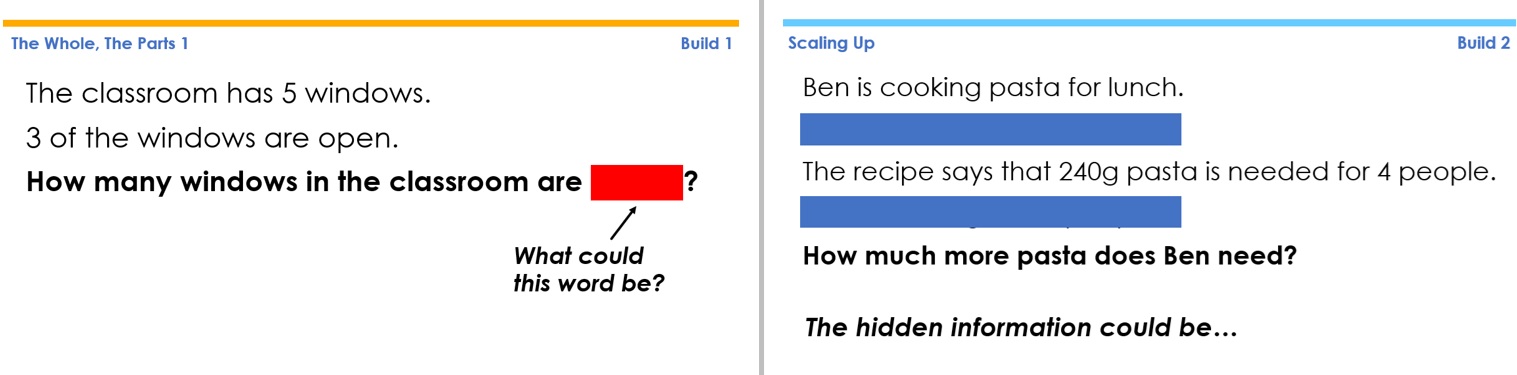
Children predict what the hidden words/information could be, as in the examples below (Y2 and Y5). Then, the information is revealed. This means children have thought about the structure of the question before they answer the question.

2. Using equipment or bar models
Sometimes, children are asked to represent questions with counters. Sometimes, children are asked ‘which bar model represents the question?’ (left-side example, Y3). For some questions, children are given part-complete bar models to fill which act as a scaffold (right-side example, Y4).


3. ‘Minimally different’ questions
Children analyse pairs of questions that are very subtly different. The children look at how the questions are the same/different. This helps children notice the subtle but all-important differences in the wording of questions (left-hand example, Y2). This variation is used in the questions that children answer (right example, Y3).


4. Depth
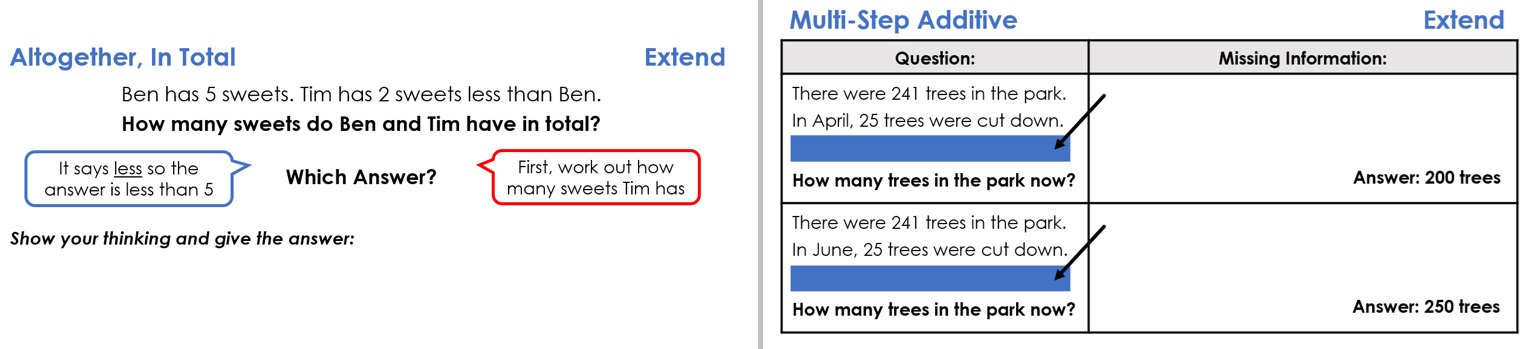
Lots of techniques are used to extend children’s thinking. This includes explaining which approach is correct (left example, Y2) or in giving the information that is missing in a question (right example, Y4).


There is a trial task for each year group to try out. Click on the links below for the resources and for the short ‘how to’ video:
Deconstructing Word Questions – Y2
Deconstructing Word Questions – Y3
Deconstructing Word Questions – Y4
Deconstructing Word Questions – Y5

Deconstructing Word Questions – Y6

The Vision: Building Problem-Solvers maps out a holistic vision for building children as problem-solvers. There are 10 videos to exemplify the key principles shared.

I hope Deconstructing Word Questions helps many children to grow as mathematical problem-solvers.

UPDATED BLOG: My 2023-2024 Writing Challenge

I have managed to post an example task for a streak of 107 days this academic year. However, at this point I’m going to redirect my efforts as I have decided to focus on writing Deconstructing Word Questions Y2-Y5. I see this as being my greatest possible contribution. It’s hard to properly communicate the vision for these resource using photos – it’s better done using short videos. I will spend the Spring term focusing on writing the resources and trialling them in lots of different classrooms. Then, in the summer term, I will post a video a week explaining how, I believe, we can transform the teaching of word questions. I will also send out lots of free resources to trial to the people on my mailing list. I am so excited about what is to come!

The resources will be released some time between September 2024 and January 2025, depending on the outcomes from the classroom trials.

Below is my original blog post:

Day 1: The Mountain Pass Logic Puzzle and The Mountain Pass Answers

I’m passionate that all children get to experience the true richness of mathematics and for maths to be an intellectually and emotionally rich pursuit. To this end, over the last 10 years I’ve strived to create maths tasks that generate conversations, give space for curiosity and provide opportunities for extended exploration. I hope that my resources are inspirational and simple to integrate with your maths curriculum.

I have so many plans for new resources! I See Reasoning – Y1 and I See Reasoning – Y2 are being written: they will be comprehensive resources for building number sense and embedding reasoning in daily lessons. Deconstructing Word Questions will be written for Y1-Y5 after the successful launch of the Y6 eBook. Then I will go back to my roots: writing a range of logic puzzles and problem-solving ‘task families’, so problem-solving skills can be built coherently.

To get into the routine of writing new resources every day, I have set myself a challenge: to post a new task every school day on social media for the whole of the 2023-2024 academic year. Images or videos will be posted at 7:30pm every day on Twitter, Facebook and on my NEW INSTAGRAM FEED. At the time of writing, I have exactly 0 Instagram followers!

I am actively seeking your feedback on all my posts. Specifically, what would you change about each task? Or if you use any of the tasks in the classroom, what age of children did you use the task with and what happened? I won’t always respond immediately – I can struggle with insomnia so I’m usually off social media after 8pm – but I will read every comment. Feedback can be emailed to iseemaths@hotmail.com

I have taken so much from the feedback given by teachers about my work – it helps me to reject my bad ideas and improve my half-baked ones! I love to receive any suggested improvements or comments.

The first post will be on 4th September. Until then, have a great summer – Gareth

Learning content, developing habits of thinking

I’ve taken a lot from listening to Dylan Wiliam speaking over the years. One of his insights has particularly resonated with me: the idea that the improvement in learning that a child derives from being in the class of a highly effective teacher extends well beyond the time that the child is in that teacher’s class. For example, if a child experiences expert teaching in Y3, they are likely to make more rapid progress in Y4 and beyond too.

It is, therefore, hard to judge the true effectiveness of teaching from end-of-year maths assessments. It might give an indication of progress made in the content goals for that year but it won’t give the full story of the long-term impact of that teaching. The lens is too narrow. If all our efforts are placed on getting children to achieve their ‘content goals’ for the current day/block/year, we may always be limited in our impact. We want out teaching to help children to learn the content and to build children’s capacity to learn other new content.

I have come to think of each maths lesson as an opportunity to develop a child’s content knowledge and their habits of thinking. Of course, surface knowledge is important as reasoning doesn’t happen in a vacuum. However, I generally look at the content of the lesson as the context through which I will build the mathematical habits of mind. This may involve helping children to represent ideas visually, explain misconceptions or spot patterns. Perhaps children will be challenged to create their own examples. Or maybe a task will require an element of perseverance and self-regulation. This approach may have a short-term cost in the speed at which content knowledge is acquired, but this is likely to be a worthwhile investment. It can give the children a richer experience of being a mathematician.

My simple encouragement is to be aware of the need to develop content knowledge and build mathematical habits of mind. To focus on the detail as well as being aware of the bigger picture. Content knowledge is more tangible and it is easier to assess. The habits of thinking that are developed, though, will play a powerful role in children’s long-term mathematical success. We want all children to develop these habits, not just pupils whose attainment is already relatively strong. It will also require us to make thoughtful choices about what we don’t teach. Where time is limited, content is usually prioritised.

A starting point might be to establish What, as a school, do you consider to be your ‘mathematical habits of mind’. What are the characteristics that you want to build within children over time? How are they explicitly taught and made visible? And how do we promote and celebrate children’s progress is developing these habits? My aim, of course, with the I See Reasoning eBooks is to write questions and tasks that help children to develop these habits. Schools generally have a clear plan for how children learn their number bond facts. I want schools to have the same clarity in how children reason mathematically and grow as creative, independent thinkers.

If you have any thoughts on this blog, please share them with me by emailing iseemaths@hotmail.com or commenting below – Gareth.

Reflecting the Emotional Experience of Mathematics, Redefining Success

Mathematics can be tremendously rewarding. The experience of making a new connection, understanding an idea or overcoming a seemingly impossible barrier is inherently joy-filled. I love seeing children battling with the various emotions that arise when doing mathematics – including the excitement of a new discovery. However, learning mathematics can also be very uncomfortable. Therefore, I believe that it’s crucial to help children become literate in the emotional experience of mathematics. And I never tell children that ‘maths will be fun today.’ Here’s why…

When we engage in learning, our brain releases a cocktail of stress chemicals to heighten our level of alertness. This is great for learning but it means that, in terms of our brain chemistry, at the start of a learning experience we have to walk through a temporary ‘door of discomfort’. At this point, I don’t want children to think that they should be enjoying themselves. The joy of a new discovery usually comes on the far side of effort, repetitive practice and maybe after some confusion. It involves discomfort. I want children to recognise and value that discomfort. Notice what it feels like and reframe these moments as part of the learning process – a gateway to success. And, of course, enjoy the moments of breakthrough!

For children to enjoy maths, they certainly need to experience success – to know that effort leads to success. For example, my training explores how children can have high initial success in problem-solving. Where children don’t experience success, I try to explain their difficulties, for example ‘When you can easily recall your times tables, you will have more brain space free to think about the question.’ I always try to address ‘mathematical status differences’ in the class, for example recognising a moment when someone perseveres through a moment of challenge. And I try to be careful in what I celebrate, downplaying the importance of an answer and placing the emphasis on the process of the thinking.

Then, I love to give children the chance to express their understanding in ways that are unique to them. In my training, I like to explore how children can extend sequences of Small Difference Questions, create their own Rank by Difficulty examples or tweak How Many Ways? tasks to increase or decrease the number of possible answers. I think we all have a deep-held desire to be unique. This is a wonderful way to express that in mathematics. It’s a skill that takes training. It’s a hugely worthwhile investment to make.

Mathematics brings up a wide range of emotions. In helping children to recognise and understand the full spectrum of these feelings (and to persevere through them) I believe children will have more mathematical success. I also believe it will also help children to grow as emotionally literate people. I’d love to hear your thoughts. Which ideas resonate with you? What do you disagree with? And how do you help children to navigate the emotions of learning mathematics? All views are welcome!

Shape Puzzles in Y2: small numbers, deep challenge

I’m busy writing I See Problem-Solving – Y2, a resource that I’m super-excited about. It will provide sequences of related questions, tasks and open-ended challenges so children can understand and then explore different problem-solving tasks. I will explain the philosophy behind the resource in a series of future blog posts.

For now, have a look at this sequence of tasks, how it builds children’s understanding of additive reasoning and lays the foundation for algebraic thinking.

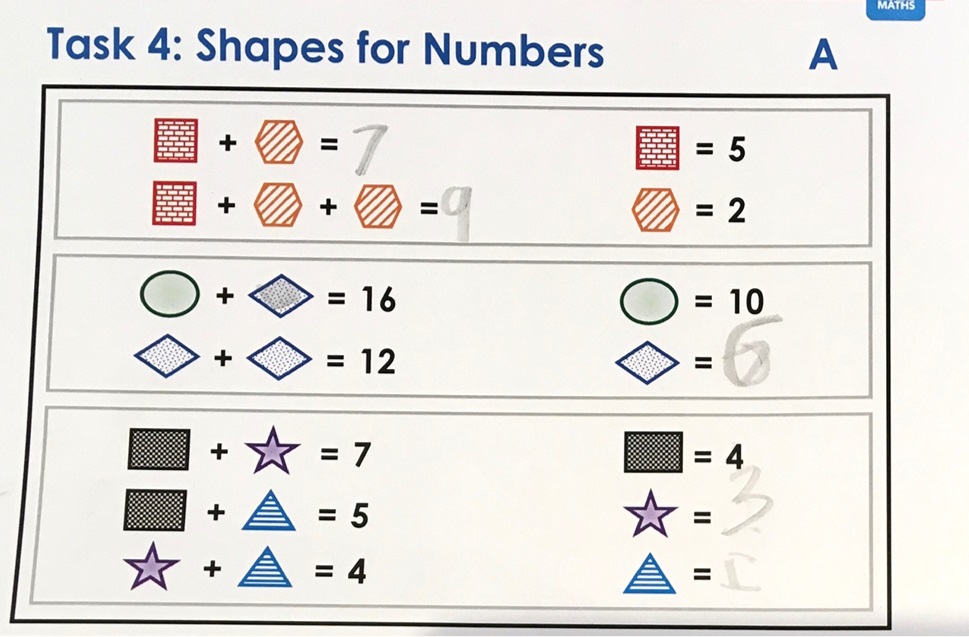
Part A: Children are introduced to the idea that a shape represents a number.

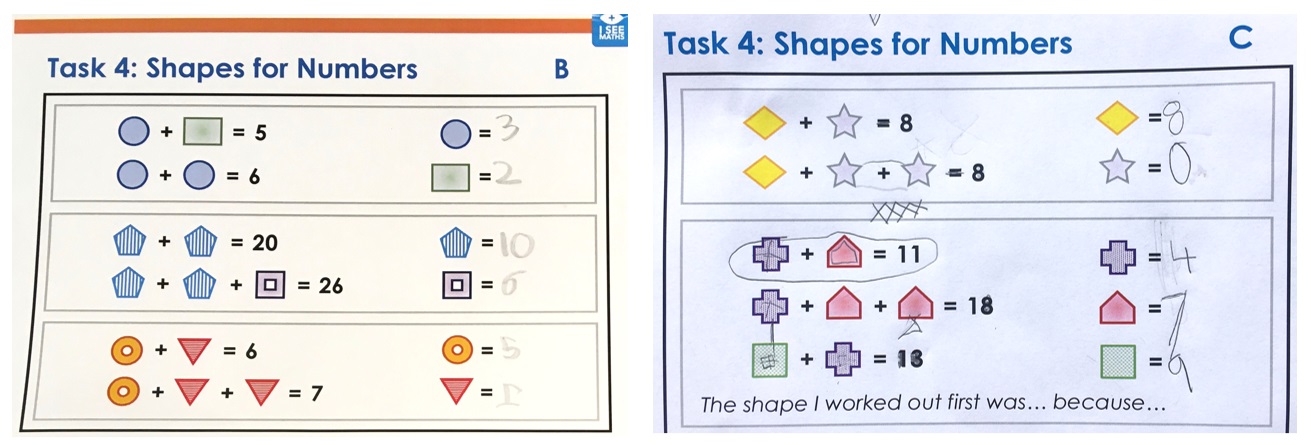
Part B and C: Children find the value of each shape. They look for lines made using the same shape. Otherwise, they workout how the sum of a line increases when one more shape is added. Notice the top right example: an extra star is added but the sum for the row does not change. This shows that the star is worth zero!

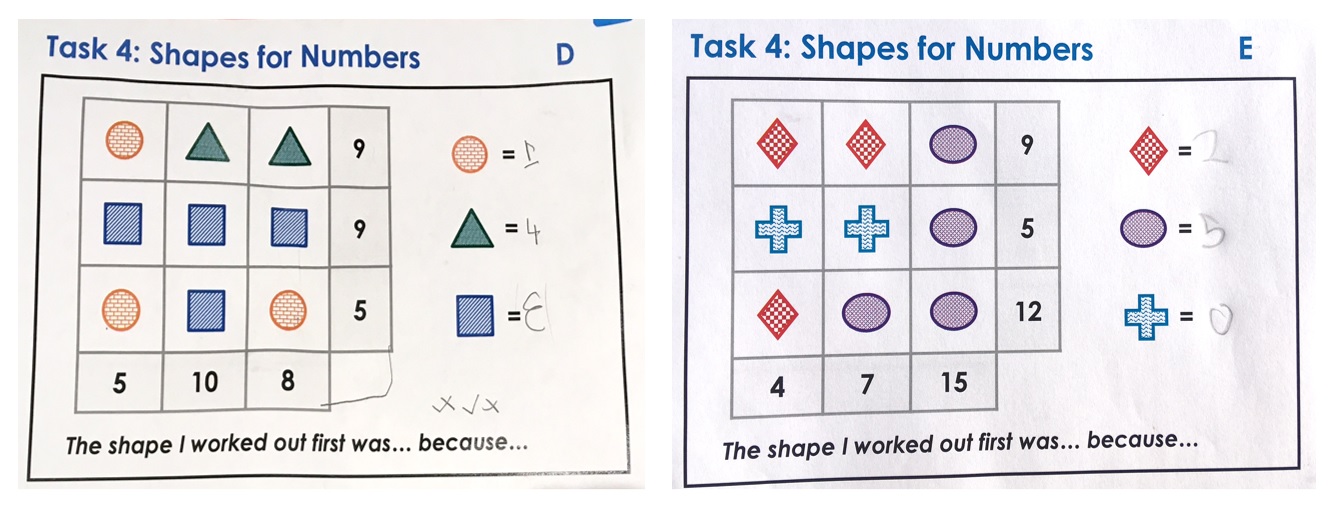
Part D and E: They apply these principles to find the value of the shapes in these grids, where the sum of each column and row is given.

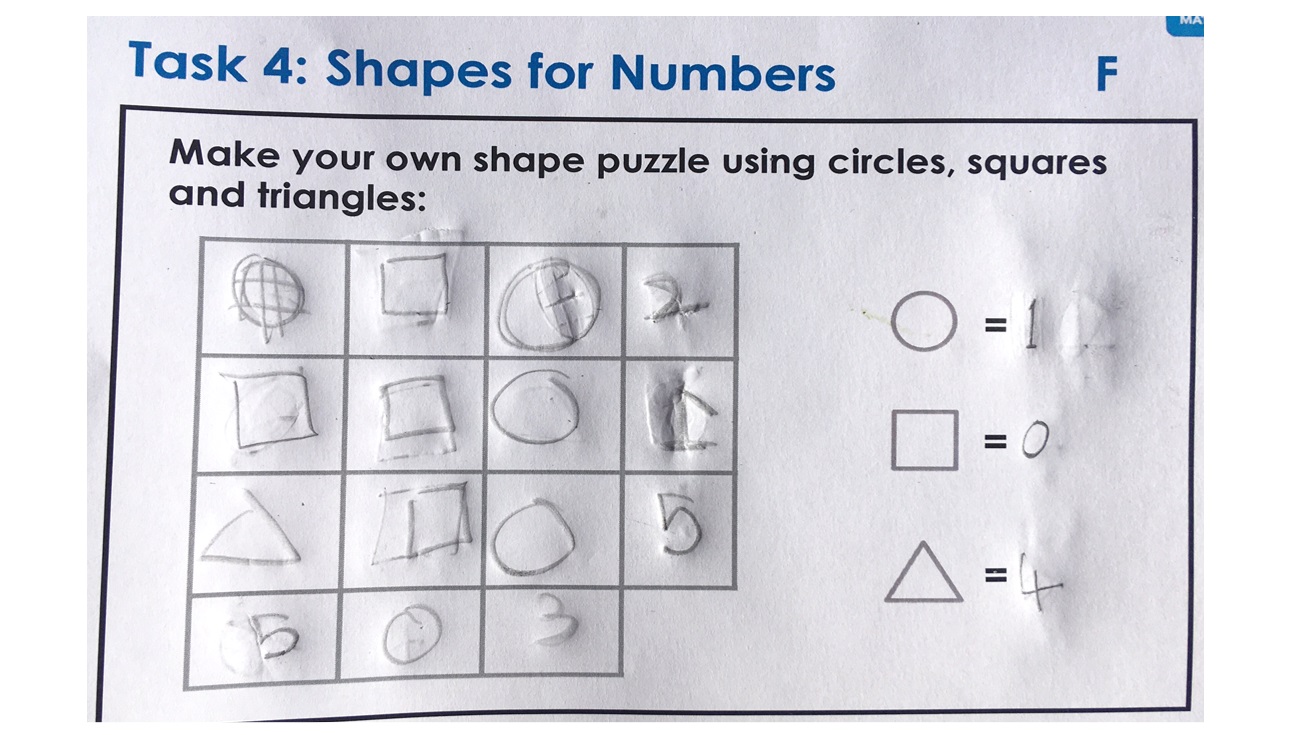
Part F: Then children can make their own examples.

This blog explains how these ideas can be extended using the I See Reasoning resources in KS2. If you want to trial I See Problem-Solving – Y2 as it is being written, click here to join the I See Maths mailing list

For more information about Gareth Metcalfe’s INSET and twilight maths training click here or for CPD sessions about using the I See Reasoning eBooks. My passion and expertise is in developing children’s ability to reason mathematically and building children as mathematical problem-solvers.

Shape Puzzles in KS2: exploring additive reasoning, laying foundations for algebra

I love using shape puzzles to explore some of the principles of algebraic thinking. The examples in this blog post are from I See Reasoning – Y4 (there are shape puzzles in all the KS2 I See Reasoning eBooks) and I often use these questions with older children too. I’ve found children love completing these questions and love creating their own puzzles!

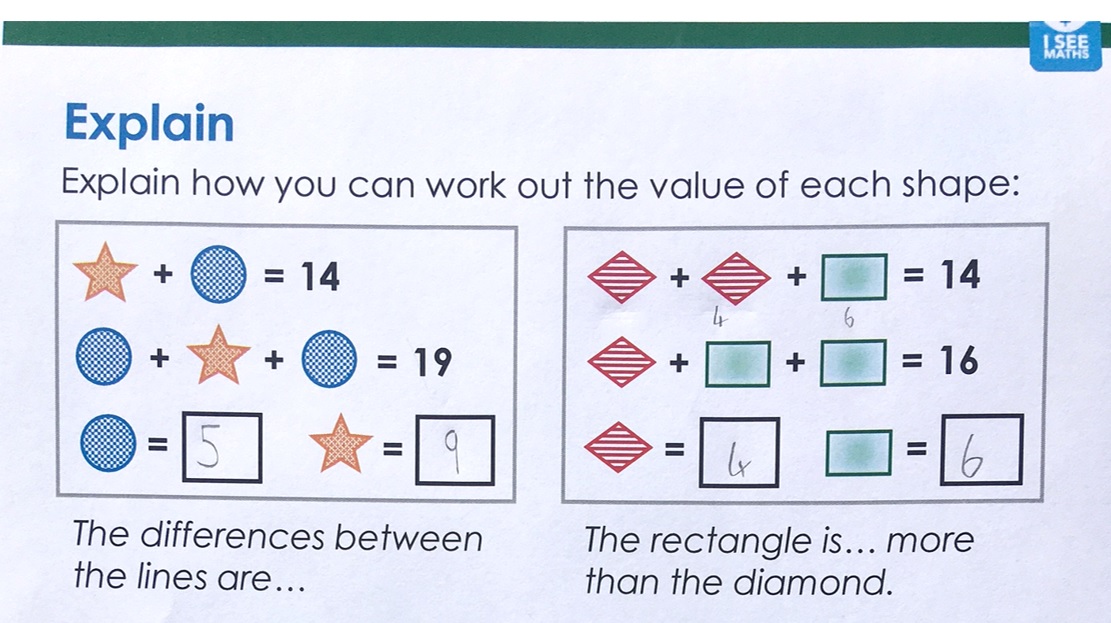
Step 1: These questions help to uncover the key strategies for working out the value of the shapes.

Left example: the second line has one more circle than the first line and its total is 5 more. Therefore one circle = 5.
Right example: a rectangle is 2 more than a diamond. The child answering this question extended the pattern to show that three diamonds have a sum of 12 and therefore one diamond = 4.

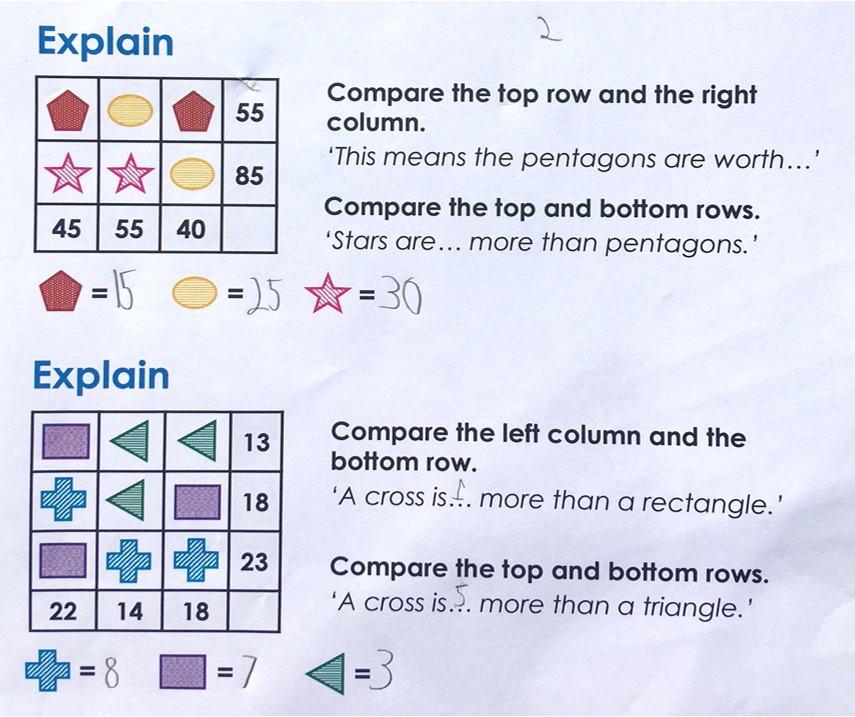
Step 2: We complete shape puzzles using the thought processes from step 1. There are prompts (which can be used or can be hidden) to suggest possible starting points.

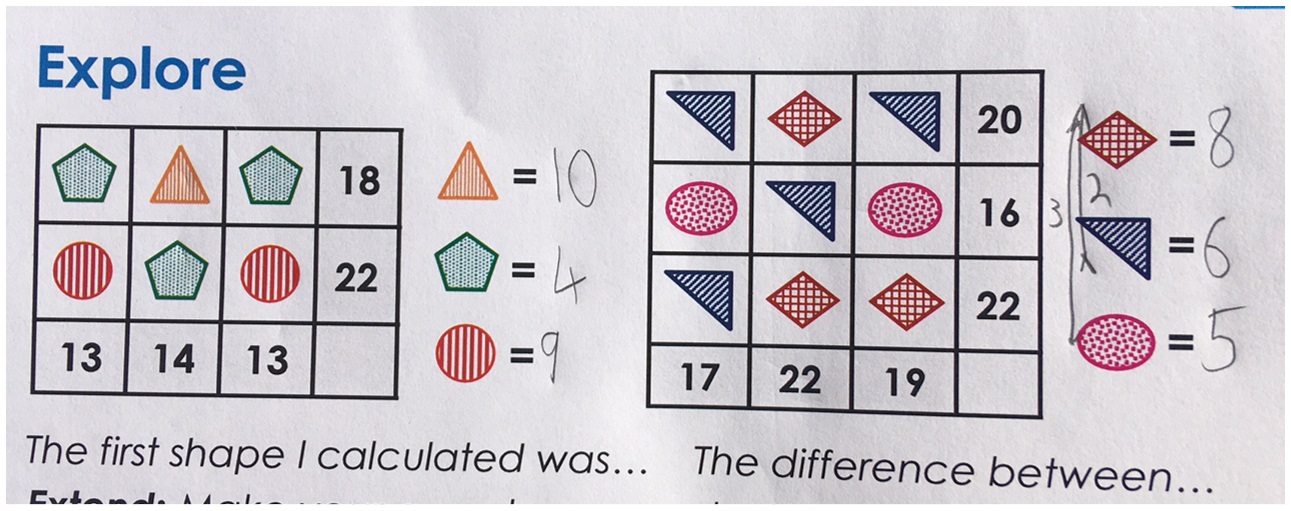
Step 3: Children complete different puzzles, explaining their starting points.

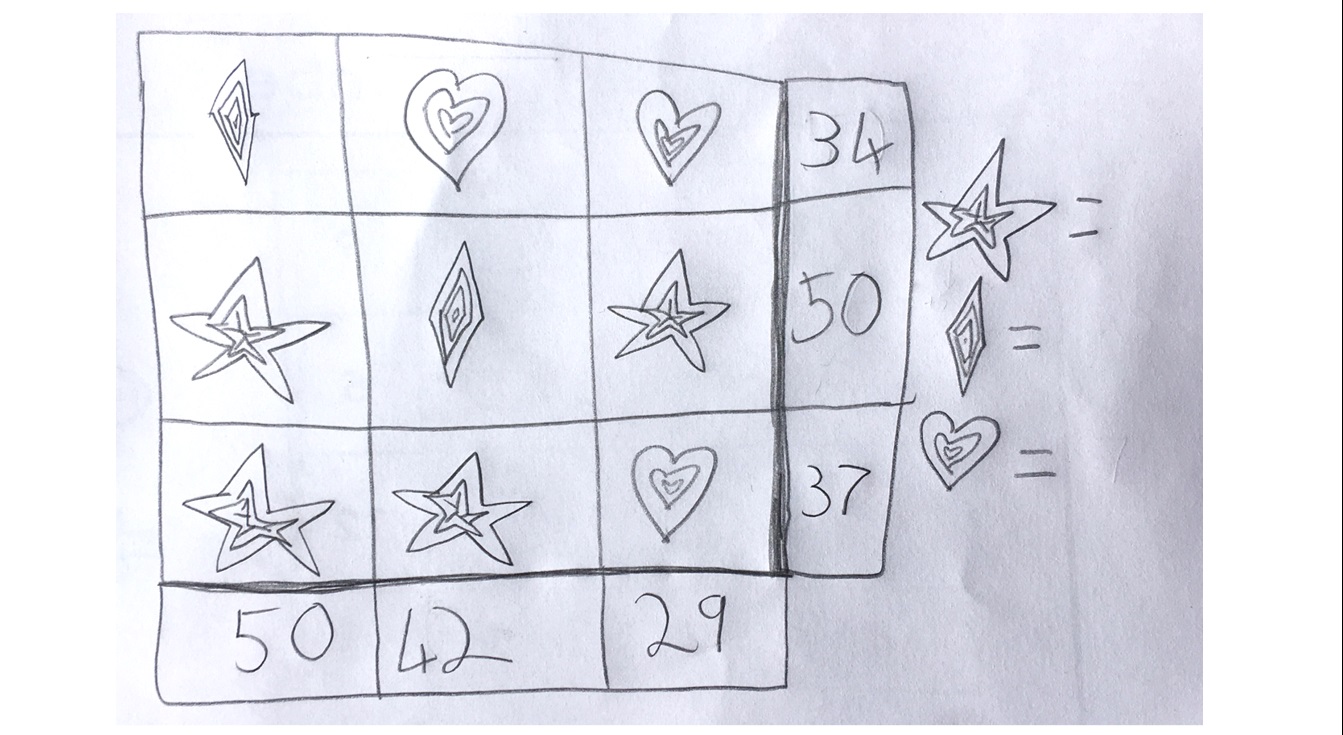
Step 4: Time for children to design their own puzzles! I specify two things: there can’t be any rows/columns that are made using only one shape; and the designer of the puzzle must be able to explain a possible starting point.

This webpage, designed by the brilliant Jonathan Hall, enables you to automatically generate these puzzles. And this blog explains how I’ve introduced shape puzzles to children in Y2. A fantastic way to explore some of the big ideas of algebra!

For more information about Gareth Metcalfe’s INSET and twilight maths training click here or for CPD sessions about using the I See Reasoning eBooks. My passion and expertise is in developing children’s ability to reason mathematically and building children as mathematical problem-solvers.

Click here to join the I See Maths mailing list and receive the latest new resources to trial.

Join the Discussion: How Expert Teachers will Rebuild Mathematical Understanding

It’s session 2 of the free Heartbeat of Education series this Thursday (11th March, 6pm-7pm) and it’s going to be a really significant one: how, as Primary teachers, can we ensure that children continue to thrive as mathematicians? And how should our maths lessons be different in this new season?

I believe that this is a time of great opportunity. It gives us the chance to reflect on children’s experience of mathematics and think about the skills and attributes that we truly value and want to build within our mathematicians. What can we do, as teachers, to lay the groundwork for children to have long-term success in mathematics? And how is this more than just helping children to ‘catch up’ on end-of-year targets? We will discuss what should be prioritised and how our teaching might be different in the upcoming weeks and months.

Register here to join the discussion live and to receive the recording of the session. I will be joined by award-winning Infant teacher Toby Tyler, leading teacher and teacher trainer Alison Hogben and the outstanding maths specialist Vicki Giffard. I want our discussion to explore YOUR questions. Here are some of the things that people have asked so far:
How do schools go about getting the balance right between focusing on the ‘Ready to Progress’ criteria as well as fully covering the National Curriculum?
How much weight should be given for retrieval practice if there are clear gaps in learning?
How should I differentiate now there are such gaps between children’s knowledge/experience in maths?

I’d love you to join in and please spread the word. Also, add your questions to the debate. Either post them on social media or email me at iseemaths@hotmail.com. I’m looking forward to a lively, thought-provoking and important debate!

Online Training: the present and the future

From next week, I will run my first online training sessions for teachers  – it will be great connecting with educators again! Initially there are four different training events, each with 10am and 7:30pm sessions, so everyone can join in. I’m really excited to explore the opportunities that online CPD can provide.

Sessions will be 90 minutes long, with perhaps 60-70 minutes of content and 20-30 minutes of Q&A and discussion to unpick the themes of the training. This will give us time to explore key ideas in depth whilst leaving participants with a manageable number of take-aways. Future sessions will then develop these themes further. I hope that teams of people join in so they can work alongside their colleagues to implement the ideas.

I’ve already run five parent sessions on Zoom: I’m slowly learning to navigate the technology! So far, everything that can be shown at a training event can also be shown online. And with the ongoing chat and Q&A features, people have been able to interact well and ask questions as we go.

I’m particularly looking forward to the ongoing dialogue that will be created with myself and between participants both during and after. With people joining in from diverse settings, including teachers from overseas, we will learn a lot from each other! As the online training develops, I intend to run a wider variety of sessions and to build future training around the areas that people want to explore further. Sessions can be targeted to specific year groups, topics or aspects of teaching. Online training brings cost and time efficiencies. A recording can be viewed by participants afterwards too.

This form of training is new to me. I’d love to get your ideas on how I can expand or improve my online CPD offering (email iseemaths@hotmail.com). This could be about the logistics of accessing sessions, thoughts on the content of training or anything else. At what time would you like sessions to run? What would your dream course title be? And how can we ensure that the impact continues long after the sessions? I would absolutely welcome your feedback. I will plan my training sessions for May soon.

I also regularly send out resources for teachers to trial to people on my mailing list so that I can get teachers’ feedback on my products as they are being written. At the moment I’m writing three new resources. I’m planning to run some free sessions in May where I’ll show some of these resources and ask for people to say what they like and what they would add/change. I’d love to get as many people joining in with these sessions as possible. The more viewpoints I can get the better!

I can’t wait to get started. Hopefully you’ll join me!
Gareth

Click here to book and for full details about April online training.