My favourite properties of number question

‘Do all odd square numbers greater than 1 have 3 factors?’

I love this question. Let me explain why, and the train of thought that it can generate.

Children usually start by generating the odd square numbers, identifying that square numbers have an odd number of factors (1, the number and the square root). This helps to underline the uniqueness of square numbers. Nothing new here, really.

So children tend to identify the first two or three odd squares greater than one (9, 25 and 49) and realise that these numbers only have 3 factors. This, I tend to find, is enough evidence to convince most children that the answer to the question must be ‘yes’.

However, this is of course a false presumption, and by making it children realise a crucial mathematical principle: that finding examples to support a theory is not the same as finding a proof. There must be reasoning as well as examples to generate a proof!

So I then ask the children to consider 81. And they soon realise that it is also divisible by 3. What’s happened to the pattern? And why?

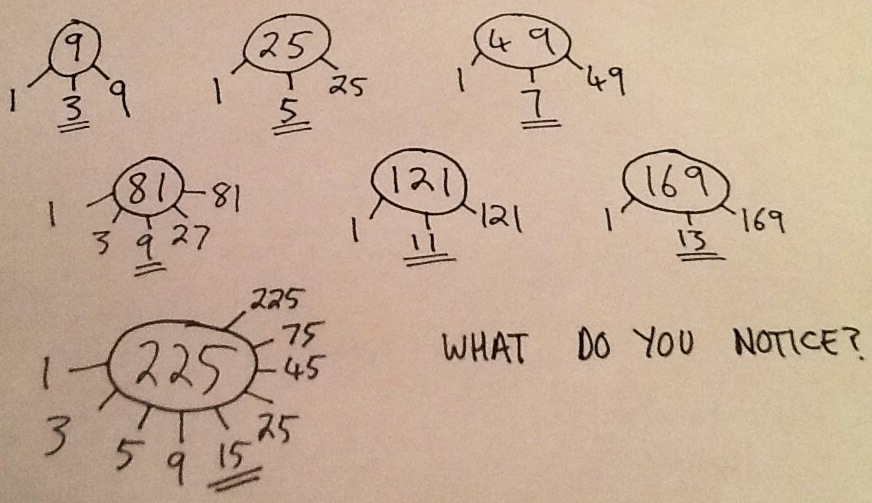
Children then investigate further examples, noting that 5 of the first 6 odd square numbers greater than 1 (9, 25, 49, 121, 169) have only 3 factors. But then 225, the square of 15, has 9 factors! There must be some logic here, and of course there is. I ask the children to consider the square roots of each number, as underlined below:

IMG_0647.JPG

After much discussion and deliberation, and a healthy dollop of struggle, someone makes the breakthrough: the numbers with prime square roots have 3 factors; other numbers can be further divided by the factors of the square.

But does this pattern continue for all odd squares? And why was 1 excluded from the list?

It’s an amazing question for exploring the very nature of the properties of number, and particularly primes and squares. And, in my opinion, for experiencing the joy and beauty of mathematics!

The rounding question

Yesterday I presented some of the children in my class with this question:

The news reported today that 2000 people have contracted a rare tropical illness. This figure is known to have been rounded to the nearest 100 people. What is the largest possible number of people that could have the condition?

It was fascinating to see the thought progression that so many of the children went through. It looked something like this:

Preliminary idea (in some cases): 1900 or 2100
Idea 1: 1999
Realisation that you can go above 2000
Idea 2: 2040
Realisation that units column can increase
Idea 3: 2044
Realisation that the units column does not determine whether rounding up or down
Idea 4: 2049
Occasional error: 2049.999999
Awareness, in this context, that the answer must be whole number.

It was amazing to see how uniform this pattern of thinking was with different groups of children, particularly as children came to the counter-intuitive realisation that you have to find a number that will round down In order to find the maximum number of people.

There’s no place quite like the classroom!

Establishing a Mathematical Culture

How can we learn well in maths? Why do some people find mathematics difficult? What does it mean think and act like a mathematician? These are fundamental questions; the way children answer these questions will to a large extent determine their success as mathematicians. I believe, therefore, that we need to have a stronger dialogue with children about the learning process, specific to maths, that will encourage positive learning dispositions. This is what I call ‘Creating a Mathematical Culture’.

Becoming a successful mathematician is far from being a purely mechanical process. Many people (children and adults) are unable to fulfil their potential specifically because of their inability to deal with their emotional response to the challenge/threat posed by mathematics. The importance of mindset to learning outcomes in maths is supported by neuroscience, the analysis of PISA tests (see below) and, I dare say, the personal experience of many of our teachers.

IMG_0339.PNG

In my classroom, I aim to establish the following five principles at the start of the year. These are the tenants that I believe are important to building positive attitudes and habits in maths lessons:

IMG_0474.PNG

Firstly, the children must be convinced that by working hard they can develop their mathematical ability. Any notion that mathematical intelligence is genetically determined, or unchangeable, must be addressed.

In my maths training, I go into the detail of how I introduce these five principles to the children: what exactly each statement means, evidence to show the importance of each statement and how they can work in this way in daily maths lessons. These principles will be referred to, exemplified and celebrated constantly throughout the year, and no doubt amended also. They give the children the framework for thinking about the learning process in maths (metacognition), and critically help pupils to embrace challenge and learn from mistakes.

I also see my ‘Mathematical Culture’ as being like a promise that I am making to my class: that I am promising them a rich mathematical diet, set in a climate of support and trust. Not only is it a guide for the children, but it is a vision for me as a teacher: setting out explicitly what I value, and a standard that I will aspire to fulfil.