I See Problem Solving – UKS2: providing challenge

I See Problem Solving – UKS2 is designed to transform the teaching of problem-solving in mathematics. Its design addresses Recommendation 3: teach strategies for solving problems from the recent EEF report. It will give all children the opportunity to understand and answer non-standard questions, whilst also providing appropriate challenge. This blog focuses on how extra challenge is provided to deepen and extend children’s learning in each task.

Each task begins with the main prompt question. For some children, answering this question may be their ‘Everest’; others will need more challenge.

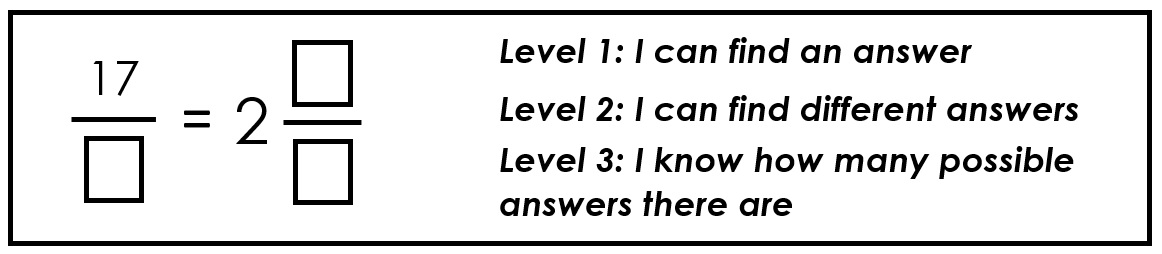
First of all, a number of the tasks include a ‘how many ways’ prompt, with the challenge coming from finding all possible answers. Here’s a typical example of a ‘how many ways’ task:
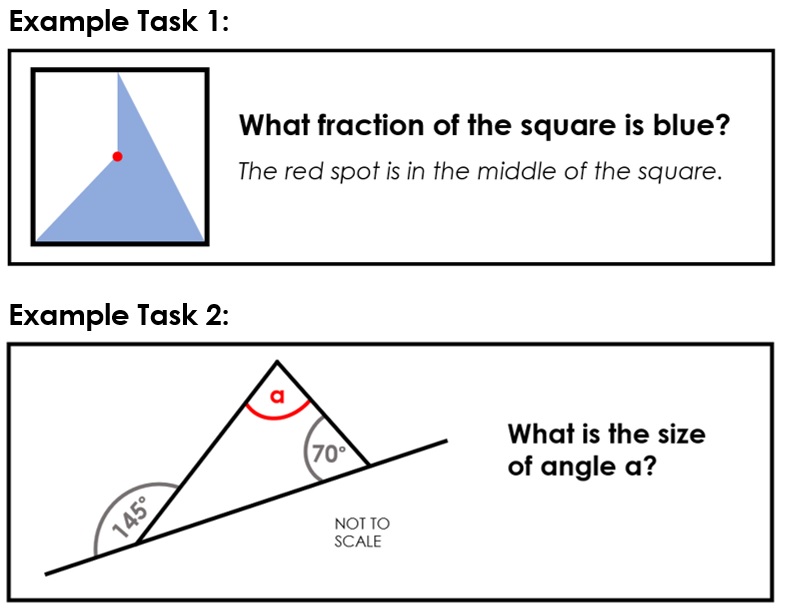
And here are two other initial prompts:
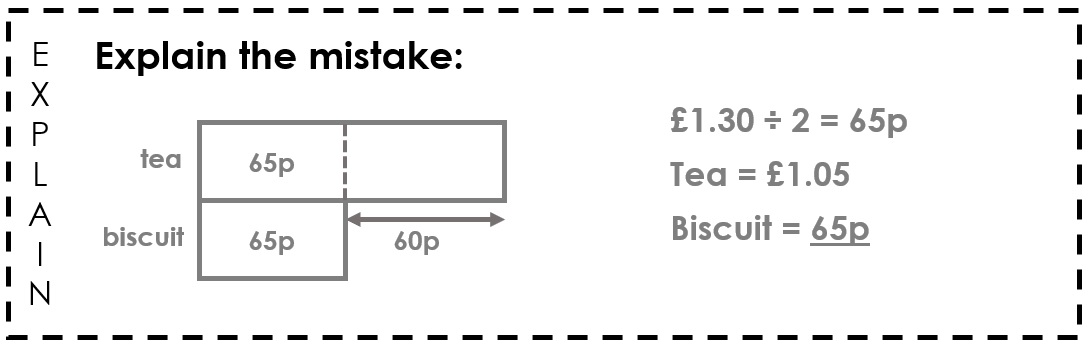
Each task comes with an Explain prompt, where children have to unpick likely misconceptions, solve related problems, rank questions by difficulty or agree/disagree with different opinions. The prompts here are similar to those from I See Reasoning – UKS2 and will extend the thinking from the initial prompt. Here are the Explain prompts for the above examples:

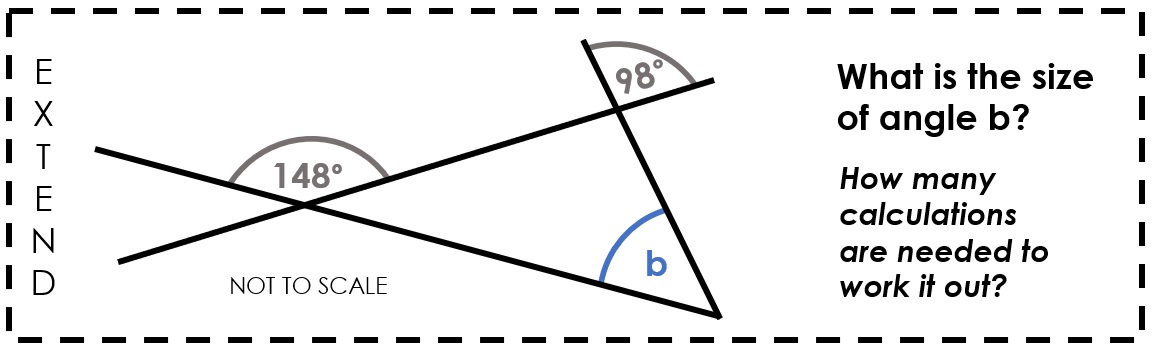
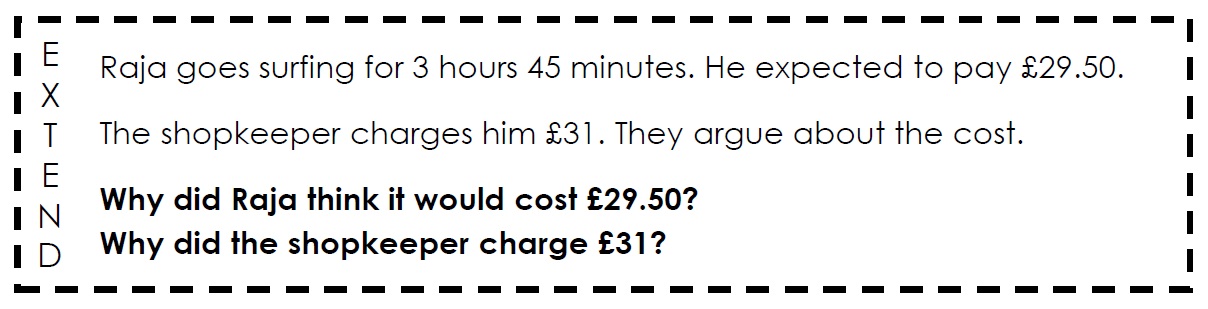
For many children, the real challenge will come from the Extend prompt for each task. These tasks are related to the initial prompt, but the challenge is taken to the next level. These are the corresponding Extend examples (and two of the friendlier ones!):

This blog explains how extra support is also provided in each task.

I See Problem Solving – UKS2 includes a huge range non-standard problem-solving tasks spanning right across the curriculum. It costs £24.98.

I See Problem Solving – UKS2: providing support

I See Problem Solving – UKS2 is designed to transform the teaching of problem-solving in mathematics. Its design addresses Recommendation 3: teach strategies for solving problems from the recent EEF report. It will give all children the opportunity to understand and answer non-standard questions, whilst also providing appropriate challenge. This blog focuses on how extra support is provided to help children to ‘see’ the structure of the problems and to experience success.

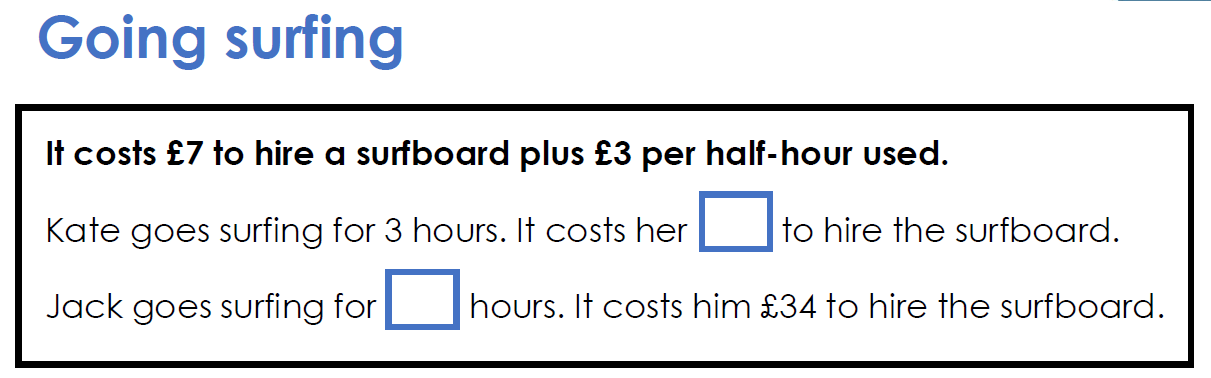
The tasks are designed to be used at the end of a sequence of lessons, so children have developed their basic skills in that curriculum area. To start with, children are given the initial prompt – a question where there is not an obvious ‘standard’ approach to work out the answer. Here are two examples of the initial prompts:

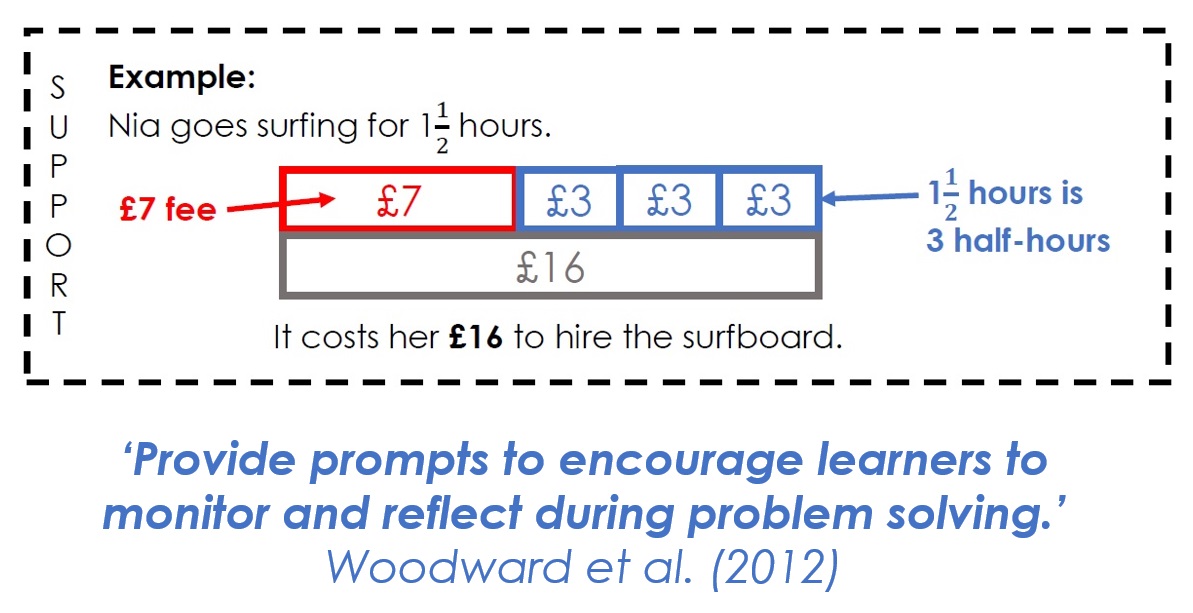
There is then a ‘support’ prompt for each task which the children may choose to use. This will help children to understand the mathematical structure of the task. It may show a part-completed bar model, give some suggestions or offer a ‘way into’ the task. This will help all children to access the task and be more likely to taste success.

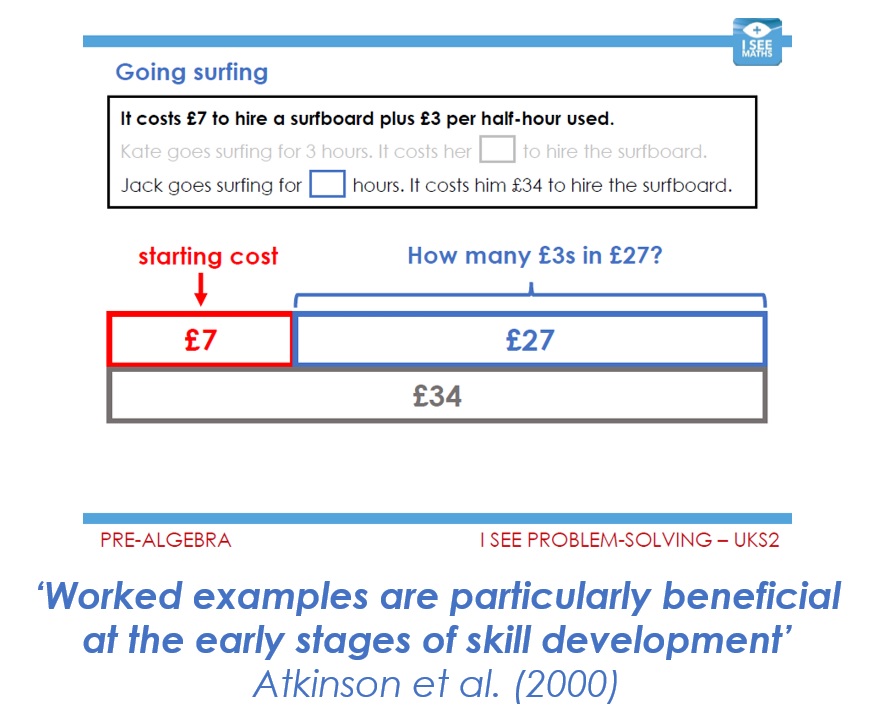
Then there is a ‘worked example’ to accompany each task. This is a series of images that shows the solutions modelled step-by-step, helping children to see the ‘deep structure’ of each problem. You will be able to download this for free as a PDF and/or as a PowerPoint file (available at iseemaths.com when the product is released). Here is a page from each of the worked examples from our two example tasks:


This blog explains how deeper levels of reasoning and extra challenge are then built into each task.

I See Problem Solving – UKS2 includes a huge range non-standard problem-solving tasks spanning right across the curriculum. It costs £24.98.

The Vision: I See Problem-Solving

My philosophy has always been simple: be firmly rooted in educational research; find ways to apply evidence-based principles in the classroom; share the ideas that work best with other teachers. This approach led to me write the I See Reasoning eBooks, and it has driven the creation of my next resource, I See Problem-Solving UKS2.

In reference to problem-solving in maths, the latest EEF research states:
‘Explicit training appears essential; these sub-skills do not appear to derive from practice without direction and oversight.’

It also says: ‘Teachers should deliberately select visual representations that are appropriate to the problem’ and continues ‘provide prompts to encourage learners to monitor and reflect during problem solving.’

My belief is that I See Problem-Solving UKS2 will help us to explicitly teach problem-solving skills, helping all children understand the mathematical structure of each question. The resource will unpick a wide range of multi-step problems from right across the UKS2 maths curriculum.

Each task centres on a main question, like the example below:

Tasks are made more accessible by the ‘scaffold’ prompt which children have the option of accessing. This might be a part-completed worked example, a related example or some other prompt to break down the question:

The ‘explain’ prompt will provide a context for deeper thought or discussion, for example using ‘explain the mistake’ examples:

There is also an ‘extension’ prompt to provide further challenge based on the same task:

The mathematical structure of the problem is shown step-by-step and very visually by the ‘worked example’. This will be made available as a PDF or as a PowerPoint file. The worked examples can be displayed like ‘flip books’, showing each stage of the problem. Click here to see the worked example for this task – click through the pages rather than scrolling up and down for maximum effect!

I See Problem-Solving UKS2 is currently in production. It is being trialled by a large team of teachers who are sending me feedback on how the tasks can be improved. To join the team, register here.

I’m writing the resource over the 2018 summer holidays, will trial a few tasks in early September then I will aim for a September release – watch this space!