Promoting Reasoning Part 3: Variation

This blog post, the next in the ‘promoting reasoning’ series, features question types that help children to build on their current knowledge and notice important similarities and differences between questions.

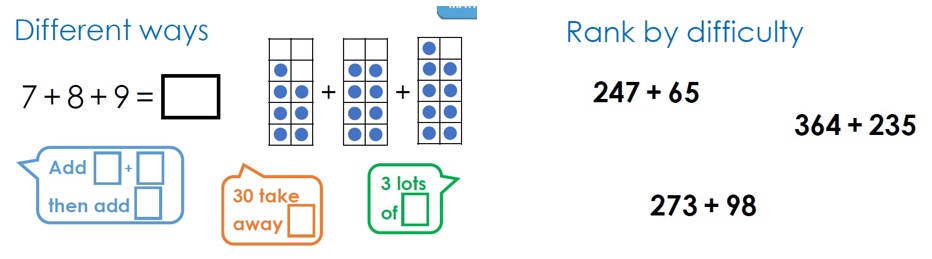
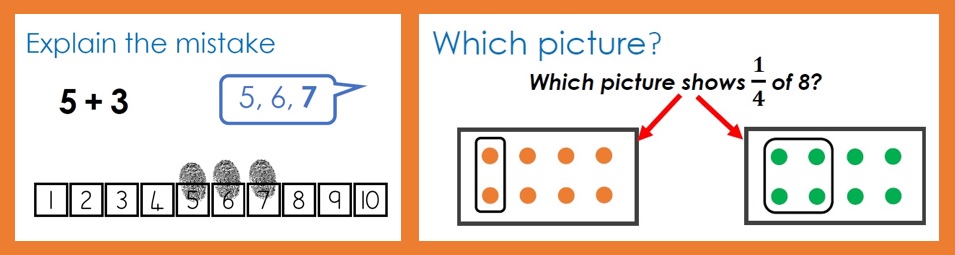
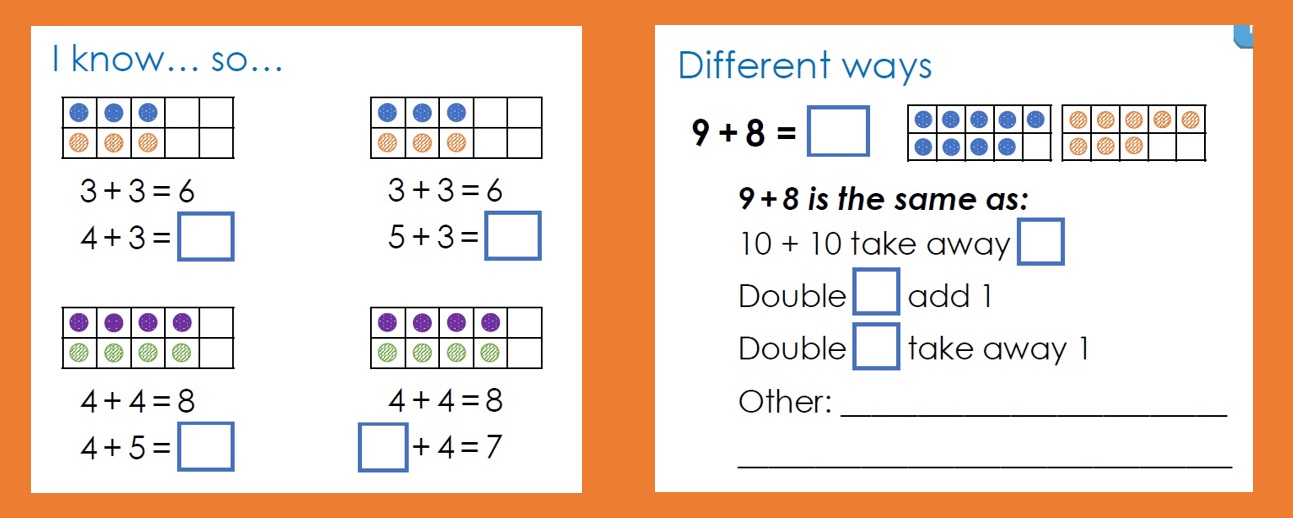
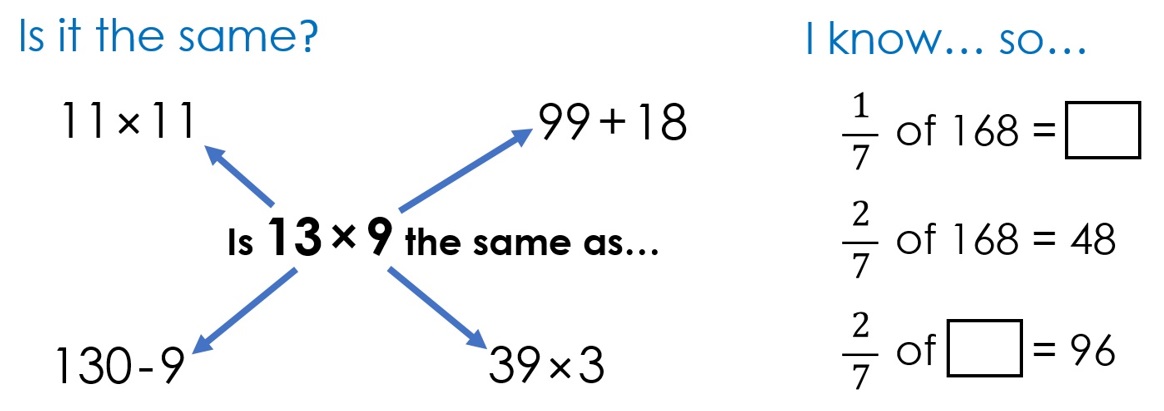
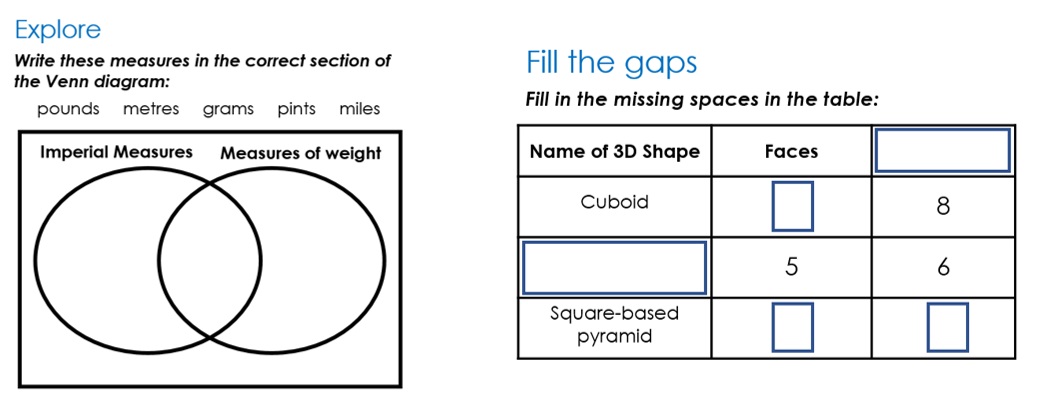
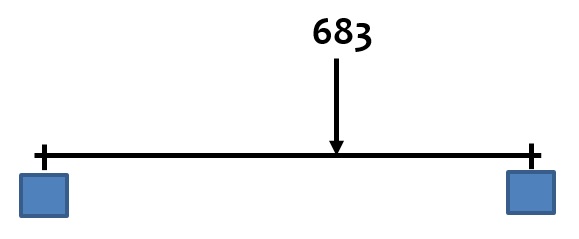
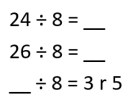
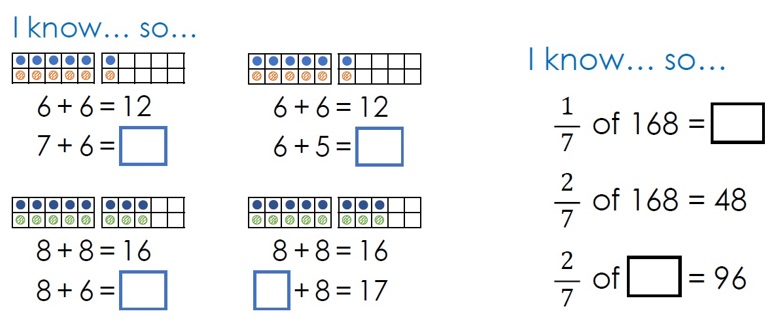
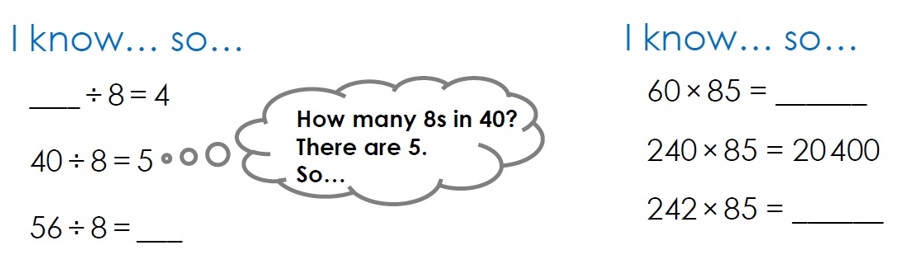
I’m always looking for ways to promote non-counting calculation (there are overlaps here with my ‘visuals’ blog). Prompts like the below-left example helps children to make connections between doubles and near-doubles facts. Children can edit the image to help them see those relationships. Similarly, I love using ‘I know… so…’ question strings. In the below-right example, I hope children will either perform the calculation using the related fact, or they will see the relationship between the three questions.

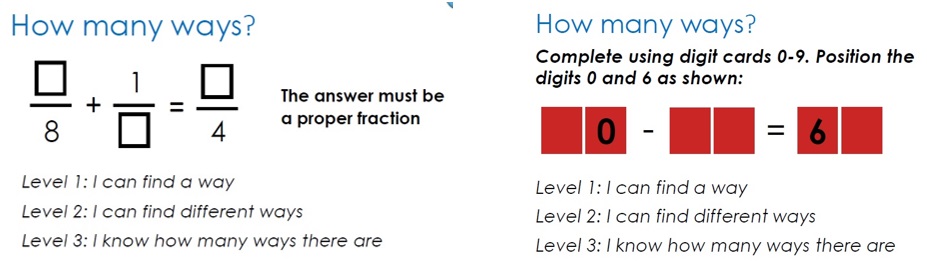
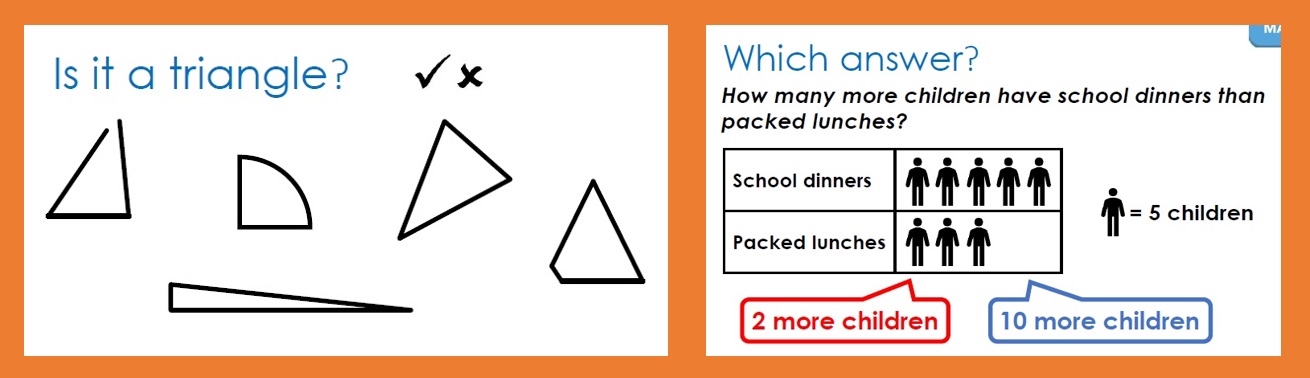
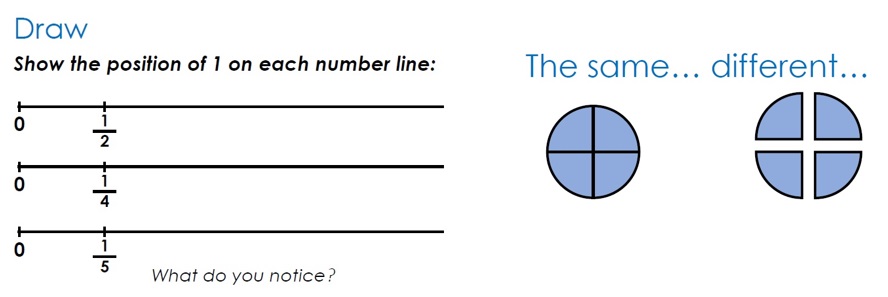
The examples below probably fit the criteria of ‘variation’ more tightly. Specifically, by keeping all but one aspect of a question/image the same, children’s attention is drawn to the key difference. Consider the below-right example: the left hand image the dominant idea is likely to be ‘one circle’; the right hand image emphasises ‘four quarters’ more. Used together, children’s attention is drawn to four quarters being the same as one whole.

When using the ‘I know… so…’ prompt, I might adjust the amount of variation between the examples depending on where children are up to in their learning. That’s all about knowing your children, the magic ingredient that every great teacher has up their sleeve!

All the examples in this blog are from the ‘I See Reasoning’ eBook range:
I See Reasoning – KS1
I See Reasoning – LKS2
I See Reasoning – UKS2

Also check out the other blogs from the series. 
Promoting Reasoning Part 2: Visual

This is the second blog post in a series looking at building reasoning within the maths curriculum. Here I’m looking at the using visuals in maths questions.

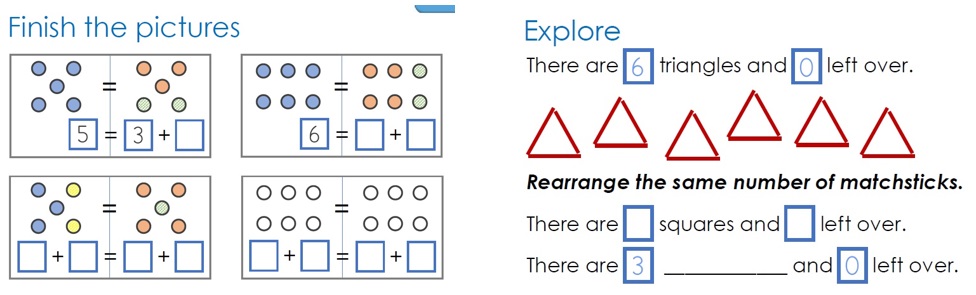
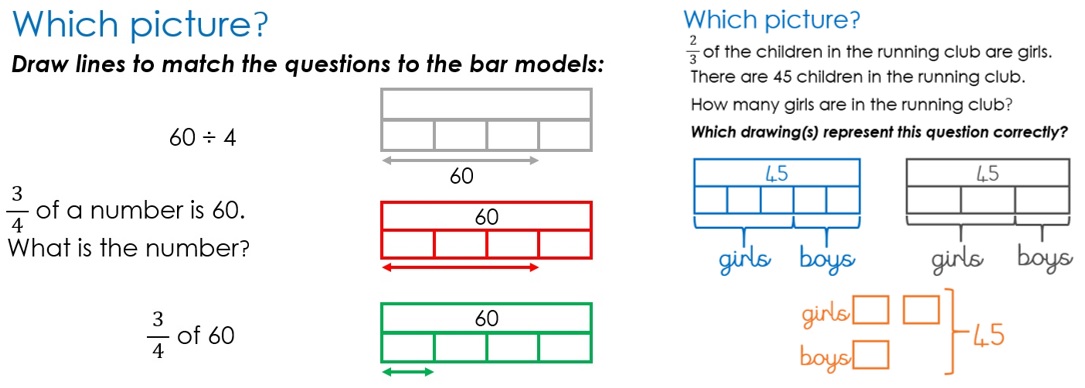
I’m always thinking about the best way to represent maths concepts practically to build understanding. The visual questions I use, therefore, are designed to correspond with the practical/visual models I have already used. The below-left example is one way that I represent the concept of ‘= means the same as’. The below-right example is a prompt that can be used to launch a practical investigation using matchsticks, developing the thought process of ‘how many [divisor] in [dividend]’ as children learn to do division by grouping.

By using questions that correspond directly with children’s practical experiences, the transition between concrete/pictorial to abstract is smoother. I might also use the visual to address common misconceptions (below-right example).

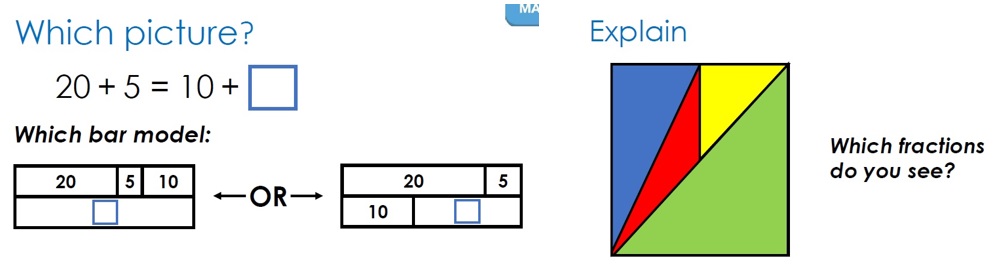
Below are two of my favourite types of visual reps questions to generate discussion. I like using ‘which picture’, where children have to consider which bar model represents a question correctly, and which bar model is showing a common error. Can children explain the mistake? I also love open-ended visuals: the bottom-right example is a particular favourite. More similar examples on this theme on the next blog!

All the examples in this blog are from the ‘I See Reasoning’ eBook range:
I See Reasoning – KS1
I See Reasoning – LKS2
I See Reasoning – UKS2

Also check out the other blogs from the series. 
Promoting Reasoning Part 1: Misconceptions

In this series of blog posts I wanted to share some of my ‘go to’ strategies for interweaving reasoning throughout the maths curriculum. This post is all about specifically addressing common misconceptions.

When planning a sequence of lessons, I tend to spend an eternity considering two things: how to represent each mathematical idea to build children’s conceptual understanding, and the possible misconceptions children may have. Initially I try to break learning down into small, easy-to-digest steps (more about this phase in future blogs).

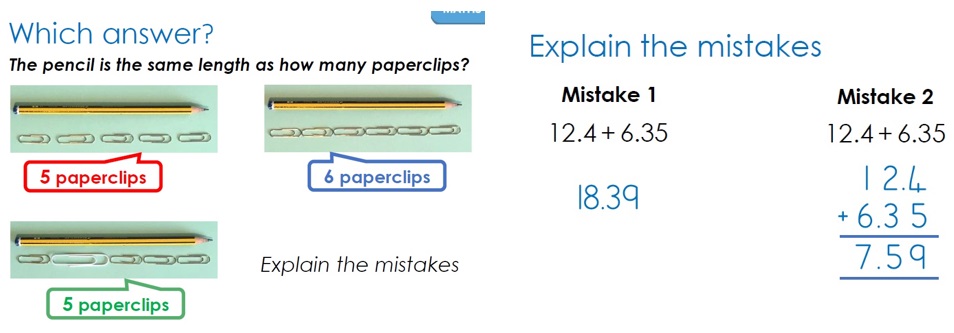
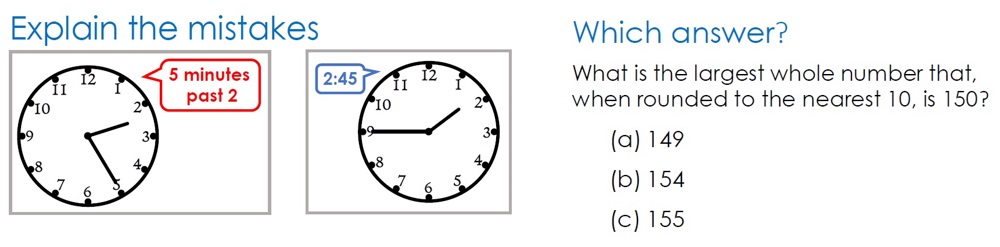
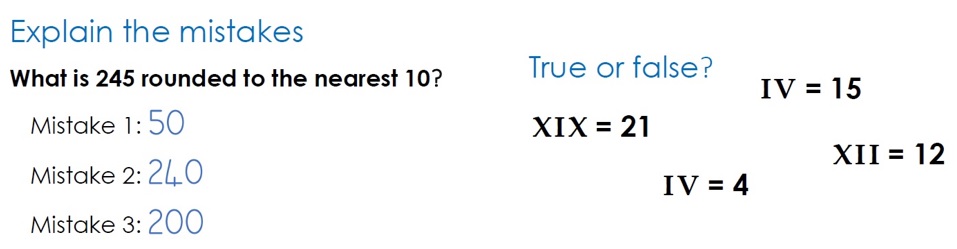
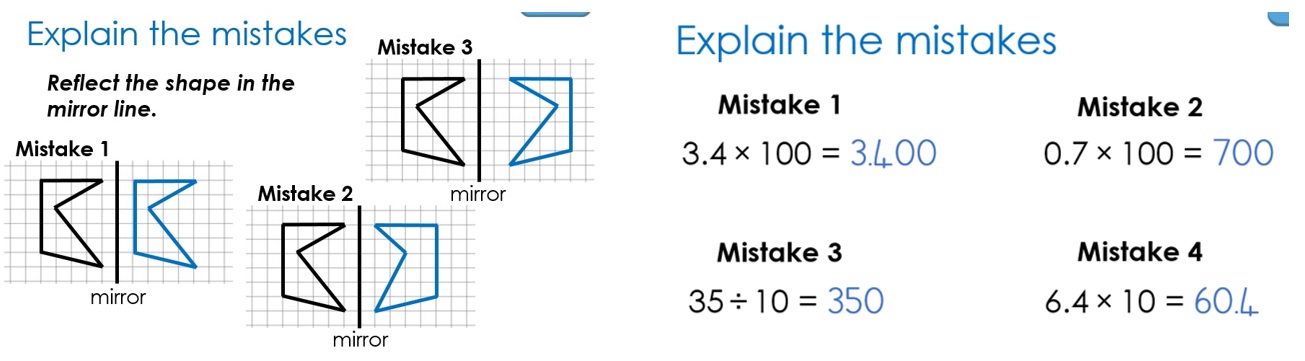
Then, when I think the children are ready, I try to address those misconceptions directly. I want to focus thinking on the key points that discern right from ‘likely wrong’, deliberately highlighting common errors. Sometimes, like the example below, I might show three possibilities and ask ‘which answer?’. Alternatively, I might ask children to explain given mistakes.

I find that these questions generate great discussion and explanation. I use these examples at different points within a lesson: sometimes as a way of addressing errors from yesterday; often as a final task before children work independently; occasionally as a plenary (although only if very confident that the children will take the correct conclusion away). Having read ‘How I Wish I’d Taught Maths’ by Craig Barton I will start using a couple of them mid-lesson to assess children’s understanding and signpost pupils to appropriate follow-up activities.

Predicting those errors is very much a skill in itself, developed over years of experience. And the process of coming to understand children’s incorrect responses, I find fascinating. Hopefully this technique will help your children to focus on those key learning points, and solidify their conceptual understanding in a range of areas of mathematics.

All the examples in this blog are from the ‘I See Reasoning’ eBook range:
I See Reasoning – KS1
I See Reasoning – LKS2
I See Reasoning – UKS2

Also check out the other blogs from the series. 
I See Reasoning – KS1

I’m delighted to announce that I See Reasoning – KS1 has now been released! It arms teachers with 281 thought-provoking prompts for embedding reasoning in every area of the KS1 maths curriculum.

The eBook’s creation has been a personal odyssey, beginning 18 months ago teaching a quite wonderful year 1 class. I’ve always been passionate about the power of visual, rich tasks to engage children in deep mathematical thought; designing tasks that achieve this for children in KS1 has been an awesome challenge. It’s led me to work side-by-side with some great teachers and share many memorable classroom moments.

So here’s what to expect. First of all, there are loads of prompts that help children to distinguish between right and ‘likely wrong’, helping to generate meaningful talk. Words are kept to a minimum – simplicity is king!

There’s a raft of questions presented with visual supports that encourage non-counting calculation strategies. Scaffolds are provided to focus children’s thinking onto key ideas or strategies.

There are a wide range of challenges, giving children the opportunity to build conceptual understanding and apply their skills in various ways.

And questions are diverse, covering all areas of the curriculum.

I believe I See Reasoning – KS1 will help to enrich maths lessons on a day-to-day basis. It’s been a joy to write and it’s my great privilege to share. I hope it gives you many great classroom moments!

I See Reasoning – KS1 is a digital download (£14.99). Buyers receive their eBook (as a PDF file) attached to an email from Etsy. There is no need to have an Etsy profile.

To see more information about the resource and to get access to the free addition sample section click here.

Also check out I See Reasoning – LKS2 and I See Reasoning – UKS2.

Full details about my maths training can be found at www.iseemaths.com and you can follow me on social media at Gareth Metcalfe Primary Maths (Facebook) , @gareth_metcalfe (Twitter) and I See Maths on Pinterest.

Chance favours the connected mind…

My vision is to help children experience maths – visual, deep maths – in all its richness. To this end, I’m passionate about creating a range of user-friendly resources that will help time-pressured teachers to deliver great maths lessons on a day-to-day basis. And to make these resources truly outstanding I need your help!

Future plans, your help
I’ve recently finished writing the range of I See Reasoning eBooks. Much to my amazement, over 800 people signed up to trial I See Reasoning – KS1. The feedback that people gave was extremely helpful. Over the next few years I will write many more resources, and I want to involve as many teachers as possible in the creation of these products (this time with trial materials being sent from the earliest conception of a product). You tell me which tasks really work, and how each idea could be better. I’m working on these ideas next:

  • A resource which represents maths concepts visually using a sequence of clearly constructed, step-by-step images. The first versions of this will be aimed at KS2.
  • A resource helping children to become effective problem-solvers. It will be made up of my favourite problem-solving tasks, broken down with the necessary scaffolds and supports that help children to see the underlying mathematical structure of each problem.
  • A resource for EYFS that is a follow-up to the I See Reasoning range, but delivered in a format more suited to an Early Years provision.

I’m after a team of people who will trial these ideas in their classrooms, let me know what they think of them and tell me how they can be improved. No strings attached, it’s all free, there’s no obligation to reply. The ideas will be plentiful and thought-provoking. You may well get lots of free, useful tasks that never end up being published!

If you are up for it sign up here. Please share this blog too, it would be great to get as many educators on board as possible. Thanks!

I See Reasoning – LKS2

I am delighted to announce that I See Reasoning – LKS2 is now on sale! It will arm teachers with a range of visual and thought-provoking tasks for interweaving reasoning within day-to-day maths lessons.

I See Reasoning – LKS2, the little sister of the hit resource I See Reasoning – UKS2, is a PDF file received as a digital download. It is comprised of 240 questions for deepening mathematical thinking and encouraging purposeful peer discussions. It is a go-to resource for prompts that build understanding and tasks that allow for extended investigations. This blog showcases what to expect from the resource by looking at three typical example questions.

Prompts that show concepts visually

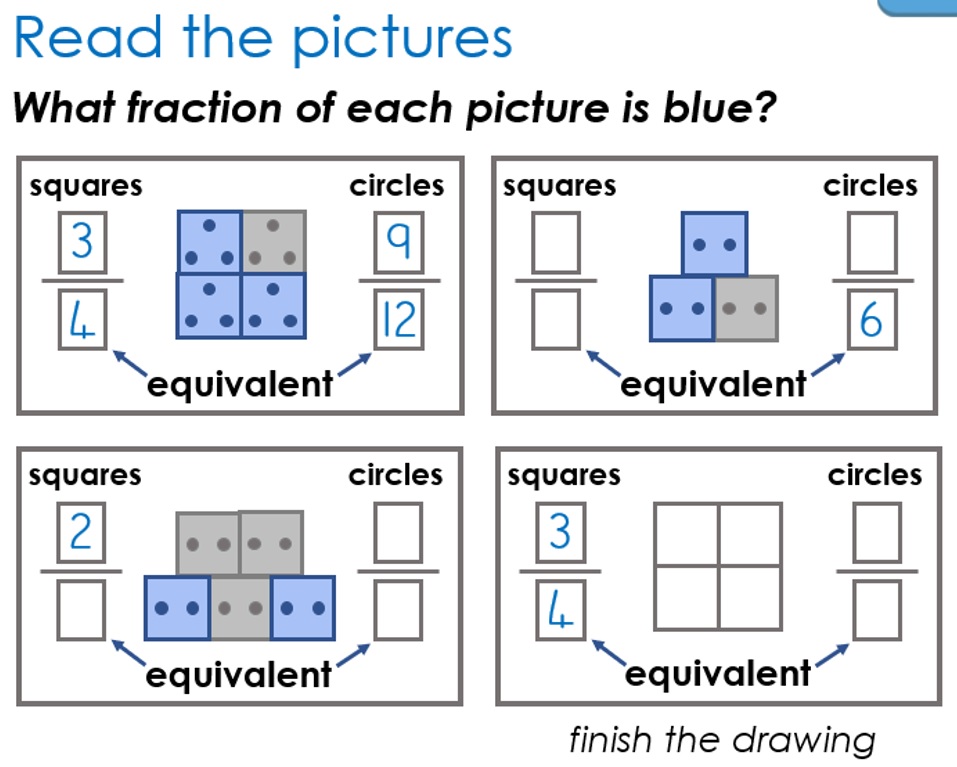
There are a wide range of questions that use visual representations to help children to make connections and develop a conceptual understanding of core concepts. There are lots of ‘read the picture’ examples like the one above, ideas are often represented with bar models and many other images are used.

Prompts that generate discussion around key ideas

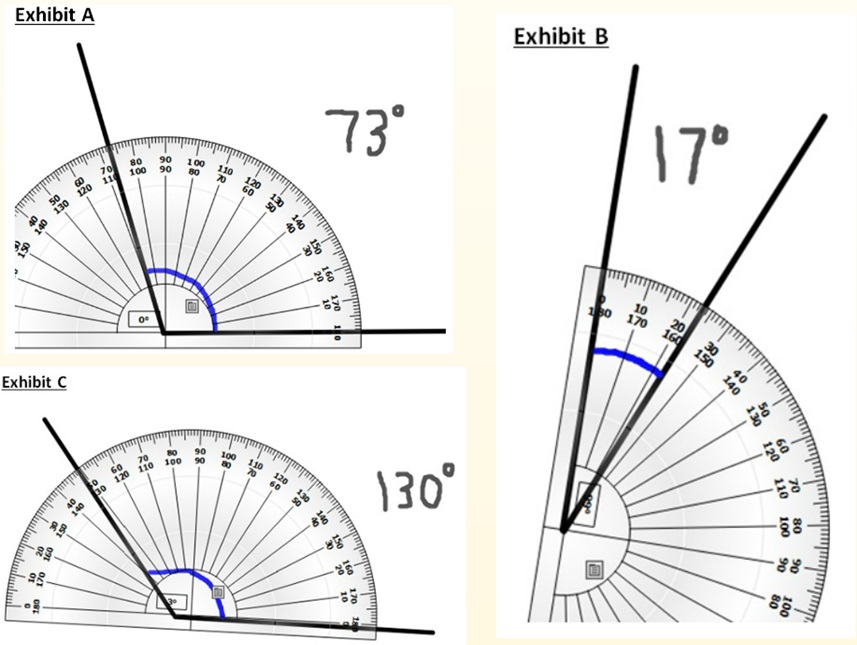
There are lots of examples that get children talking about key concepts and identify likely misconceptions. In this example, will children recognise that the size of the angle is represented by the amount of turn rather than the length of the lines? There are thought-provoking images from right across the LKS2 curriculum.

Opportunities for extended exploration

Many of the questions will ask children to calculate in different ways or find multiple solutions. This means challenge is added by getting children to explore the same type of question in more depth, working systematically and flexibly to find all possible answers.

It’s my belief that teachers generally agree on the principles of great maths teaching. However, time-pressured teachers need great resources at their fingertips. That’s what I attribute the unbelievable success of I See Reasoning – UKS2 to. It is ever-increasingly popular and has sold in 12 countries!

I have been so touched by the very many positive messages I have received in recent months. It’s my great pleasure to help teachers create meaningful and engaging maths lessons. I hope I See Reasoning – LKS2 is another piece of this jigsaw.

I See Reasoning – LKS2 is on sale via Etsy here. Information about the resource, plus the free multiplication section, can be accessed on this page.

For further information about training and resources, visit www.iseemaths.com

I See Reasoning – UKS2

We all want to be able to build reasoning into daily maths lessons. For a time-pressured teacher, that can be easier said than done. I See Reasoning – UKS2 provides rich tasks to deepen learning across the maths curriculum. It’s my ‘go-to’ resource when preparing lessons.

Concepts in I See Reasoning – UKS2 are often shown visually. In the Which picture? questions children match questions to a correct visual representation:

Explain the mistakes questions draw attention to likely errors:

Questions encourage connections between related calculations:

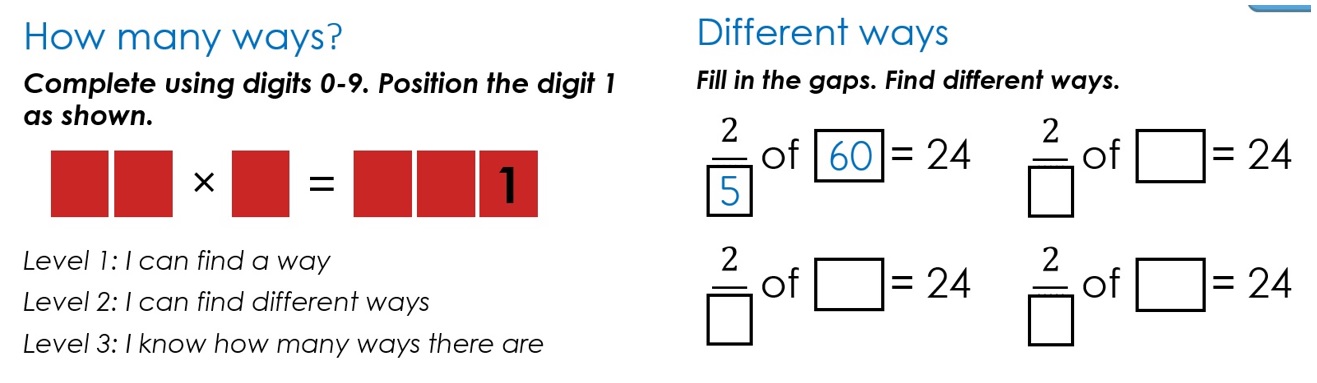
Children are encouraged to find multiple solutions:

And there are a range of other question types besides:

I See Reasoning – UKS2 comes as a PDF file emailed direct to your inbox. You can then save the file in a location of your choice. You can view the file from an Etsy account if you have one (although you don’t have to make an account to receive the file by email). Circulation of the file is prohibited.

Screenshots can be taken to be used in presentations or printed for children’s work. There are 176 questions, all varied in form, with answers provided where necessary. I See Reasoning – UKS2 corresponds to US grades 4&5 and Australian year groups 5&6.

I believe that I See Reasoning – UKS2 can be used to supplement any scheme of work. I hope it helps to deepen the learning in your classroom; I also hope that it makes your life easier when planning at the end of a busy school day!

CLICK HERE TO BUY I SEE REASONING – UKS2

Training and Resources for Summer ’17

I set up I See Maths to help time-limited teachers create powerful learning experiences in maths, engaging children intellectually and emotionally. To that end, here’s what I’m offering this summer:

Training
I’m delighted to announce four new conference dates this summer: full conference details can be found here. Early Number Sense: Beyond Counting  will give a clear Nursery-Y2 vision for how children build a strong feel for number and learn to calculate using non-counting strategies. We will explore how mathematical play can be extended and how reasoning can be embedded. Reasoning and Depth in KS2 Maths will give an exciting and practical vision for deepening mathematical learning, including how images and resources can be used to build understanding.

If you are interested in this training, you may consider arranging a conference event at your school – all that is needed is a spare room. This is a very cost-effective and popular way of running training – for full details click on the top two links on this page.

Resources to Buy
I’m working hard on the I See Reasoning eBook range and hope to write the UKS2, LKS2 and KS1 versions this term (I may be dreaming!). This will give teachers a massive bank of questions and tasks that will open up discussions and encourage reasoning. I’m extremely excited about this project – this blog gives more detail.

The iPad app I See Calculation is also in the final stages of being built. It will show standard written methods for calculation one step at a time. A child could check their answer to a question with a calculator; with I See Calculation they will be able to check each step of their written calculation.

Free Resources
I’m intending to create a series of free ‘flipbook’ dot pattern games that will help children to visualise addition, subtraction and multiplication, opening up discussions about calculation strategies.

Full details about my INSET training and in-school support can be found by clicking the links. I’m a NCETM Charter Standard provider of CPD and, being a class teacher, still very au fait with the realities of teaching in the classroom.

I hope that, in some way, my work can help you in the daily challenge of delivering great maths lessons. Enjoy the summer term!

I See Reasoning – In Production!

I’m passionate about creating maths tasks that get children thinking in new ways and generate curiosity. I’ve spent many enjoyable hours dreaming up such tasks: open-ended prompts that promote discussion; images that build understanding; questions that get children exploring big mathematical ideas in depth.

This summer I’m releasing all of my favourite tasks in a series of eBooks called ‘I See Reasoning’ – there will be UKS2, LKS2 and KS1 versions. I believe these tasks will become a ‘go to’ resource for primary teachers as they plan lessons, giving a range of thought-provoking questions and prompts for each maths topic. This isn’t another bank of SATS-style questions – tasks are more visual, more extended and much more open-ended.

First released will be ‘I See Reasoning – UKS2’. For each topic expect:

Prompts that facilitate open discussion

Explain the mistakes (above left), less information (above right), rank by difficulty and ‘broken calculator’ are common structures.

‘Minimally different’ questions
Varying the structure of questions very slowly. All of a child’s working memory is focused on the mathematical concept being developed – a structure I suggest using early in a sequence of learning.

Tasks providing variation and deep exploration
A wide array of varied question structures and ideas. Think visual, open and extended, often making use of structures like ‘how many ways’ or ‘always, sometimes, never’ and a range of games using digit cards 0-9.

A place value activity using digit cards 0-9


Sorting quadrilaterals branching database task 

I’m aiming to release the eBooks every 4 weeks. They will be view-able from different devices, making them user-friendly. I hope they help save teachers’ time in preparing lessons, supplementing your current resources.

Alongside First Class Maths and Maths Outside the Box, I believe that the ‘I See Reasoning’ eBooks will help children to engage in mathematics intellectually and emotionally.

More updates to follow!

Designed to Thrill: Maths Outside The Box

There’s so much to applaud about the way primary maths education is changing. Equipment and images are being used to build understanding; open questions allow children to explore ‘big ideas’ in depth; fixed mindset views are being challenged and changed.

I want to see one more piece added to this jigsaw: children becoming more emotionally engaged in mathematics, the kind of mathematics that I love. Rich, diverse and intriguing tasks that fire the imagination, the kind that you don’t want to put down. That was the vision behind Maths Outside The Box.

The 15 Maths Outside The Box tasks will broaden children’s experience of maths and give them interesting, extended contexts in which to apply their skills. I trialled the resource with a group of high attaining Y4 children (we had so much fun); I also used the tasks with all but my most able Y6s. Challenge comes more from the application of logic than the difficulty of calculations, so tasks aren’t specifically designed for children in a particular year group.

There are four Number Challenge tasks: for example, in The Raffle Puzzle the challenge is to work out the five winning raffle ticket numbers by piecing together the information from the six clues:
raffle

One of the three Data Cruncher tasks is Can We Have a Dog? where a range of information and graphs are used to estimate the cost of owning different breeds of dog over the course of their lifetimes:
dog

The Mountain Pass is one of four mind-bending Logic Puzzle tasks: can you piece together the information to work out how the four walkers can all cross Gravely Gorge before sunset?
gorge

I love the Investigation tasks. The Human Ruler allows children to explore the relationship between different body parts and I will always remember trialling Marathon Pace: the children tried to replicate the exact running speed of Uncle Grant and Aunty Kirsty on the school field!
marathon

I’m extremely proud that my resources are published by Alan Peat ltd. I first attended one of Alan’s training sessions in 2006 and was absolutely blown away by the quality of his ideas. Alan and Julie also happen to be 24 carat gold as people too. They have given me unconditional support, are fiercely principled and are great company. Amy Doorbar also deserves great praise for her amazing graphic design on the resource.

I hope Maths Outside The Box inspires many: on sale here!