As educators, we are acutely aware of the need to develop positive attitudes towards maths. The way that children view maths, and view themselves as mathematicians, are crucially important. In the blog Emotional Regulation in Learning Mathematics, I explore how we can help children to navigate the emotional experience of being a mathematician.
However, caring for children as mathematicians is far more than providing emotional support: it is about the nature of the tasks that we put in front of children. This is how we show what we value and what we believe mathematics is. On this subject, I have been inspired by the work of the wonderful Anne Watson. She has written and spoken extensively on this topic, both in the UK and internationally.
I had the fortune to spend a day with Anne. When we met, talked about my daughters school play. After the performance, a parent said how wonderful it was for the children to have this experience, where they can flourish personally (I totally agree). This is different to learning maths, I was told, which is academic. This felt so jarring! Anne said that we would never think that way about a child writing a poem. Writing poetry requires academic skills, but we also think of it as a personally expansive act. And so is mathematics. Maths can be such a powerful lever for personal development, when children engage in rich mathematical tasks.
In the last decade, I we have developed more awareness of educational research and of best practices in mathematics teaching internationally. This has added real rigour to mathematics teaching in the UK, it has been very positive. I also believe that the true nature of mathematics is for children to be playful, curious and engage with their classmates in a shared pursuit. I believe that these two things – rigour and playfulness – can sit together. They are not opposing forces.
It has made me think about how we can design a curriculum that is mathematically rigorous and mathematically playful. It has made me think about how mathematics can also be a tool for connection, how it can be socially enriching.
The actual task design, I believe, is not something to dump at the feet of teachers. It is for those of us involved in leading mathematics and who design mathematics. We must care about children’s emotional and intellectual engagement in mathematics. This must be the unmissable hallmark of the tasks that we provide for children.
My default has always been to focus on the ‘how’ and I will share some examples below. But more than anything, I would love to engage in a global conversation on how mathematics can be playful and rigorous. I would love to hear your thoughts, ideas and examples. I want to broaden my view and build upon my own repertoire as a task designer. I would love to work alongside different people locally and internationally as part of this shared pursuit.
A few examples…
One technique that can be used are the ‘odd one out’ tasks below (akin to the Which One Doesn’t Belong examples). Children can access the task if they can give an answer; the challenge is to come up with a reason for each example.

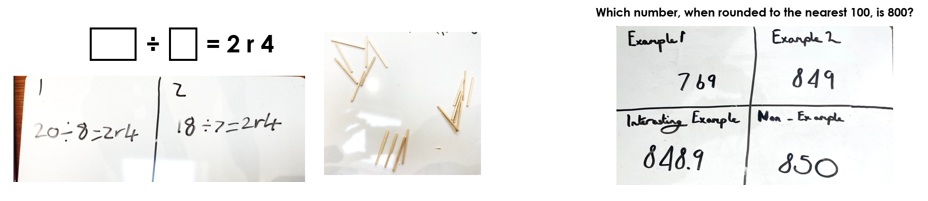
I also love questions with different possible answers. Prior to the left-hand example question being given, the children explored dividing by 3 by making triangles with matchsticks (e.g. with 20 matchsticks, 6 triangles can be made and the remainder is 2). We understood that the there remainder is always smaller than the divisor. Then, children found answers to the question ___ / __ = 2 r 4. Answers included 68 / 32 = 2 r 4. For the example on the right, we modelled the process of rounding using number lines. Misconceptions were highlighted and discussed. Then, children found a range of different answers to the question and could identify common wrong answers.
I’d love to hear your thoughts and your own examples – Gareth.
 Gareth Metcalfe Primary Maths