Adapting ‘I-We-You’ to deepen mathematical thinking

The principles of ‘I-We-You’ are central to my maths teaching: give children the tools to think with clear models and examples; build understanding and address misconceptions in the guided practice; then children work with high success in their independent practice.

Issues can arise, though, if an ‘I-We-You’ approach leads to a more procedural approach to teaching. Mathematics is not about following a set of pre-determined instructions. I might need a prescriptive approach if you are teaching me to wire a plug. Step-by-step instruction can help me to learn how to do a column subtraction. But it isn’t how I can become a mathematician. And it won’t lead to me becoming emotionally invested in my mathematics. Maths lessons should allow children to play around with key ideas, become curious and make connections.

There is another big challenge in the ‘We’ phase of the lesson. How can we provide questions/tasks that build understanding and extend thinking for all children? If children are given a question to answer in the ‘We’, some children may finish almost immediately. Other children may need more time and more scaffolding.

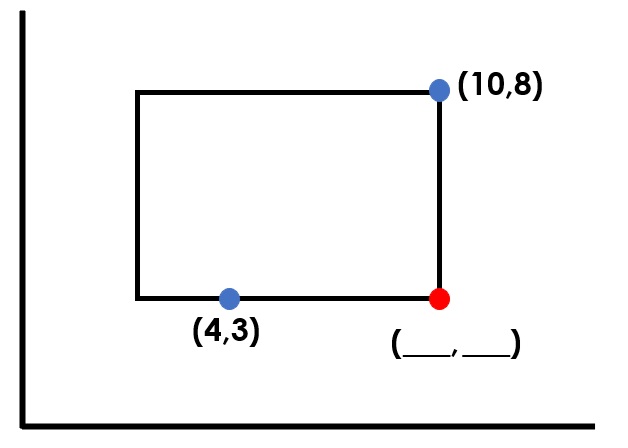
How can we hold all these ideas together? Is it possible to provide high-quality modelling and engage children in effective guided practice, whilst allowing space for children to be curious and make their own discoveries? I believe we can! In the ‘I’, think about exploring concepts rather than modelling steps. For questions in the ‘We’, think about using the slow release of information (the subject of this blog) or using pairs of questions (the subject of a future blog) to engage all children in discussion. Consider the question below:

Following an ‘I-We-You’ approach could mean modelling two questions that are near-replicas of this one. Then, I could give this question to the children to answer on their whiteboards. What problems do I see? Firstly, some children will be able to answer this question within seconds. The rest of the class, then, feel a pressure to catch up. Speed is emphasised, the answer becomes the focus. Secondly, will the children be able to answer a different coordinates question when the ‘steps to success’ no longer apply?

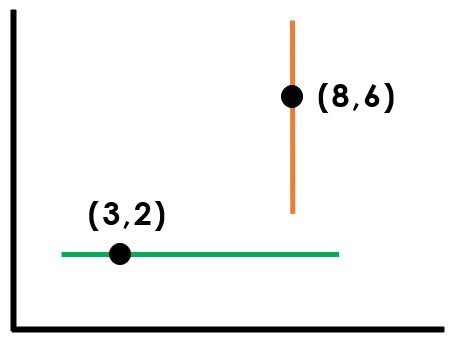
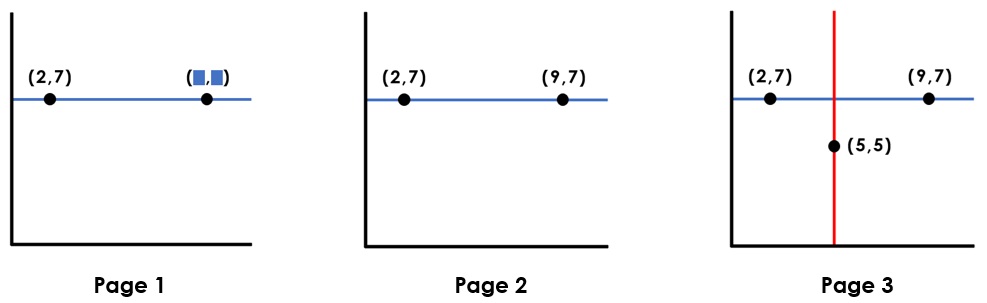
Here is a subtly different approach. In the ‘I’ phase, start by giving example coordinates that are and are not on the green and orange lines, noting the x/y coordinate that stays the same:

Then, looking at page 1 of the example below, I ask children to predict what the hidden coordinate could be, before revealing (9,7) and noting that the y coordinate is still 7. Next, introduce the red line (page 3). Ask children to predict which other coordinates could be on the red line. I could compare the positions of (6,4) and (4,6). Are they inside or outside of the bottom-left rectangle?

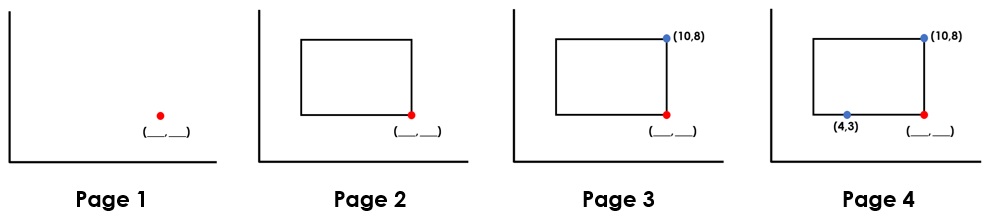
My main focus for this blog is to look at the slow release of the information for the question below, in the ‘We’ phase. Rather than presenting the whole question to the children, start at page 1. Ask the children what the red coordinate could/could not be. Note that x > y and spatially reason about the different possible coordinates. This acts as our estimate. Then, introduce the rectangle from the question (page 2) and ask the children ‘what information will we be given that will mean we can answer the question?’ Explore all possibilities. In doing so, children have the time and space to think about the structure of the task before the question itself is introduced. The necessary information is slowly revealed (pages 3 and 4) and children can now give the answer having had time to think about the structure of the question. To extend, coordinates on the vertices, edges and inside/outside the rectangle can be given.

The power of the slow reveal is that children get to ‘play around’ with the big ideas before they have to give an answer. Children have more time to process the information, which is revealed in stages. Challenge exists as we consider ‘is that definitely what the missing information will be?’ Reasoning is emphasised and children use their imaginations!

Please share your thoughts, objections or related examples! Is there another maths curriculum area that you would like me to consider on a future blog? Or other similar example tasks that you could share? I hope that this blog can spark some interesting conversations and collaborations!

I See Reasoning – Y1 and Y2: Exploring Concepts, Creating Reasoning Habits

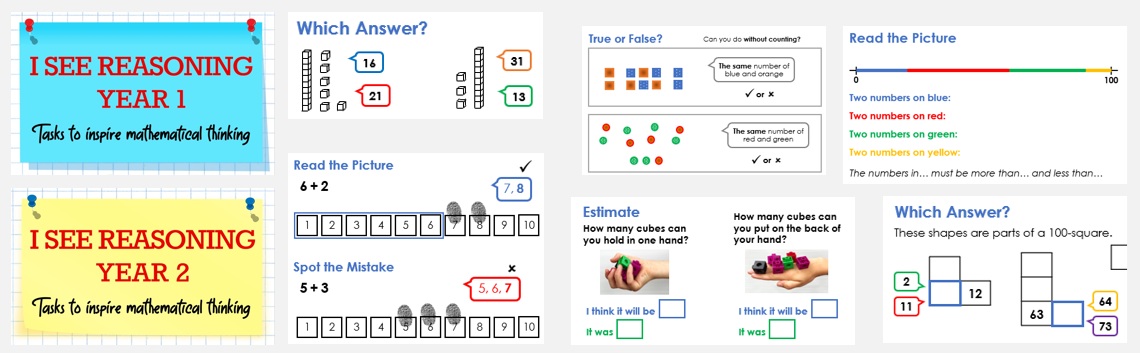
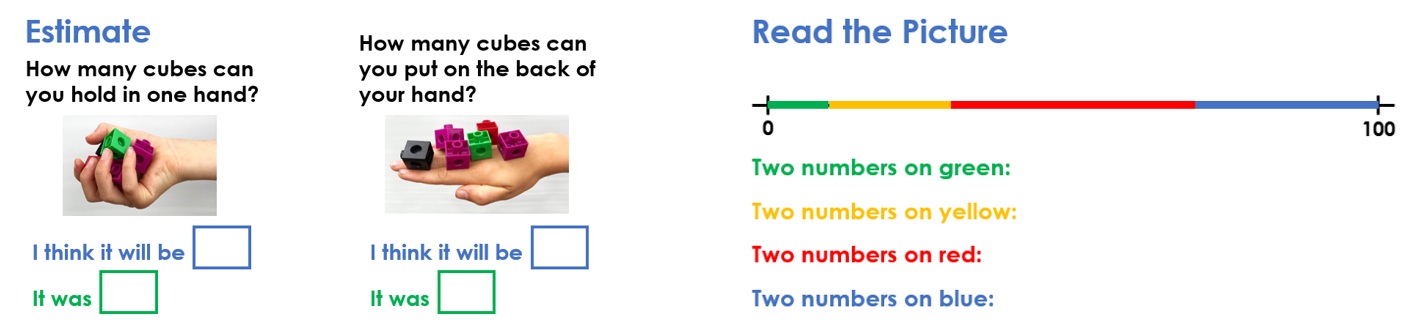
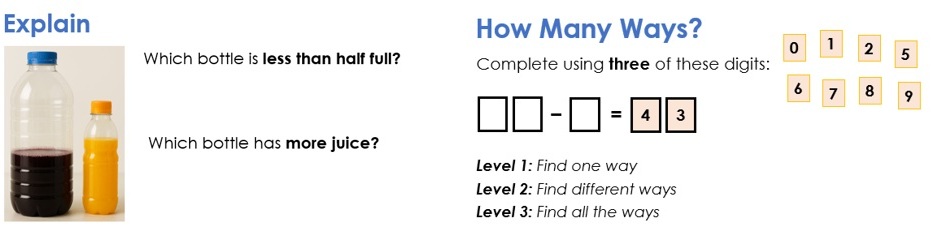
We want KS1 children to develop a deep understanding of Y1 & Y2 maths content. We also want young children to be able to explain their thinking, identify common errors, estimate, explore ideas and think creatively. The tasks in the I See Reasoning – Y1 and I See Reasoning – Y2 eBooks help to give children these experiences, inspiring a wide range of mathematical conversations and explorations.

These new eBooks have replaced I See Reasoning – KS1. They follow the same format as the original eBook, but include many, many more examples (365 tasks in the Y1 eBook and 392 tasks in the Y2 eBook) and they have a range of new types of reasoning questions. Here are some of the key ideas:

Non-counting strategies, estimation, reasoning

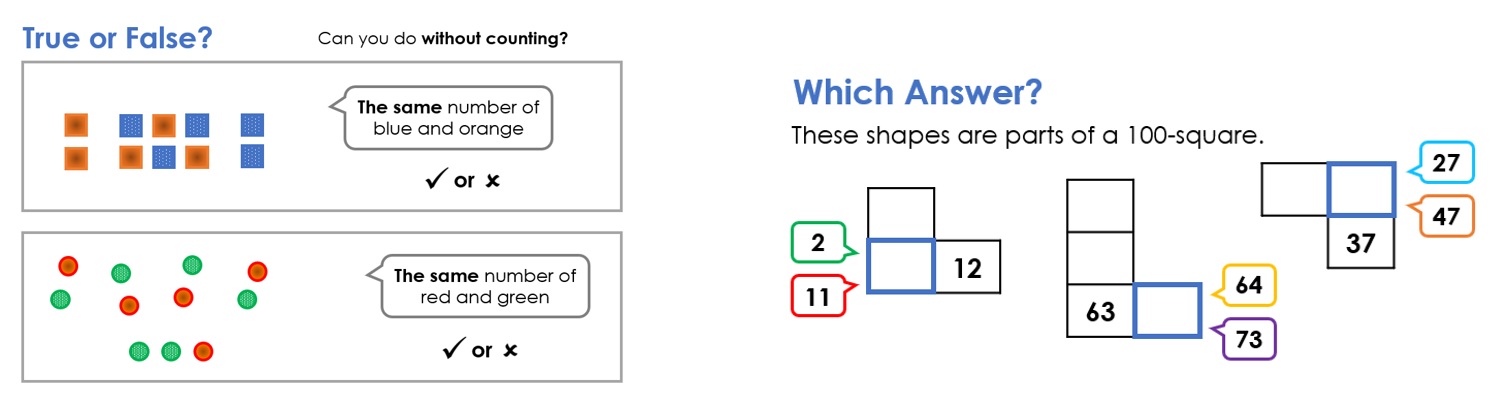
A HUGE focus is placed on children explaining answers using non-counting strategies. This includes ‘how many dots’ questions, where children describe their non-counting strategies. It involves calculations that border 10 or subtractions with small differences. The emphasis is not ‘what’s the answer?’ but instead ‘how did you know?’ or ‘what do you visualise?’ The questions are highly visual and don’t require too much reading.

Misconceptions, visuals, patterns

The questions introduce the key I See Reasoning question structures. Children will learn to spot mistakes, explain mistakes, compare questions and spot patterns. They will be challenged to explain what they noticed and find all of the answers. In doing so, children will be trained in the routines of thinking mathematically, routines that can be extended in KS2. This will help to build reasoning tasks into every maths lesson, giving schools a progressive approach to how reasoning is taught.

Exploration

There are lots of questions, of many different forms, for exploring mathematics. This includes estimation tasks, open challenges or questions with different possible answers. There are also a range of spatial reasoning tasks, for children being able to visualise items from different perspectives.

Depth

There are also a wide range of tasks to add challenge! These are very diverse and sometimes require children to find multiple answers or explain their thinking. These tasks are highly varied depending on the area of the maths curriculum that they cover.

The introductory price of the eBooks is £30 each (including VAT). From 1st January 2026, they will cost £35 each (including VAT).

I See Reasoning – Y1 and I See Reasoning – Y2 lay the foundations for children to experience maths as a thinking, exploring, explaining subject. If you click on the links, you can view a sample section of each resource. I hope that they inspire the children in your class and give you many fantastic classroom moments!

The New Deconstructing Word Questions – Y6

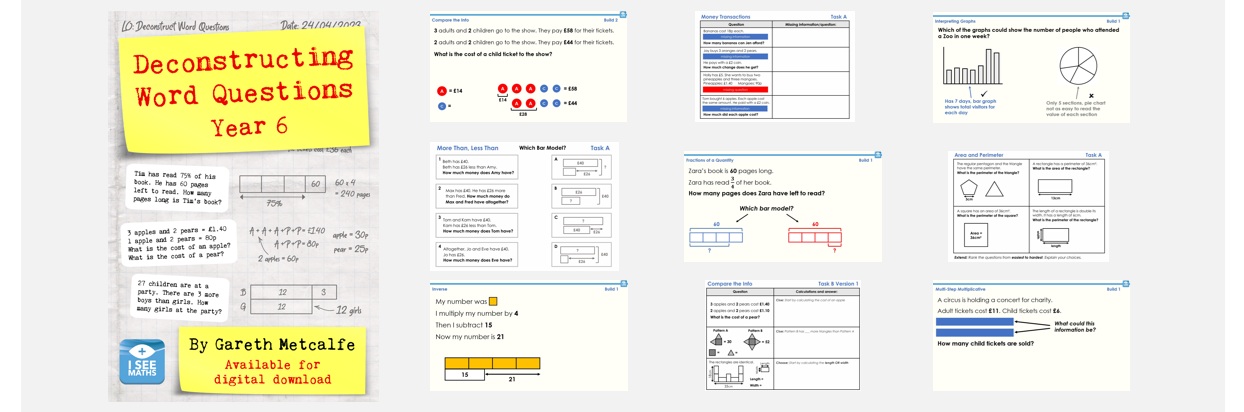
The updated version of Deconstructing Word Questions – Y6 is now completed! Full information about the resource, including a free sample task, can be found here. It provides a coherent, detailed approach to teaching children to answer word questions and gives a wide range of thought-provoking challenges.

This resource has been re-released in April 2025. If you purchased the original resource, you can have this new version for free! Just email iseemaths@hotmail.com and attach the original version of the resource (as proof of purchase) or give the order number for your original order. Then, we will reply by sending you the new resource.

Why has the resource been updated and re-released?
Since writing the original version, I have written Deconstructing Word Questions resources for Year 2, Year 3, Year 4 and Year 5. All of these resources followed a specific lesson structure:
Build 1 – teaching prompts
Task A – pair discussion task
Build 2 – teaching prompts
Task B (Version 1 and 2) – questions
Extend – deeper challenge
I have re-written the year 6 resource so that it also follows this lesson structure. This means that the resources give a totally consistent whole-school approach to teaching children to answer word questions. This video shows how the resources can be used to teach a lesson:

I want schools to have a whole-school vision for teaching children to answer multi-step word questions. Therefore, I am running 90-minute online INSET sessions on 1st and 2nd September to communicate this vision. It would be great to have you involved!

The ability to answer word questions is one part of how we can build children as mathematical problem-solvers. The full vision, including detailed guidance and video exemplification, can be found on this page. I believe it gives a practical, exciting vision for how we can build all children as mathematical problem-solvers!